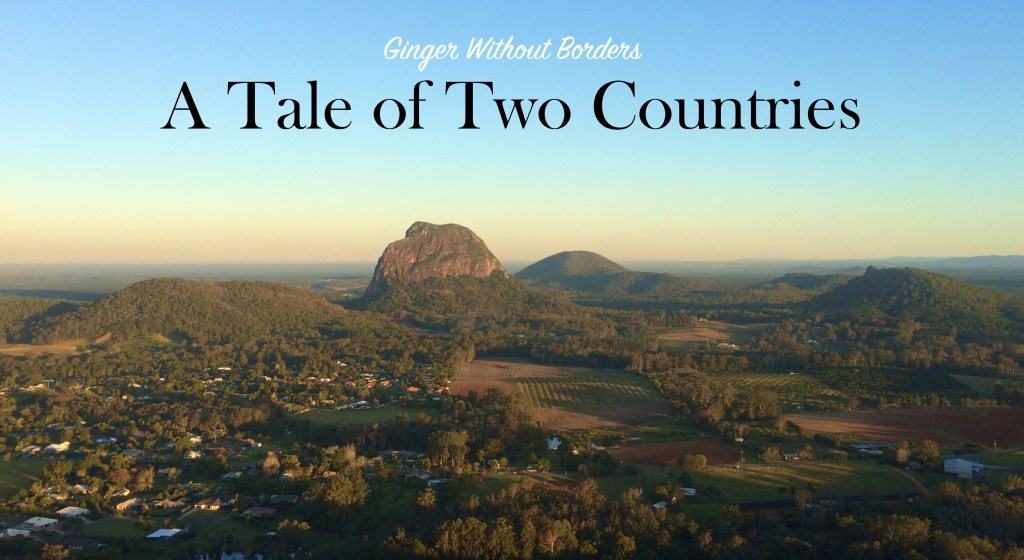
Our purpose in South Australian is not to visit the city of Adelaide. Just west of Adelaide is a one hundred mile long and twenty mile wide island about 10 miles off the Australian coast. It was uninhabited until Europeans arrived in the early 1800’s. An Englishman explored the north side and a Frenchman explored the south side. Both of them put aside their loyalties in the Napoleonic Wars raging in Europe to share their maps and discoveries in the interest of scientific discovery. The island is named after the animals that fed the almost starving men on the English ship – Kangaroo Island.
Approximately 50% of the original wildlife habitat remains, the other half being devoted to farming. 5,000 humans live here with 100 sheep to each person. Because of its isolation from the mainland, the Australians introduced certain wildlife in attempts to preserve those animals. It is now considered by some Australians to be the country’s largest zoo. The Island’s tourist office is calling it Australia’s Galapagos Island.
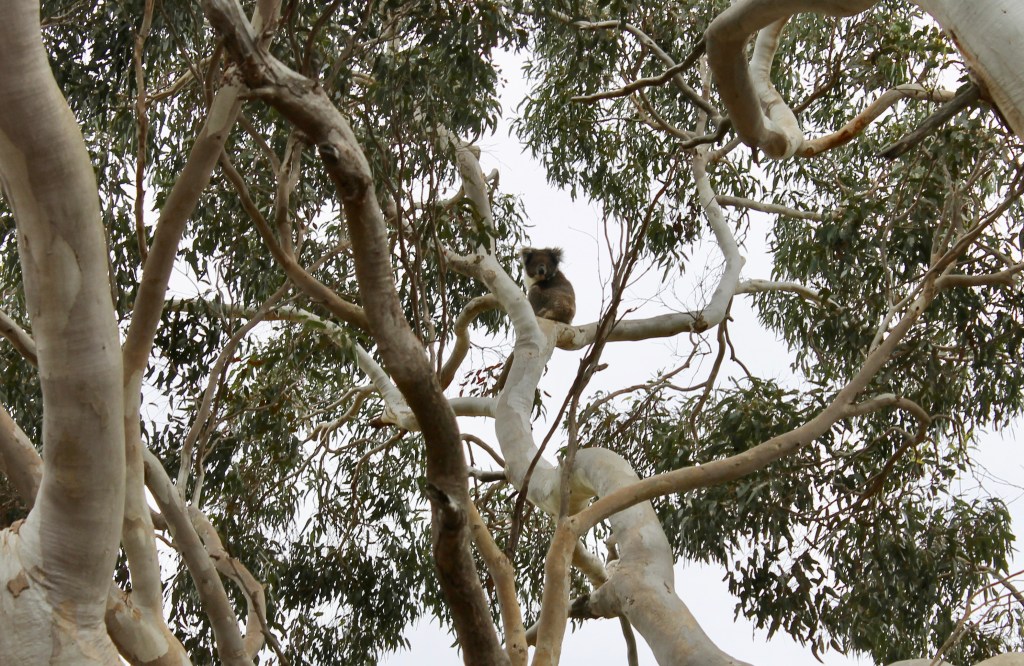
Because of the abundant eucalyptus trees, when the koala was introduced, they multiplied to the point that they are now damaging certain forests. The wonderful folks at Exceptional Kangaroo Island tours found our first koala within 20 minutes of our arrival by air. Getting out of the tour bus to view the animals was refreshing since the temperature in South Australia is in the 60s (a nice change after the heat of Queensland). A koala eats only eucalyptus leaves (hence the stress on the eucalyptus groves) and does not drink any water, getting its water from the eucalyptus. We saw a number of these iconic koalas today, including a mother with a joey (not the one pictured below). Hard to say Australia without thinking of this guy (we have a small toy one that has been hanging on our frig since it was given to us by some Australian students we hosted shortly after we were married 37 years ago.)
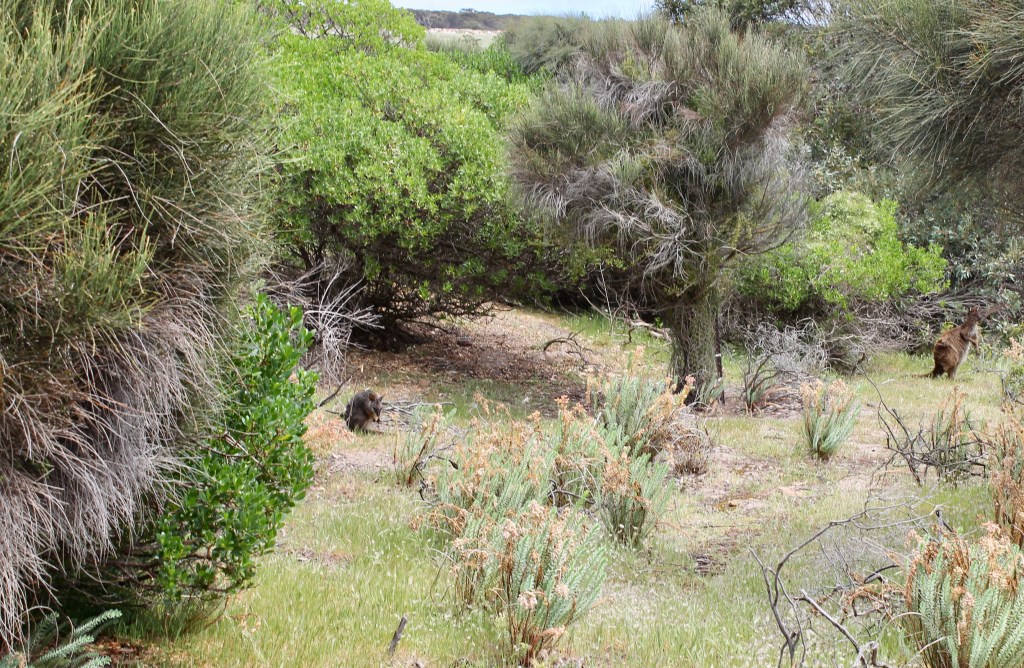
The original native wildlife of Kangaroo Island include both a separate subspecies of Kangaroo (much darker than their cousins on the big island) and a subspecies of wallaby, the smaller cousin of the kangaroo. We found both at the Stokes Bay on the north (British named) side of the Island – wallaby on the left and kangaroo on the right (Bay at the top). The wallabies were a little rare today but the kangaroos were numerous, including at least three joeys.
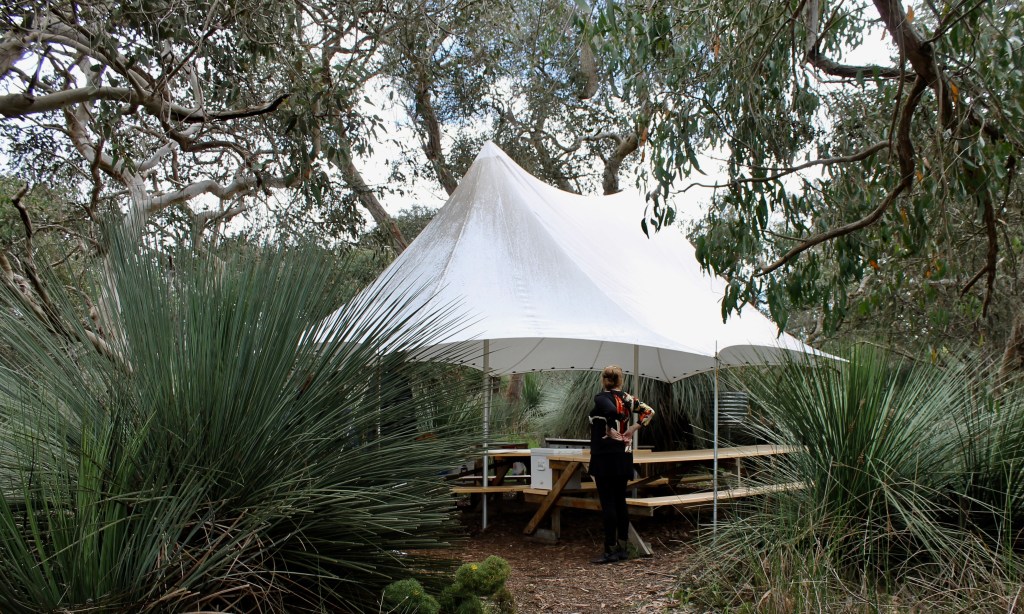
Almost immediately after leaving the rocky Stokes Bay beach, we spotted a large echidna in the trees beside a curve in the road. The driver felt unsafe to pull over on the narrow dirt road in a curve, so we have only memories of the echidna. We then drove up to the higher ground that runs down the center of the Island for another al fresco lunch in a eucalyptus grove in the middle of a farmers paddock (Australian for field).
Our final trek of the day took us to the south (French named) side of the Island to Seal Bay. Protected by coral reefs that tore the bottom out of the seal hunter’s ships, Seal Bay is the last home of the hair sea lion (the larger cousin of the fur seal) on Kangaroo Island. Sea lions only reproduce at the location of their birth. They were hunted to extinction on the other beaches of Kangaroo Island. Seal Bay is the third largest colony of Australian sea lions in the country.
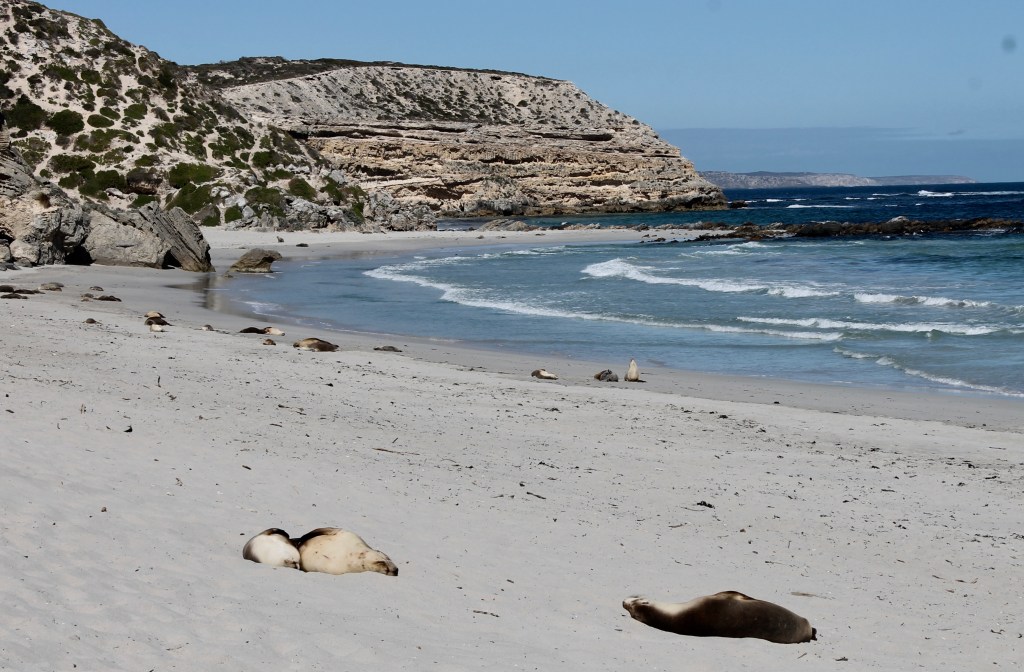
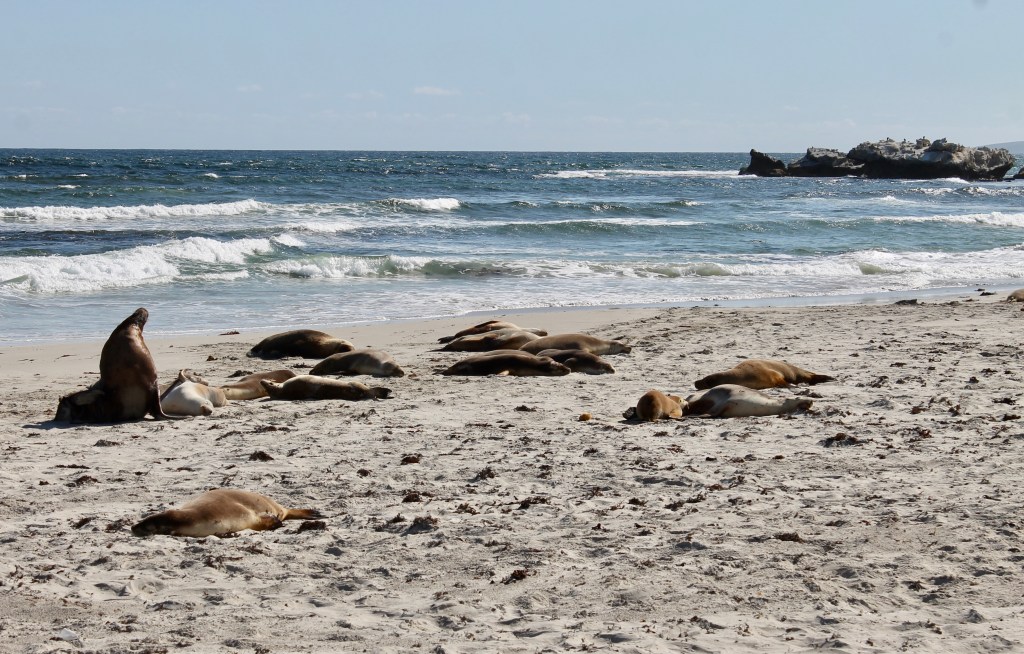
At Lena’s insistence, we toured the Galapagos after she switched her major to biology at UBC. There are both fur seals and sea lions there and they are very noisy. We all fell in love with the sound of the seals on the beach. These sea lions were almost silent. The only sound was that of the crashing waves, even when two males started a battle over a female in heat.
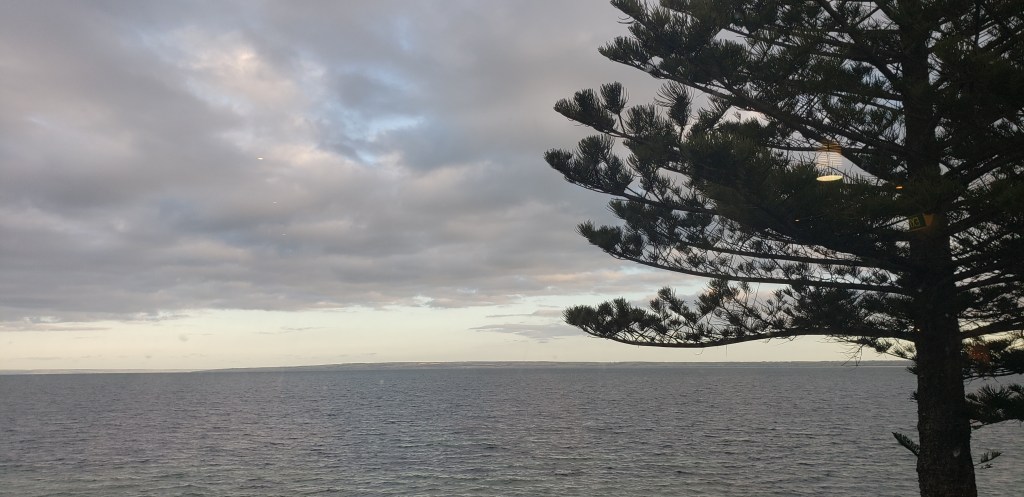
So ended another day full of discovery Down Under. We were dropped at a hotel with a room overlooking the channel to mainland Australia and dinner (this time at a restaurant that had no al fresco dining) with a great view. Hard to tell, but the horizon of the water is the Australia mainland.
Side Note: We spent an hour last night carefully weighing our carry-on and checked baggage (and left some stuff at the hotel apartment in storage) since we were flying a regional express airline to Kangaroo Island. We got to the airport early only to find just 3 folks in front of us at the check-in and the clerk didn’t weigh any of our luggage!
PS. Lena, you will be happy we are spending your inheritance here – not as distinctive as the Galapagos, but equally impressive with its wildlife. Your Mom saw an echnida in the wild today, so she is too happy to worry about me.
 Ginger Without Borders
Leave a comment