The weater shifted to the south Thursday night in Melbourne, so we woke up to light rain and heavy winds. We checked to make sure the wind would not have any effect on our flight to Hobart. Qantas said the plane was on schedule, so we pulled our coats from the bottom of our bags and headed to the airport. It was a short 45 minute flight and since Hobart is on the southwest shore from Melbourne, most of that time was flying over Tasmania. The plane flew low enough that we could see the checkerboard fields of the farmlands down the center of the island bordered by the mountains on the east and west coasts.
Nicknamed Tassie, the main island is the 26th largest in world, but it is surrounded by 334 smaller islands. National parks and World Heritage Sites cover almost 42% of its land area. When Britian lost the US (and Georgia in particular) as a colony, they needed a new penal colony. The first was Sydney, but the second and third were in Tassie. Over 75,000 convicts (40% of all British folks transported to Australia) were sent to Tassie, and Hobart in particular, because of its natural protected harbor.
Due to that harbor (and the free labor of convicts, male and female), Hobart became a world center of shipbuilding, whaling, and exporting of natural products. The historic stone warehouses built during that period remain around the harbor and have been converted into hotels and restaurants.

Towering over Hobart is Mount Wellington (named in 1832 after the British General who defeated Napoleon at Waterloo), a rocky flat-topped mountain that rises to 4,170 feet above sea level. It was originally named Table Mountain by the first British naval officers to explore Tasmania (including Captain Bligh, who had a great career exploring the South Pacific after he survived the Bounty mutiny). It was explored by Charles Darwin in 1836. We drove through a light rain on the twisty road to the summit (only about 10 miles from Hobart). The first few turnouts had only views of the clouds.
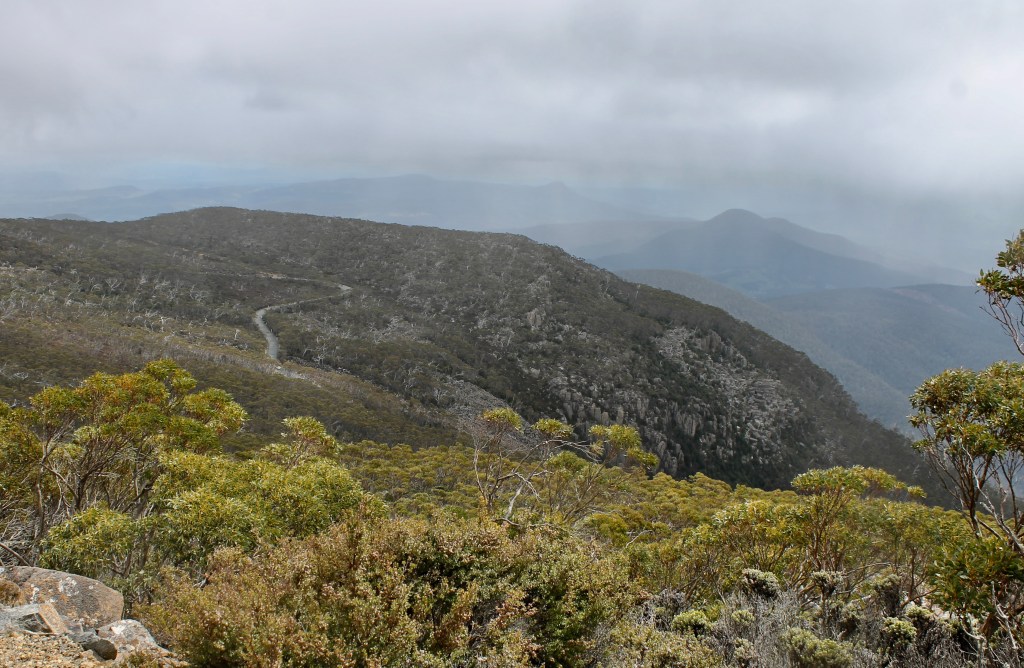
The wind was blowing fairly steadily by the time we pulled the rental car into the parking lot at the summit. The clouds had lifted but the wind was still blowing. The views in all directions were amazing. Dawn suddenly announced “its snowing!” It was a light snow and did not accumulate on the rock outcrops of the summit. But it was very cold. The thermometer at the glass and steel overlook to the east over Hobart read 36 degrees. Welcome to winter!

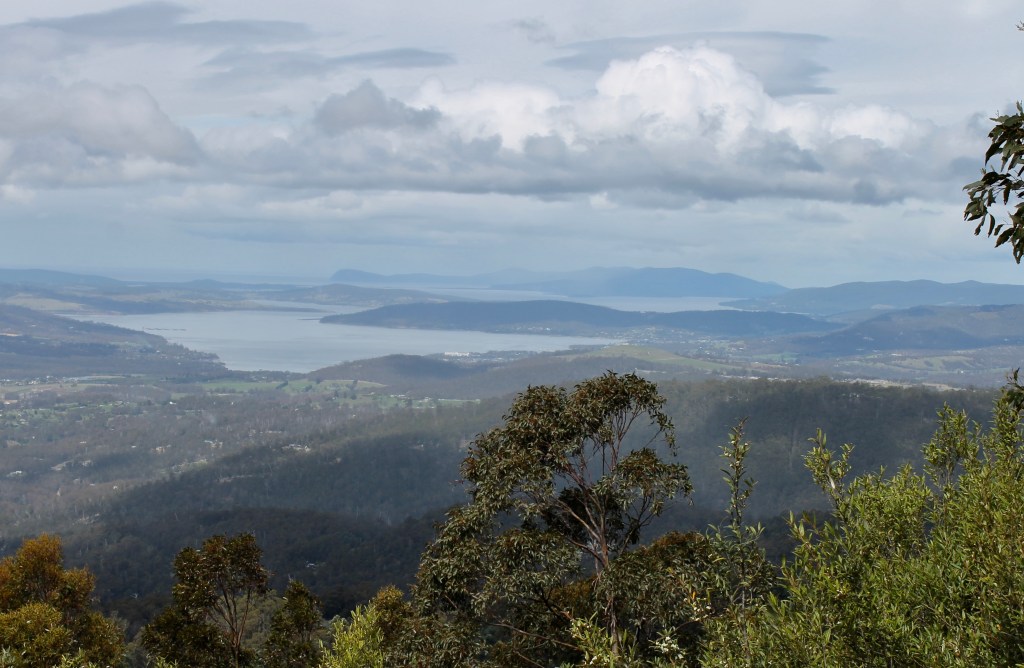
We ventured out into the cold of the boardwalk that gave views to the north and south. Bruny Island Nature Park to the south was still caught under the rainclouds.
Almost frozen by this point (and having a hard time remembering that we were in the low 90s in Melbourne just two days ago), we drove down the winding park road to a cafe with an actual woodburning fireplace. I had some coffee (hey, I am driving on the left side of the road) and Dawn had her usual pot of English Breakfast tea. It rained as we drank.
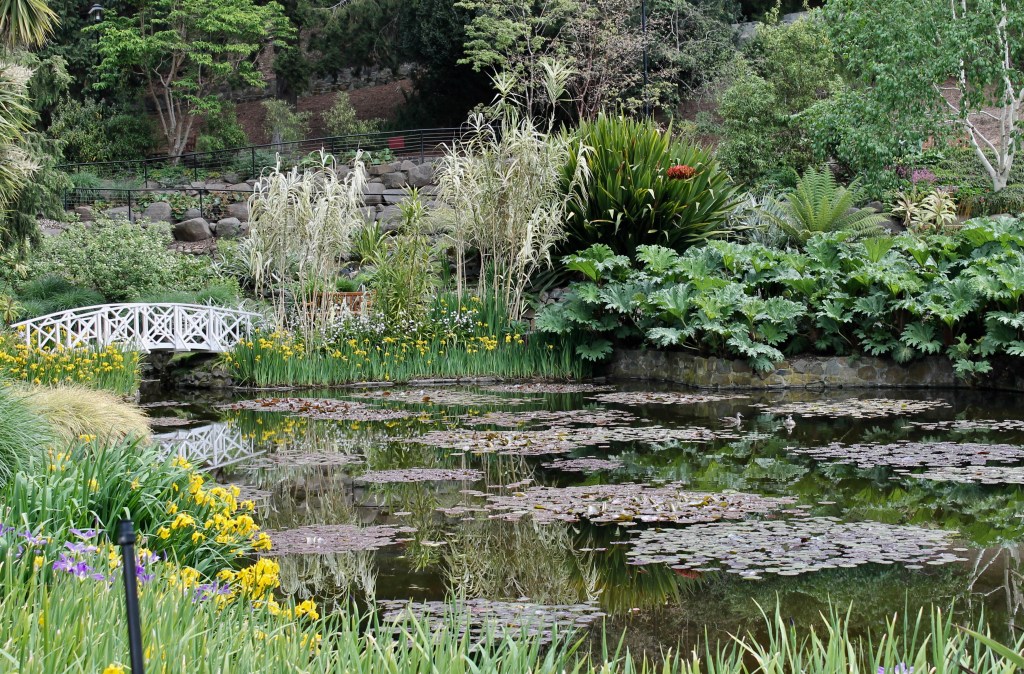
Hobart is home to the Royal Tasmanian Botanical Gardens, founded in 1818 and the second oldest Botanical Gardens in Australia. We had planned to see that in the afternoon but we were willing to abandon that plan if the rain continued. We were lucky that the rain had stopped by the time we arrived at the Gardens and although the clouds threatened, it did not rain again.

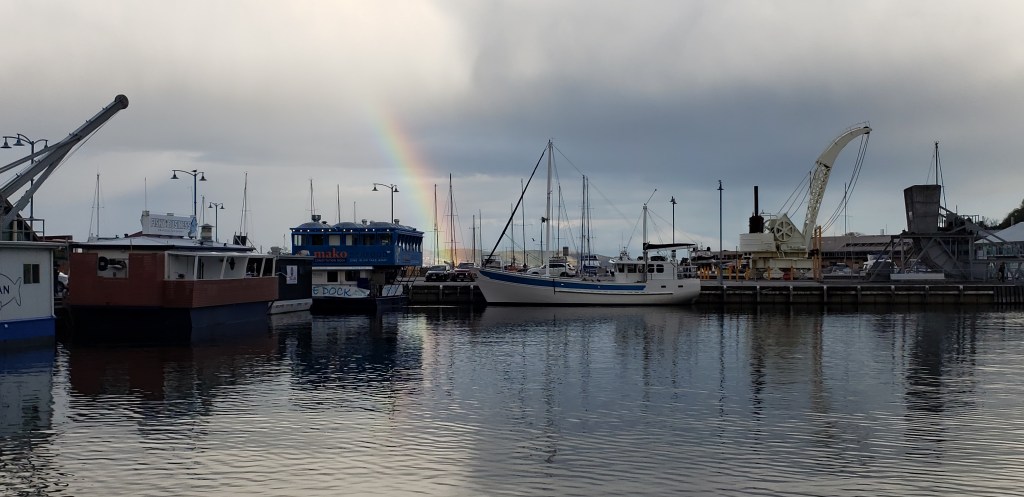
But we had to get back to apartment because at 6PM England was playing the All Blacks of New Zealand in the semi-finals of the Rugby World Cup, and my apparently Rugby crazy wife did not want to miss the All Black’s Haka to start the game. I was hungry after our wanderings of the day and went down to the harbor to eat some fish where I was greeted with the best ending of a day – a rainbow over the harbor.
PS., yes Lena, I am spending a lot of your inheritance on fish dinners (or in tonight’s case 1/2 dozen Tasmanian oysters and fish) and your Mom is really happy – she is watching Rugby, has three books to read and finally found some aboriginal herbal body balm. Maybe I will be good for the whole week in Tasmania?
 Ginger Without Borders
Leave a comment