Our next National Park is Cradle Mountain in the northwest of the square that is Tasmania. But to get there in one day would require a five hour drive, so we elected to stay in Launceston (the second largest city in Tasmania) which is about halfway to Cradle Mountain. The power went out during breakfast at the Lodge, so our “hot” breakfast items took a little longer to come out of the Lodge kitchen than usual. That is part of the “attraction” of an ecolodge – the power blinked often and the satellite antennas for the telly were easily disrupted by rain clouds. Since we often camp where there is no power or electricity, we actually enjoyed the absence of power or telly.
So our biggest disappointment about Freycinet National Park was the absence of animal life. The desk clerk explained that there was a lot of wildlife in the Park, but none of it (other than echidnas) comes out during the day. She said Tasmania has no koalas, so all the time Dawn had spent scanning the tops of the eucalyptus trees for koalas had been wasted effort. We have tried to avoid driving at dusk, so, in fact, we were looking at the wrong time for native wildlife. The scenery in Freycinet was fabulous so we agreed that our time at the Lodge had been well spent.
The Lodge clerk suggested that we not follow the directions suggested by google but rather head north along the coastline and then drive over the Mount Elephant road into the long valley between Douglas National Park and Ben Lomond National Park. Our first stop on this route was Bicheno, once known as Waub’s Harbour and the location of a number of whaling stations due to its safe harbor. The close-in island that made the breakwater for the small fishing harbor (named the Gulch) is home to lots of seagulls and cormorants.
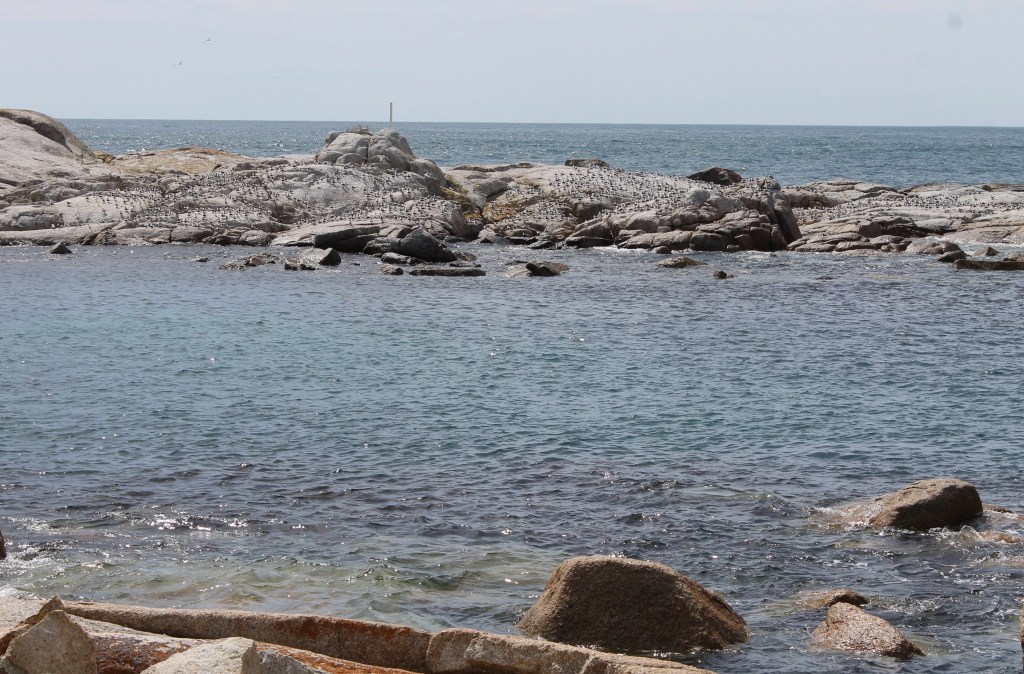
And the outer islands just beyond these are also home to fur seals and there were a group of about five today. The same rocks that we saw in Freycinet also covered the shore here with a novel characteristic – a blow hole that spouted with each big wave. So just north of the Park, we did get to see some wildlife (and some novel scenery).

The drive over the Mount Elephant road was as twisty as an Appalachain backroad but the forests were populated by eucalyptus and tree ferns. But the vast green valley that continued for over two hours between the mountain ranges on our left and right was populated only by sheep and cattle.

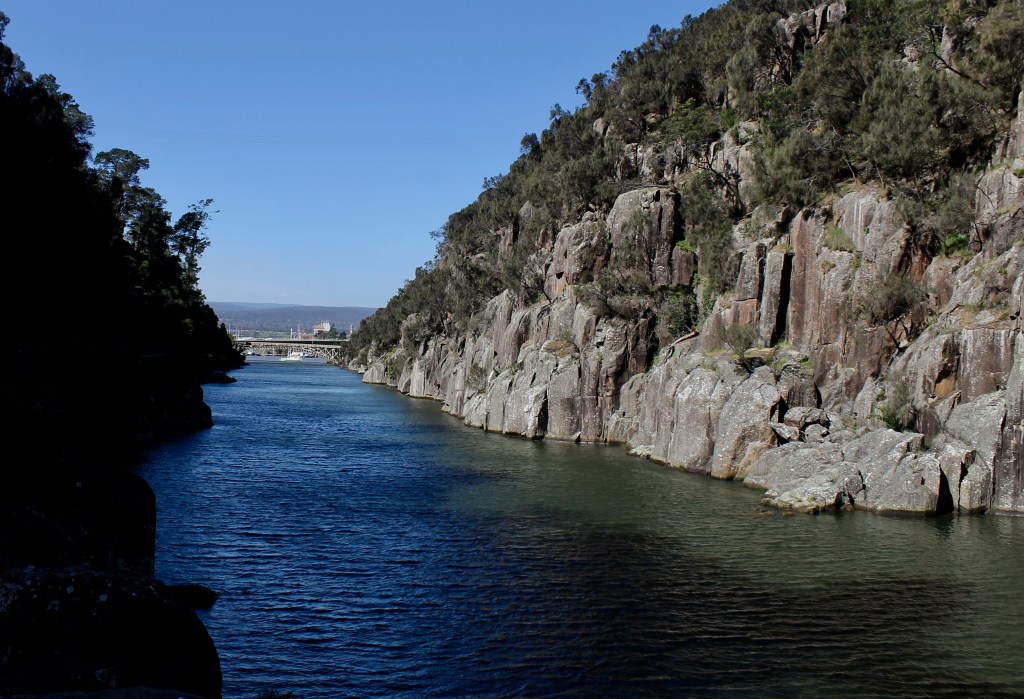
Launceston’s most famous geographic feature is the Cataract Gorge, which is just a 15 minute walk from the city center. After checking in to the hotel, we headed to the Gorge Park. Almost as soon as we started down the trail to the Gorge, we spooked two pademelons, the smaller short tailed cousin of the wallaby and kangaroo. Then we climbed the steps to the walkway hand built into the side of the gorge by the town in the 1890s. No wildlife but lots of flowers sprouting from the rock ledges.

When we returned to the shop at the top of the gorge, the time was getting close to 4:30pm. The garden at the shop featured peacocks and when we got there, the peacocks had company. There were two wallabies looking for food in the manicured lawns of the shop.

And while having our afternoon refreshment on the deck of the shop, Dawn spotted a group of ten to fifteen yellow tailed black cockatoos who started flying back and forth among the pine trees trying to make their calls drown out the screams of the peacocks. It was quite a noisy time. And, not 15 minutes from the second largest city in Tasmania, we had seen more wildlife in two hours than we had seen in two days in a National Park.
PS., dinner was lamb since we are not near the coast and it was a well spent portion of your inheritance Lena. And Mom is really happy because I found Tangueray and Gin in a premixed bottle, and since I was the one who walked 20 minutes to find it and get it from the bottle shop (Australian for ABC store), I am in good shape (for exercise and with Dawn).
 Ginger Without Borders
Leave a comment