The host at our Dunedin hotel did not have a high opinion of the sites of Christchurch. And after the devasting losses of the earthquake, we did not disagree with him. Our next target is the Banks Peninsula, the Christchurch equivilent to Dunedin’s Otago Peninsula. His suggestion was that we visit the Orokonui Ecosanctuary before we began our long drive back to Christchurch.
Orokonui sits atop the ridge on the opposite side of Koputai Bay from the Otaga Peninsula. The road up over the ridge begins at Port Chalmers, which is where the monster cruise ships dock for Dunedin. It is also the container port and a much more reasonable site than taking those monster ships into the docks at Dunedin (where they would tower over the historic town center much as they block the view of the Sydney Opera House).
About half way up the hill is a memorial to Robert Scott, the antarctic explorer. The message he wrote when he knew his mission was doomed are inscribed on the statute. This is the view from below his memorial.
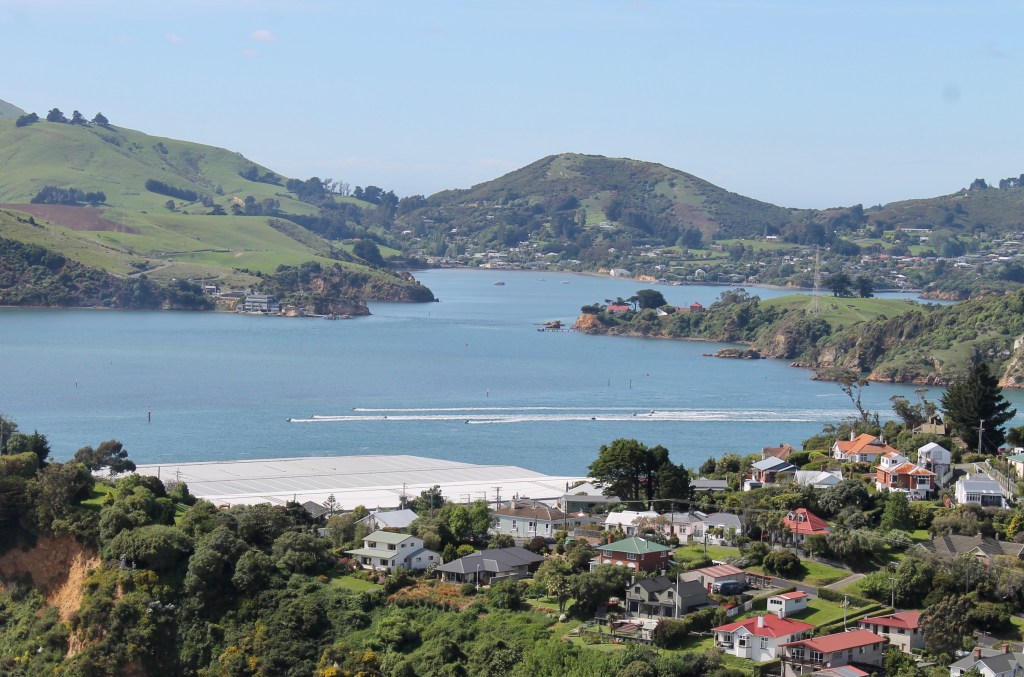
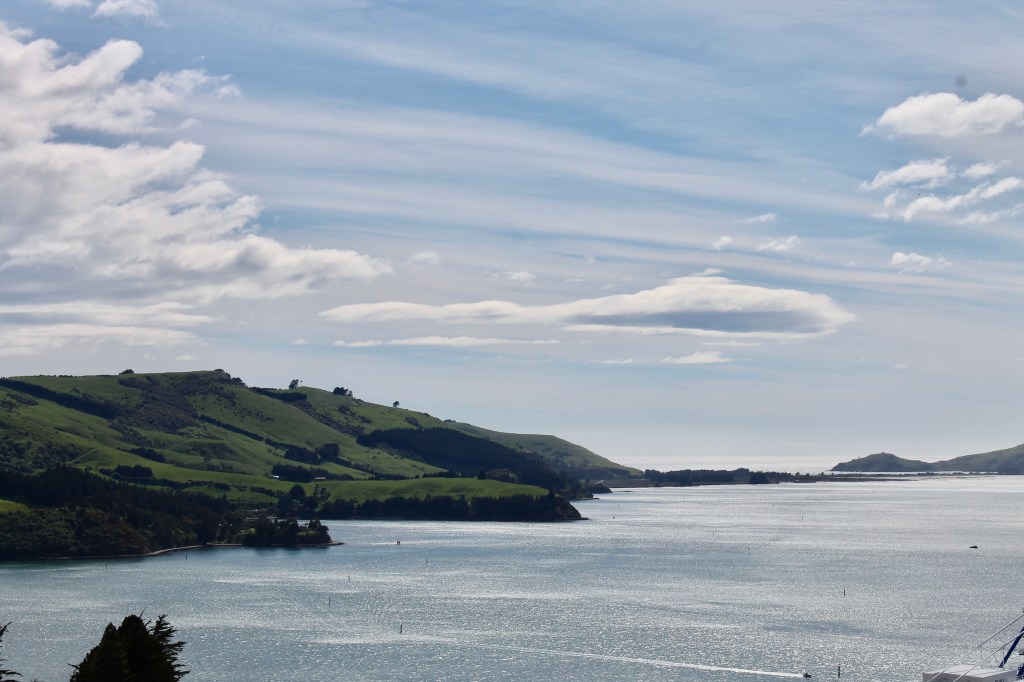
The road to Orokouni was just as crooked as the high rode to Harrington Point across the bay but it never narrowed like its brother. The Orokonui Ecosanctuary sits just over the top of the ridge on a former farm. From it, the view is of the Blueskin Bay.

In order to serve as a breeding ground for endangered NZ bird species, the center had to be able to keep out the introduced staots, wild cats and dogs, opposums, and mice that feed on the native birds. The only mammal native to NZ is a small bat. So the center built a 5.5 mile long fence made of stainless steel mesh small enough to keep out baby mice. Covering almost 750 acres, the cleared farm land was replanted with native plants and the unfarmed forest includes a large grove of eucalyptus (one is 243 foot high and claimed to be the tallest tree in NZ).

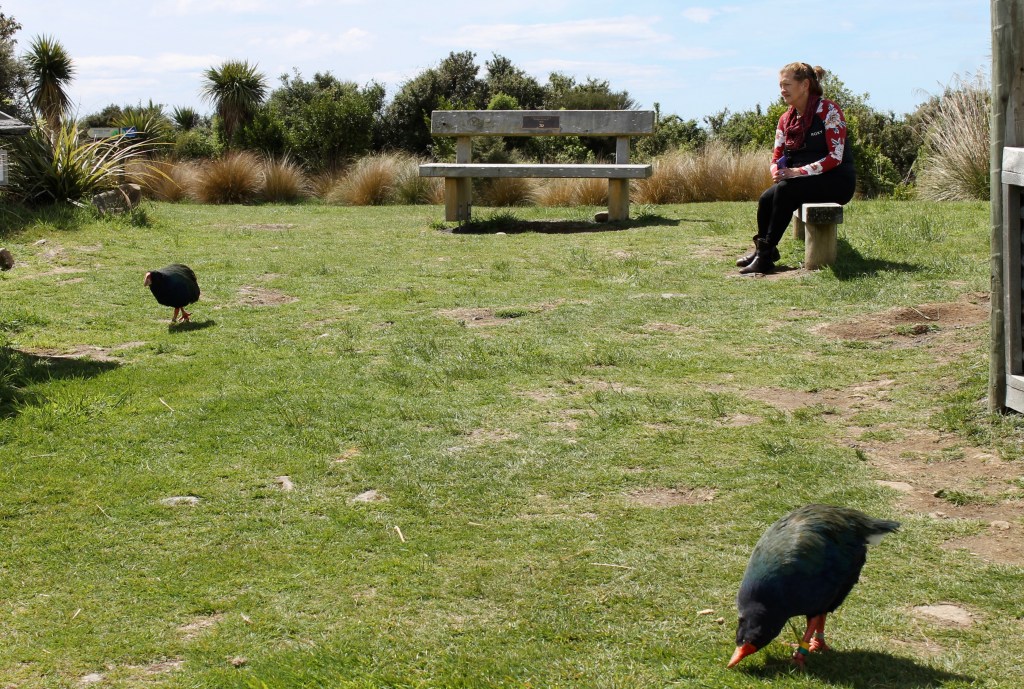
We arrived just as the staff finished feeding the takahe. If you remember from the Te Anau blog, these flightless birds were believed to be extinct until 1949. Unlike the avairy in Te Anau (where we met our first takahe), there are no fences around these birds other than the one around the center. So we just walked up on the takahe eating grass.

I beleive we were both stunned to be so close. The birds ignored us and pecked at the grass. It was similar to our experience in the Galapagos where the animals just ignored the humans and lived their lives without fear of humans. We must have sat and watched for 20 minutes. Not as thrilling as seeing an albatross take flight, but being so close to an “extinct” bird is a privilege.
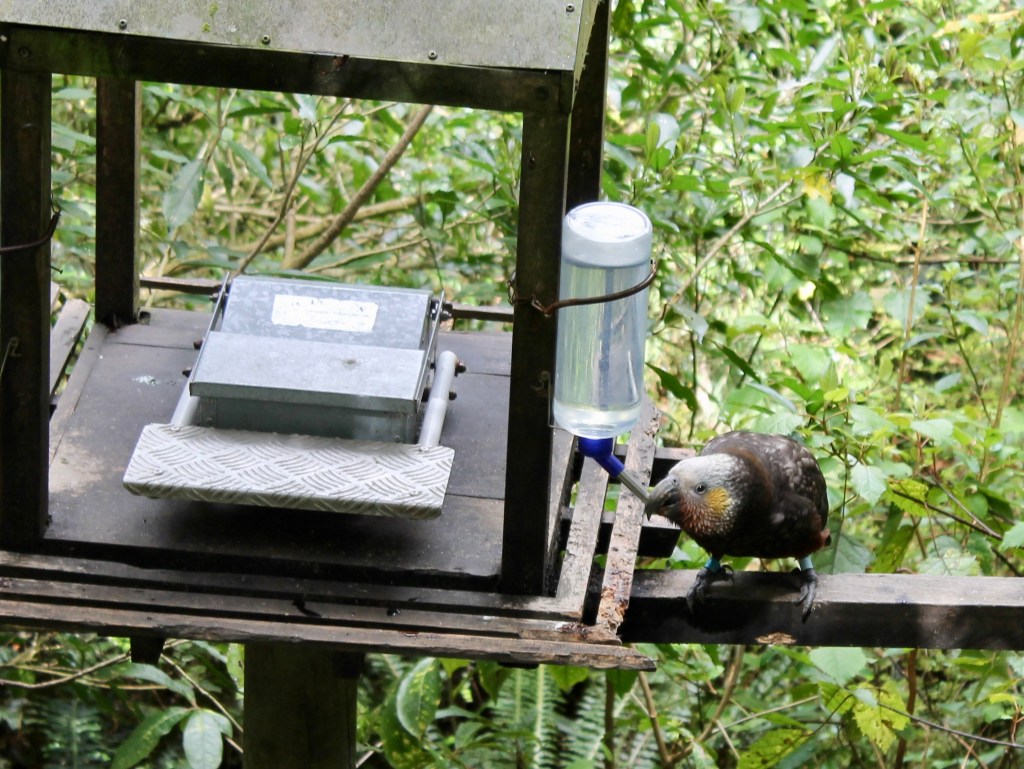
We followed the grass tracks deeper into the bush, where I was dive bombed by a couple of bellbirds, a dark olive robin sized bird with a musical call. The center had set up feeding stations with bottles of sugar water and birdseed feeders. The first one we found had a pair of tui fighting (or in a mating ritual) and keeping the other birds (mostly bellbirds) away from the water feeders.

Then we crossed through the knee high internal fence that kept the kiwi confined to a smaller portion of the center. Kiwi are noctural, so we had no chance of seeing any of the pairs that the center is nuturing. We were now headed deeper into the eucalyptus grove for the next feeder. There we found another dominant tui trying to protect his turf (the tui has a really beautiful song that has become Dawn’s favorite), but they are very territorial. Within five minutes of our arrival, a large bird emerged from the forest to challenge the tui. It was a South Island Kaka, a brown parrot with red under-wings (endangered mostly due to loss of habitat).
With the kaka in control of the feeder, the other birds just waited for it to fly into a nearby tree. The closest bird is a tui (landing on the limb as I took the picture), the kaka is on the right and one of about half a dozen bellbirds is furthest away.
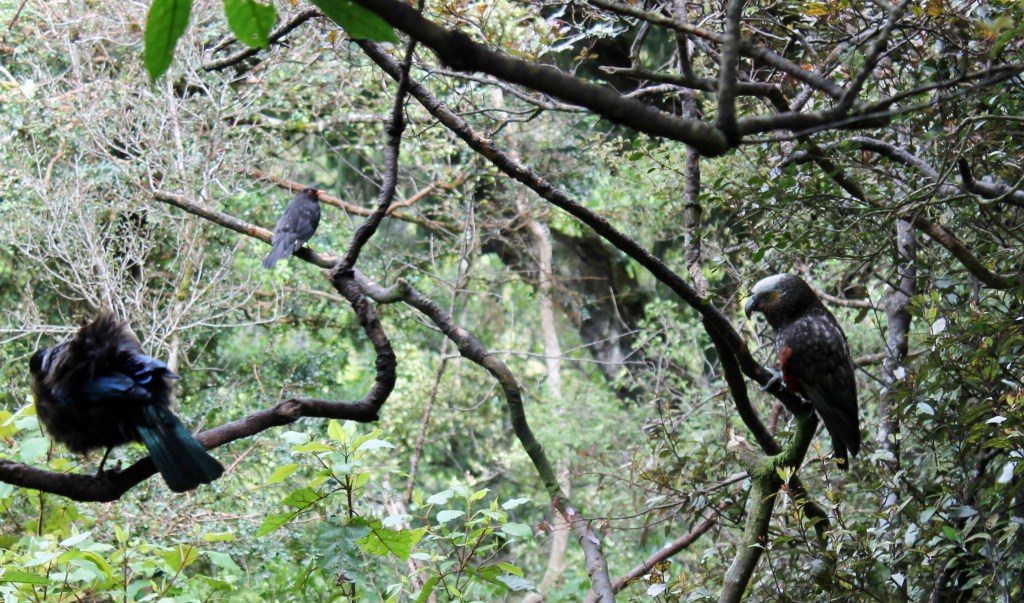
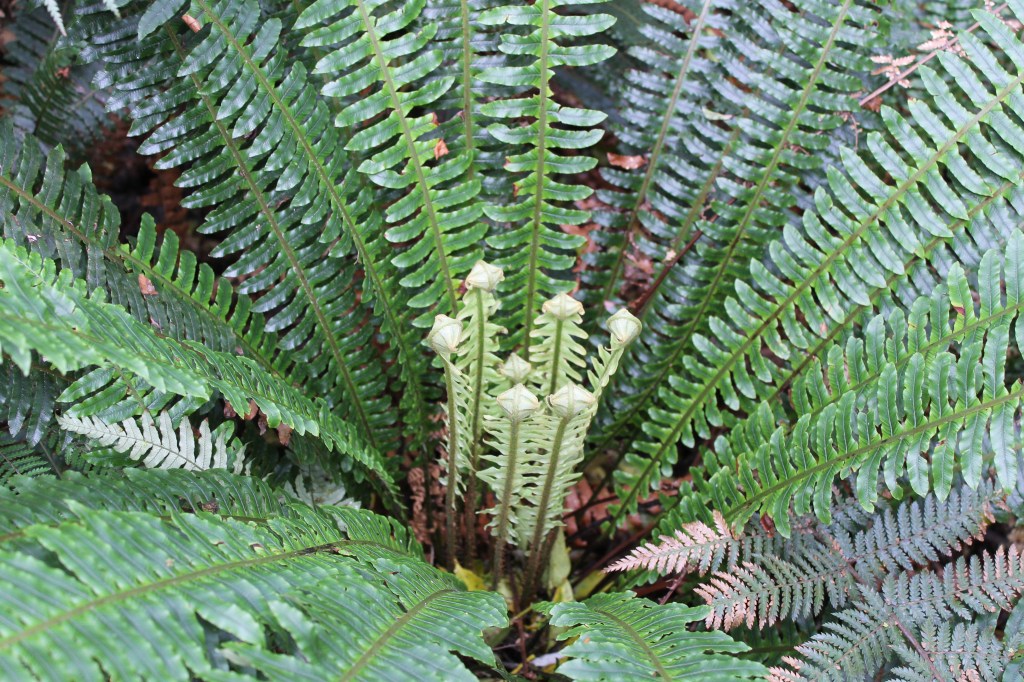
As long as the kaka kept his presence in the tree, the bellbirds had a feast at the feeders and the tui stayed in the tree. But once the kaka flew off into the forest, the tui chased the bellbirds away. The tree ferns were begining to sprout, so I had to get a plant picture. Then we headed for Christchurch.
PS., Lena, we are spending your inheritance on your two favorite things, plants and birds. And Mom got a nice long nap on our 4 and a half hour (ugh!) drive to Christchurch (that is another story), so she is happy and I am going to bed.
 Ginger Without Borders
Leave a comment