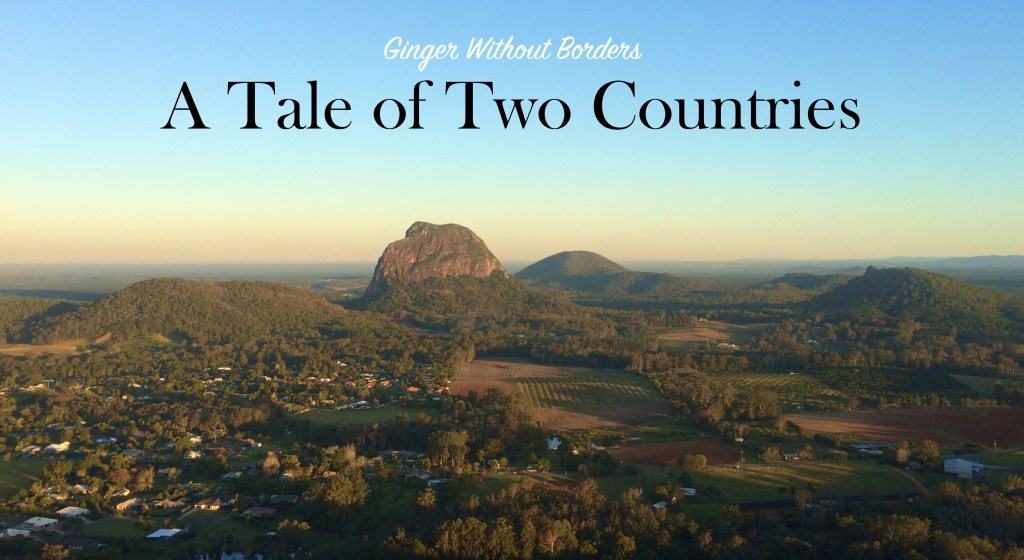
We added our next destination to our schedule because our daughter said it was the best place to have a Maori experience. We have been lots of places with tourist attractions promising a Maori experience, but the one in Rotorua, the Tamaki Maori Village, was the first and is still the most award wining Maori experience in NZ. So we pointed the car north and headed up Highway 5 for our three hour journey to Rotorua.
We decided to stop in Taupo for lunch based on the recommendation of Lena’s friend, Lauren. The city sits at the top of Lake Taupo, NZ’s largest lake by surface area (Lake Te Anau is larger by volume because it is much deeper). Like Lake Te Anau, Lake Taupo has snow capped peaks (but these are a little more distant.
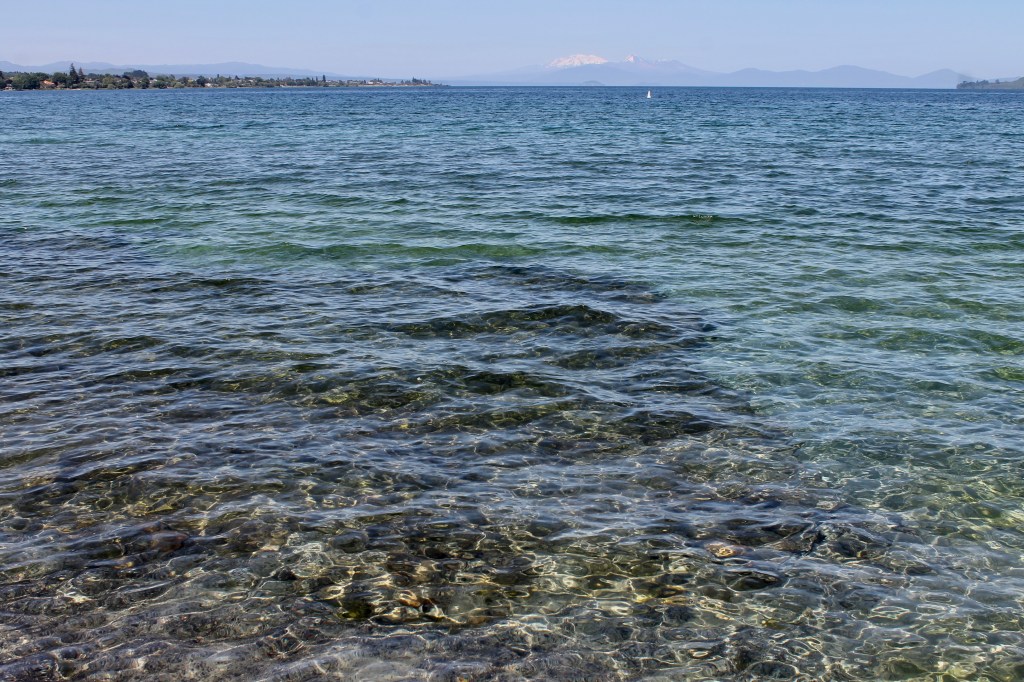
But this lake has more than just snow capped peaks. We had entered the volcanic center of NZ. Shaped like a shoe, the volcanic area runs southwest to notheast in the middle of the south island and several miles into the Bay of Plenty. Lake Taupo is in its center and is surrounded by pools that feed it scalding hot water. The water of the lake stays cool but never gets cold. There is also not much wind here usually.

Rotorua is towards the north end of the volcanic shoe on the south shore of Lake Rotorua. The town was created in 1883 specfically to promote the area’s potential as a spa destination. When the train from Auckland opened in 1894, the town exploded. Rotorua is now the 10th largest urban area in NZ. And the town’s botanical garden has numerous pools of scalding hot water.

The smell of sulpher was definitely in the air. The nickname of the town is Sulpher City. Both Lena and Lauren has warned us that the smell could be strong but at least while we were there, it was not that obvious. From our hotel window, there were clearly plenty of hot water pools in town. Our hotel used one to heat its water.

The waitress in Taupo recommended that we drive out to Kerosene Creek, a free recreation are south of Rotorua (we passed it on the way into town). We had to drive a couple of kilometers down a fairly rough dirt road (I had visions of being in Tasmania) but a couple from Wisconsin told us the creek would be worth the hard road. Not far from the carpark (parking lot in English), we came upon a mountain steam and followed it to a small waterfall and pool.
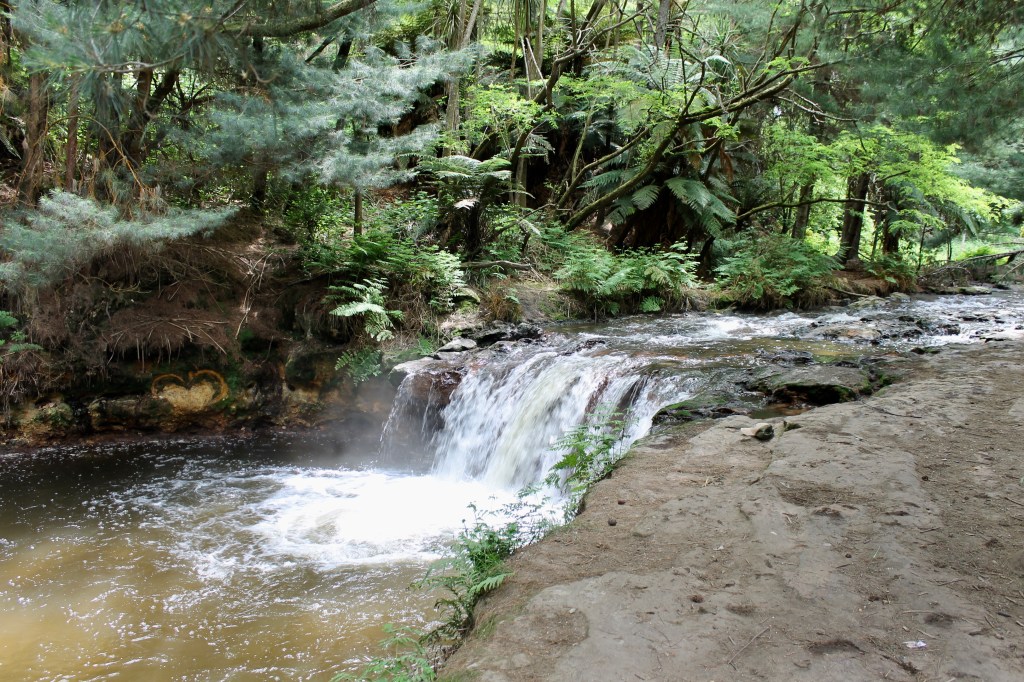
Now our family has spent a lot of time in similar mountain streams. All of them were quite cold. But this stream and the pool below the waterfall both measured 102 degrees fahrenheit (a Dutch guy had a watch that measured the temperature). Even when we were in the water, the sensation was just difficult to get used to! When you stood in the center of the pool at the bottom of the falls (the white area in the picture), the rocks under your feet could get quite hot and the water would blow the smaller river stones against your legs. But the best sensation was to put your head under the waterfall (the right side of the falls – the center was too strong) and let the water massage your back and shoulders. After a while, we went up to the stream above the falls and just laid on the rocks in the stream flow. We played in the hot water for about an hour, then drove about three miles away to the mud pits. According to the signs there, the temperature in the mud could reach 100 degrees celsius. We were careful to stay well away from the spouts of mud as it bubbled.

We got back to the hotel in time to rinse off before the bus picked us up for the Tamaki Maori Village experience (Dawn got about a half inch of clay out of our socks). Begun in 1989 by two Tamaki brothers (much like Whale Watch Kaikoura), this is a family owned business and most everyone who works there is a member of the Tamaki family. Several of the other Maori families in Rotorua have created their own versions of a Maori experience. Over 35% of the population in Rotorua is Maori and it feels like more Maori than any other place we have been in NZ.
Our bus driver announced that his Maori first name had 27 letters in it (and tried in vain to get us to pronounce it). Our experience in Hawaii was that a lot of the names had many letters to them. But his last name was Irish (he said his family was from the best two islands in the world). He also said that the passengers on his bus would be the Kotuku (great egret) tribe and he chose me to be the tribe’s chief.
Their program was not the usual presentation of culture. The Tamaki had us actively participate and gave me as chief instructions on what to expect and how to react. As chief of the Kotuku, I had to receive the powhiri (the traditional greeting when the Maori are not sure if you are friend or foe). I had read that when Captain Cook first encountered the Maori, the powhiri unnerved him so much that he would either avoid the Maori or shoot at them (on his next visit to NZ, he took a Tahitian interpreter). But, even after being coached about what to expect, it was still a little unnerving to have a spear directed at you while the owner was shouting at you. When he finished, he laid a fern leaf at my feet as a welcome gift. After I picked it up, we excanged the hongi. That is the ceremony where we shake hands and then touch foreheads and noses (twice) so that we exchange the ha (the breath of life). We were now friends and I and the Kotuku were accepted as friendly. And Dawn was now the Miss Chief (that works on so many levels).
The Tamaki then led us through seven circles where we participated in activities that taught us Maori games, practices and customs.

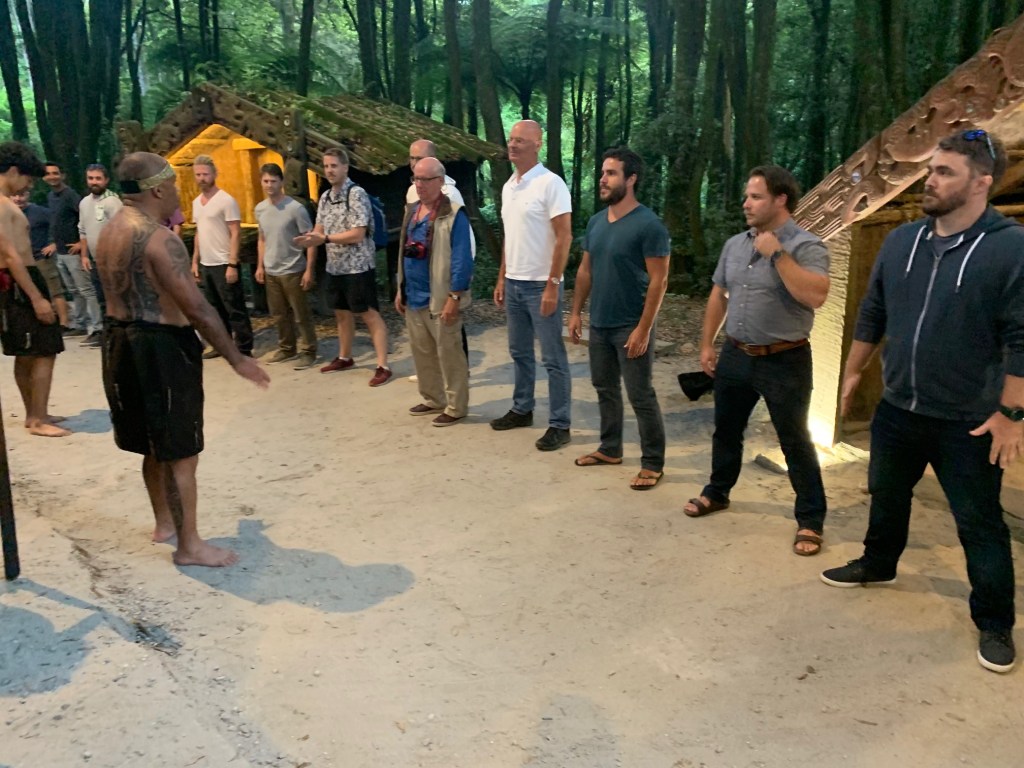
When it came time for the men to learn the haka (you know what that is if you have ever watched the New Zealand rugby team), I was instructed to use my most forceful voice to call the men of my tribe to stand behind me. Now those who know me know that I had years of experience yelling calls for the Apple Chill Cloggers. So when I yelled for my men to come forward NOW, all the Maori men within hearing distance turned around and gave me the thumbs up (our bus driver said mine was the best call to the haka that Spring). Dawn recorded the training instuctions, so I will practice my haka again when we get home.
At the dinner that followed (a hangi), the Maori served (among a lot of other really good food for a buffet) lamb, stuffing, and cranberry salad. Then Dawn remembered that it was Thanksgiving Day and noted that we were celebrating it with the natives of NZ. I have always been proud that at least 6% of my DNA is native (not so proud of the nose that results from those genetics though), and it felt good to be with native people that were clearly very proud of their heritage. They were doing a great job of sharing their culture and teaching folks “from the four winds” about the contributions of that culture to modern NZ.
PS., Lena, we called you to wish you a Happy Thanksgiving so you know where we are. When we planned this adventure, we knew we would be gone from our family for Thanksgiving. But life, as it has so many times on this adventure, gave us a very memorable Thanksgiving. Happy Thanksgiving to all!
 Ginger Without Borders
Leave a comment