
Both of Kingston’s parents are from the State of Kerala which is a long narrow state (think California or Chile) on the Southwestern Malabar coast of India. Kerala is nicknamed “God’s own country” because of its beautiful sand beaches and lovely Western Ghat mountain range. It has been named as one of the top ten paradises of the world by National Geographic Traveler. So we had multiple reasons to plan a tour of Kerala as a part of our India trip. Both Dawn and I enjoy train travel and Kingston insisted that no trip to India would be compete without a train trip. His family made the train trip from Mumbai to Kerala at least once each year his whole life. It is (if everything stays on time) a 24 hour train ride! In spite of (or maybe because of) the length of the trip, this would be an adventure.
The best train for this adventure originates in Navi (New) Mumbai where Kingston’s sister and her family live. Navi Mumbai is a planned city to the east of Mumbai across Thane Creek (which flows into the inlet that separates Mumbai from the Indian mainland). In 2015 Thane Creek was declared a flamingo sanctuary where over 130,000 flamingos were counted in 2022. The sanctuary is over 10 square miles, over half of which is mangrove forests.
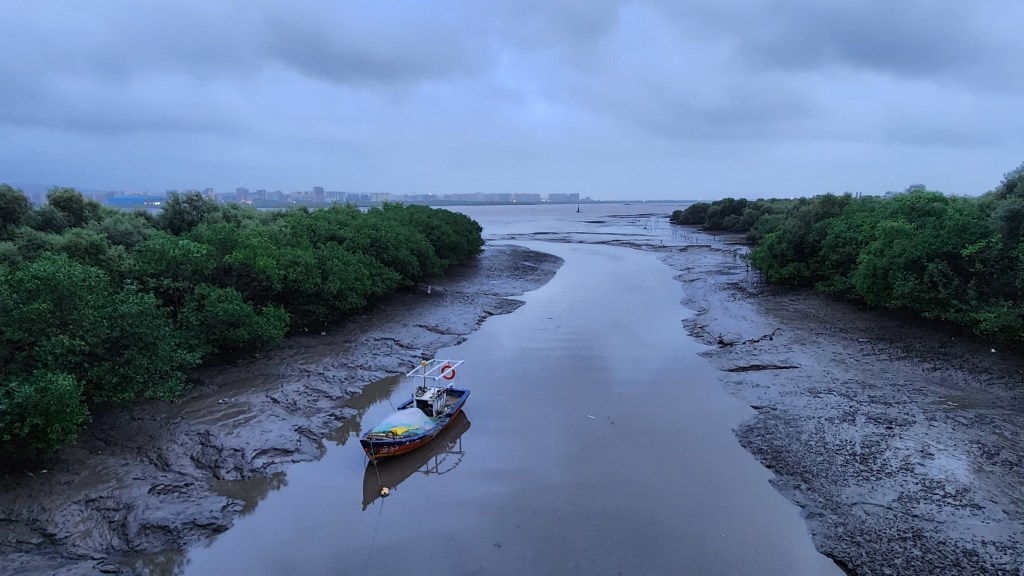
Nevi Mumbai was originally mainly a fort that the Portuguese captured and controlled from 1682 to 1733 when the Maratha Empire seized it. The Marathas held it until the British East India army (more on this later) captured and destroyed the fort. The area was then largely ignored until 1971, when the population of Mumbai grew to almost 6 million, resulting in a quick decline in the quality of life for most of its inhabitants. A Regional Planning Board was established. After study, the Board proposed building a twin city across the harbor with the twin goals of reducing further development in Mumbai and alleviating population growth in Mumbai. The Board proposed 19 nodes for residential development and a ban on the creation of any slum pockets. Nevi Mumbai grew slowly until a commuter line to Mumbai was built in 1992. The 2011 population now exceeded 1.1 million, but Mumbai has continued to grow to over 21 million. The attempt to forbid slums also failed with over a fifth of the population living in substandard housing. There is hope that some growth might be diverted to Navi Mumbai once the proposed Navi Mumbai International Airport is competed in 2024.
We spent most of Day 5 rearranging our luggage and leave some things behind in Mumbai. After our Kerala tour, the four of us were flying to New Delhi and internal Indian flights have fairly strict weight limits. Sister apartment in Navi Mumbai is fairy large (and near where Brother also owns an apartment he leases out). Her family bought the apartment because it had a view of one of the lakes where the flamingos gather every Spring. Growth in her area soon blocked the view but they have bought a new apartment that does have a view of the flamingos that should not be blocked. We got a tour of the new digs on Day 6. Sister and I had been trying to find me a pair of shoes to match my new Indian clothes without any luck in Mumbai. So we also spent part of the day in the shopping area near their place in search of my new shoes (and we were successful). Unlike the jumble of store fronts and temporary shops where we bought our clothes in Mumbai, Navi’s shopping area was just store fronts that were very well maintained. The street traffic and crowds were also much less. I understood why she preferred less congested Navi even though it was 30 minutes to an hour (depending on traffic) from the rest of her family.
The train to Kerala was scheduled to leave at 11PM. Kingston’s folks were going with us and about 10:15, we bundled all our bodies and luggage into two cars to head to the railstation. We were in the car with Brother-in-law who was apparently using a map feature on his phone for directions. We went through a maze of what appeared to be residential areas that I was surprised any map app could decipher or that a “planned city” would have near its railroad station. This was not to be our last venture through a maze of Indian residential areas. Upon arrival at the station, we had to cross over the tracks to reach the platform for the train to Kerala. The station did have elevators but they were not well marked, so we lugged our baggage up the first set of stairs before we discovered where the elevators were hidden.
The platform had electronic signs that reported the arrival of the train once it got close enough. India has the third largest rail network in the world and in terms of passenger travel, it is the biggest. Trains in India go almost everywhere (quite unlike the limited offerings of AmTrack). And they are inexpensive to use. But like trains everywhere, they are not necessarily very punctual. Given my many delays at airports, I long ago gave up any expectation that travel would be punctual. Brother had purchased our train tickets and was not able to get us all six of us in the same section. The train was late arriving (no surprise) and after loading our luggage, I went to my assigned seat but Dad indicated I should not store my luggage. Then he and Kingston began a seat swap with several other passengers and was able to get arrange for all of us to be seated in the same section. The train left for Kerala around midnight. As we were leaving the station, the attendant arrived with a blanket and a pillow for each of us.

So we prepared for sleeping by arranging the seating into bunkbeds. The back of the seat is raised and once the cables hanging from what I thought was a shelf (it is a bed) are attached, it becomes a bed. There is a sign on the wall indicating which seat (three abreast) is assigned to which bunkbed. Lena took the top bunk, I was the middle and Dawn had the seat (which became the lowest bed). The padding was fairly comfortable, the train was airconditioned, the lights were dimmed at night, and the blanket was quite warm. The pillows were not much. The gentle rocking of the train helped me sleep much better and longer than I have ever done on a plane. Our train tickets included meals (delivered to our seats) and I awoke around 7am upon the arrival of our morning coffee. This was followed after a reasonable time with our breakfast.
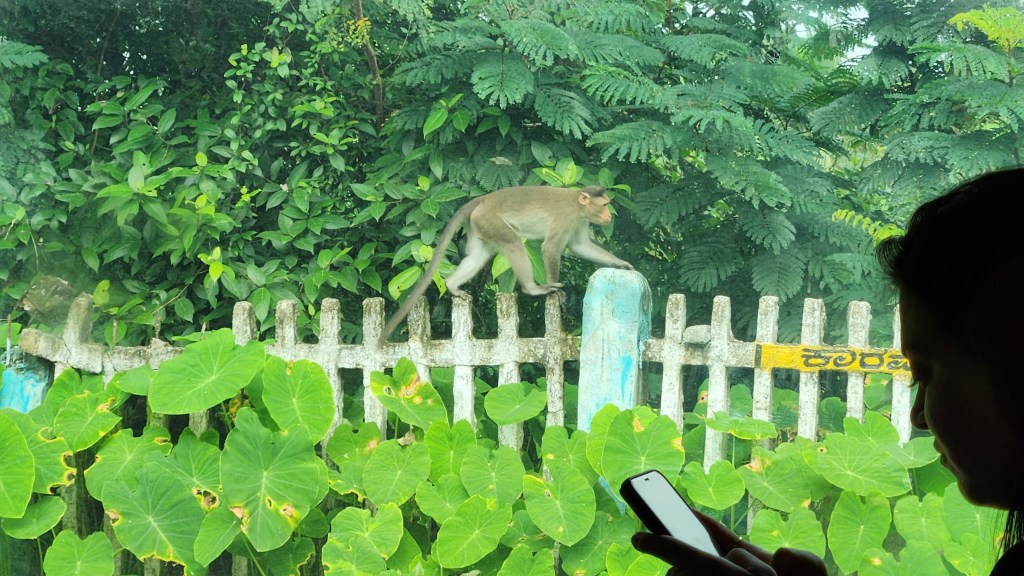
The train (a national, not regional train) stopped at several stations and at one of the first of these larger towns, we spotted out first monkey. It is a Bonnet Macaque and this one was running a little circle on the posts. He would run along the top of the fence, cross the bluish post, disappear in the bushes and shortly begin again where he started. He must have run this circle route 6 times before we left the station. We were to see a lot of these monkeys in Kerala.
When we planned our trip to India, we were well aware that Lena’s red hair would attract attention and that happened the first time we got out of the car on Mumbai’s waterfront. Less thought was given (at least by me) that our white skin would also attract attention. I got up to use the bathroom after breakfast and had not at that point given any thought to the fact that there appeared to be no other white folks on the train. I passed some young Indian men smoking (even though the signs clearly prohibited that). Almost immediately, they literally surrounded me and started peppering me in English with questions about where I was from, where I was going, etc. Luckily, Kingston’s Dad had followed behind me and in a fairly loud and stern voice (Indians respect their elders, generally referred to as “uncle” or “auntie” even if unrelated) told them I was with him and to allow me to proceed to the bathroom. I was shaken enough that I simply returned to my seat to process what had just happened and how I would have handled the situation if Dad had not rescued me. Dad continued a conversation with the young men and returned to tell me that they had been drinking (also not allowed) and my principal inquisitor was an off-duty policeman from Cochi. I did recover enough to return to the bathroom and the Cochi policeman began an almost hourly visit by our seats to apologize for being so insistent in his questioning. We did not see him when we visited Cochi.
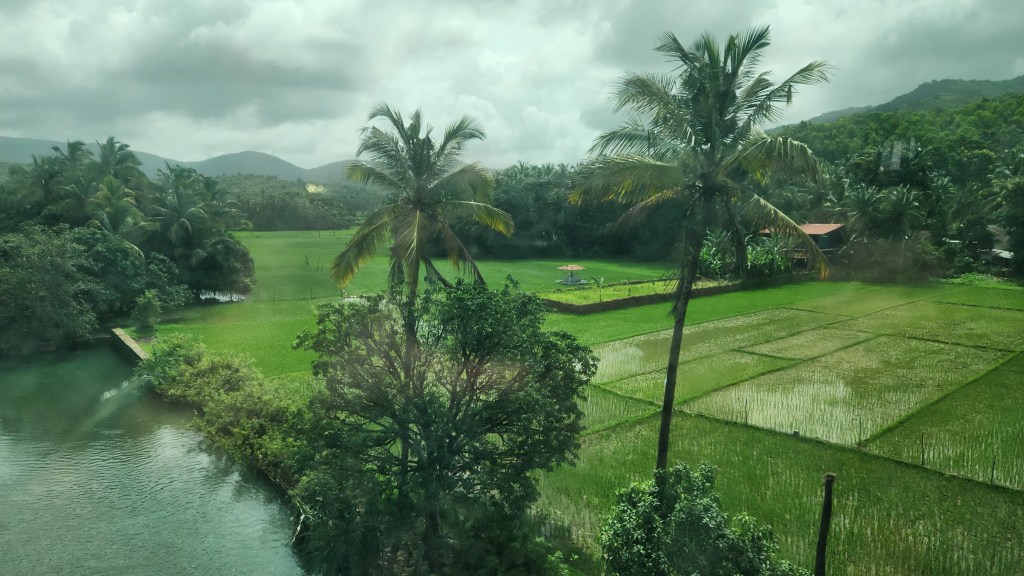
Before lunch, we passed into Kerala and began to pass lots of rice paddies. Rice is the staple food of Kerala. While Kerala does not grow the most rice in India (that honor belongs to the State of West Bengal), rice is the most important food crop grown in Kerala. Southern India cuisine features rice and spices. Two main Southern Indian dishes are dosa (a lentil and rice crepe, usually served for breakfast) and idli (steamed lentil and rice cakes). We ate a lot of both while in India. We also saw many hours of rice paddies.
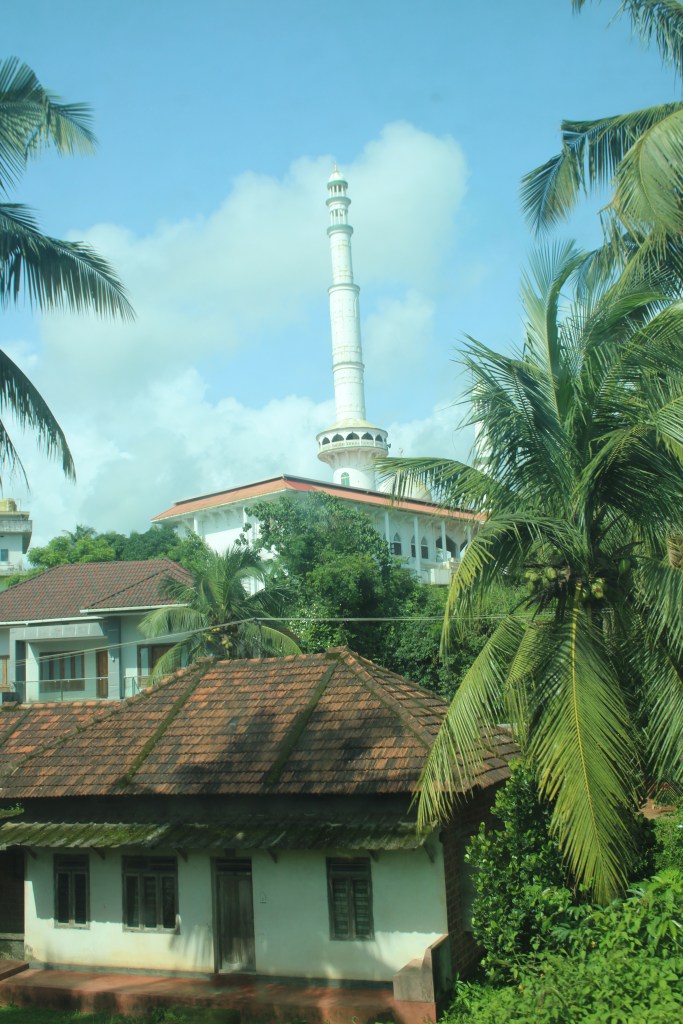
Although the many hours of fields that we passed on our train journey might indicate a mostly rural state, Kerala is in fact the second-most urbanized state in India. At 859 persons per square kilometer, it is three times as densely settled as the national average. It is very religiously diverse with Hindus (55%), Islam (26.5%), Christian (18.5%) and other. Kinston’s family is Catholic. The Portuguese were the first Europeans to land in India in 1498 and built their first settlements (and forts) in Cochin in Kerala in 1505 (more on this later). They brought the Catholic Church with them. And those priests went about converting the locals. The Catholic Church Kingston’s family attends in Mumbai was established over 400 years ago. We passed numerous mosques, temples and churches on our train journey.
We ate lunch and then dinner and noted that we were some time behind the published schedule. Then night came but this time we had only a little time to sleep. We arrived at the capital city of Kerala, Thiruvananthapuram (better known as the shorter Trivandrum) at around 2am on Day 8 (you do the math regarding how long we were on the train). Trivandrum is where Kingston’s Mom owns a house in the neighborhood where many of her family live and near where she was raised. We were staying at a local resort. Mom’s brother picked us up and drove us though another maze of residential areas to the resort on the bay next to the beach. But we were too tired after our journey to say anything more at this point.
 Ginger Without Borders
Leave a comment