
Our 24 plus hour Rail Adventure from New Mumbai finally arrived in Trivandrum at 2am on Day 7. On those rare occasions when I arrived at an airport that late (or early, depending on your view), the building was largely empty but for the few employees needed to arrange baggage for the arriving passengers. On an Indian raliroad, the passengers take care of their luggage, so I was expecting an empty rail station. I was surprised to find that the rail station floor occupied by about 20 men in laborer uniforms sleeping on cardboard between the seats of the platform. These were likely railroad contract workers who had early shifts to cover. It brought to mind a conversation we had with one of the contractors while we strectched our legs on a platform at one of train stops. His job was to distribute the food ordered by passengers during our Rail Adventure. He indicated that he had not been paid in over two months. While the ticket takers were government employees (and these were valued Indian government jobs), many other railroad services had been privatized. I later found a report from the Auditor General of the Indian Railways indicating that over 75% of the railway’s contract workers were not paid the required minimum wages. This worker said he stayed on the job because he would eventually be paid something and jobs were not easy to find for low skilled workers. Once we left the train station, there were even more folks, both men and women, sleeping on the sidewalks outside the station. I assumed these were likely passengers for early trains who had no easy transport to the station.

Kingston’s Uncle (his Mom’s brother) met us at the rail station with a van large enough for us and our luggage. His Mom’s house is near Poovar, a fishing village almost at the southern tip of Kerala (it was about 40 minutes from the Trivandrum rail station). Once we arrived in Poovar, by the dim light of the moon, we negotiated though a maze of residential areas before we entered what appeared to be a plantation of palm trees and then drove on a narrow road which ended at an open air stand-alone reception pavilion. It was manned by four emplyees even though it was not close to 3am. Once we checked in, we were taken by golf cart through spacious dark grounds to our hotel room wing, so it was hard to get a sense of the extent of the resort’s size. By now, it was 3:30am, so we collapsed into our very nice airconditioned beds.
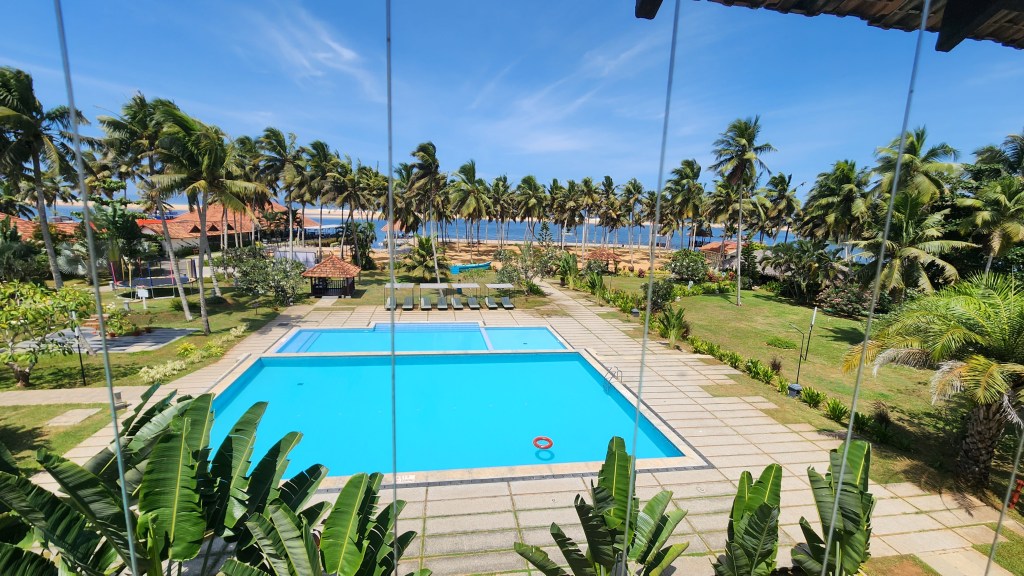
We awoke to a view of a tropical paradise (see above). August is supposed to be the monsoon season in India but 2023 was to be dubbed the “August drought monsoon” in some of the local newspapers. There had been signigicant rainfall everwhere in India in June and July (parts of New Delhi were flooded) but there had been no rain in Kerala for two weeks when we arrived. There was a clear blue sky and a gentle wind as we made our way to the breakfast buffet. We chose a table at the end of the dining pavillion nearest the beach. It was to become my favorite place to welcome morning during our trip to India. The breeze was light every morning and you could faintly hear the crash of the waves on the beach across the backwater bay.
At breakfast, I was pleased to find that they (like our hotel in Mumbai) had a station where one could order eggs various ways. While I ate Indian curried tomatoes (and mint sauce) whenever they were available, I continued my passion for American-style sunny side up eggs. Unlike Mumbai however, there was no bacon, so I had to settle for chicken sausage to pair with my eggs (there would be mornngs with no meat options at later hotels). It was here where I began to try spiced Indian coffee instead of my usual European cappachino for breakfast. I did not go back to cappachino for the remainder of my time in India.
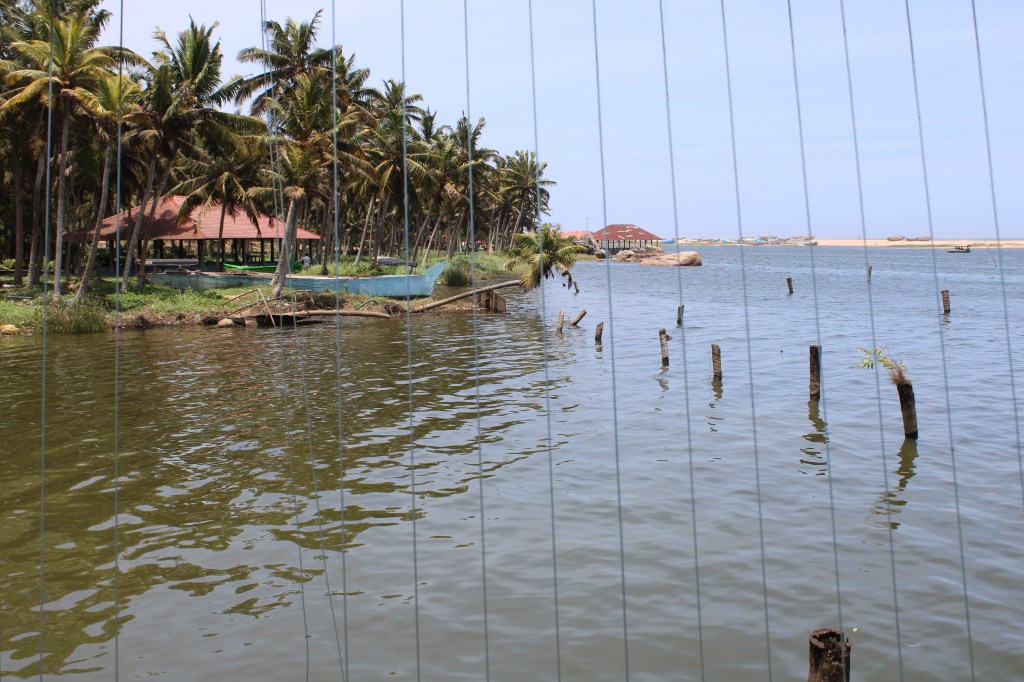
The hotel manager generously made a point of stopping by our table every morning. Until a German family arrived in a couple of days, we were his only white guests. I asked about the history of the hotel at his first visit. He explained that it had been developed by a local investor after the Indian Ocean Tsunami in December 2004. The tsunami had devasted the beachfront (and much of Southeast Asia). The local government decided to give economic incentives to revive their shattered economy. The area where this hotel was developed had in fact been a coconut plantation that was rendered largely worthless after the tsunami waves (and its winds) scattered the coconuts and tore down most of the palm trees. He was an employee of the Indian hotel chain that purchased the property from its original local developer. There were a number of workmen every day toiling on improvements to the property. As the picture shows, the resort had an ideal location overlooking the backwater bay between the mainland and the sandbar on the Arabian Sea (a smaller version of the NC Outer Banks).
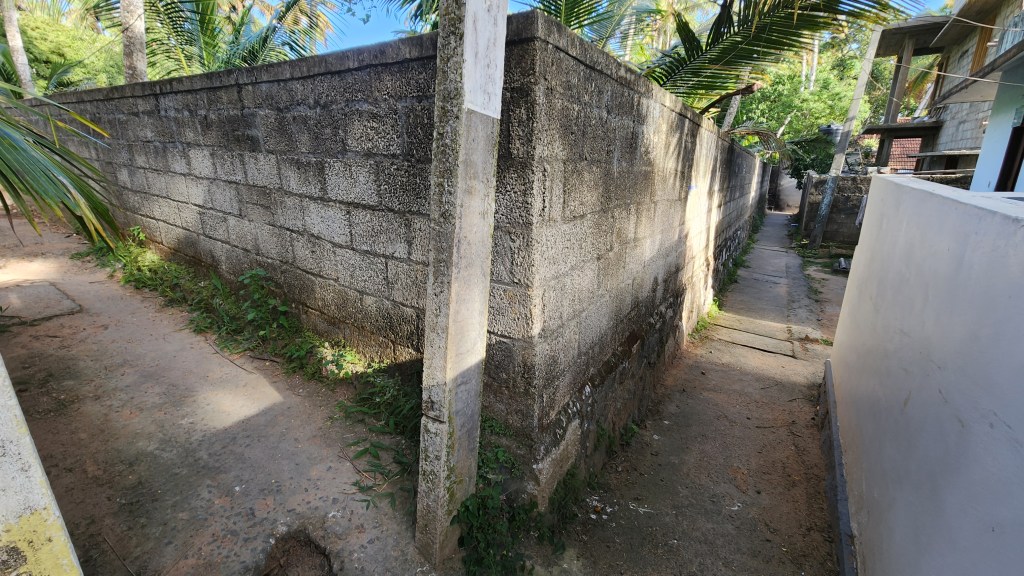
We knew in planning the trip that this would be the day we recovered from our Rail Adventure. We now had light to explore the ample hotel grounds for the remainder of the morning. Then Kingston and Uncle picked us up in the afternoon and we drove to his Mom’s house. Like all the homes in the area, her home is surrounded by low concrete block walls. The walls form passageways through the neighborhood. Many of the nearby homes are owned by other members of Mom’s family. After some sweet Indian tea, we explored the neighborhood.

The 2004 earthquake that caused the tsunami was the third most powerful ever recorded and its tsunami remains the deadliest natural disaster of the 21st Century (almost 230,000 deaths in Southeast Asia). While the tsunami killed over 8,000 folks in the neighboring state of Tamil Madu on the eastern side of India, Kerala location on the western side of the Indian peninsula somewhat protected it from the biggest tsunami waves. Still, there were over 150 deaths north of Trivandrum. But Trivandrum had considerable property damage near the beach. Many of the fishermen lost not just their homes on the beach, but their boats and livelihoods. For local governments, there was an urgent need to provide housing and employment for all the displaced workers, particularly the fishermen (the economic value of their work constituted almost 10% of the state’s economy). So, adjacent to the existing neighbor where Mom’s house was located, the local and state governments built blocks of houses primarily for the families of fishermen (sometimes called “Tsunami houses”).
Kingston’s Dad’s family were fishermen for generations. As a teenager, one of his uncles was killed while fishing. Dad decided his future would not be as a fisherman. He got an education, married a local girl, moved to Mumbai, found an Indian govenment job and raised his family. Both my parents were from the mountains of North Carolina and we spent almost every summer returning to those mountains. Similarly, Kingston’s family made the pilgrimage to Kerala every year. For us, it was only a six hour car ride, not a 24 hour Rail Adventure.

After our “day of rest,” Kingston had a lot of places for us to visit for our second day in Kerala, so Mom cooked an early dinner at her home and we were back at the hotel by 9pm. I wandered down to the dining pavilion and watched the sea birds at their evening feeding. The brahminy kite (also known as a red-backed sea eagle) is very common near all waterways in India. We had seen a community of them in the lake near Sister’s apartment in Navi Mumbai. Here at least there was enough light for me to get a good picture of one searching out his dinner. Then I was off to bed.
 Ginger Without Borders
Leave a comment