
In a time long, long ago, when the gods still roamed the earth, Rama, the seventh incarnation of the supreme protector of the world, fell in love with Sita, the daughter of the Earth, who chose him to be her husband. Several years after their marriage, Rama’s half-brother, Lakshmana, was exiled into the forest at insistence of their father’s third wife. Rama elected to join his half-brother in exile in the forest. Sita, the epitome of devotion as a wife and mother, joined her husband in exile. While living in the forest, Ravana, the shape shifting demon-king of the evil island of Lanka, became entranced by Sita’s beauty. When Rama and Ladshmana were away, Ravana abducted her.
Fortunately, an old friend of Rama’s father, Jatayu, the demi-god King of the Vultures, heard Sita’s screams as she was seized by Ravana. Though very old, Jatayu gathered his strength to attempt a rescue. Although Jatayu fought bravely, Ravana defeated him and cut off one of his wings. Jatayu fell to the earth on the rocks in Chadayamangalam in Kerala. Rama and Lakshmana, finding Sita gone from the forest, began a search and came upon the dying Jataya. Jataya told them it was Ravana who had seized Sita. Then Jataya died.
Ravana spirited Sita to his island kingdom Lanka. Every day for a year, he tried to woo Sita with his immense wealth. Every day she rebuffed him with a stinging rebuttal. But Ravana dared not force himself on Sita. Without her consent, he would burn to ashes. As a demon-king, Ravana had a grant of immortality, but the grant did not include humans or monkeys. So Rama transformed into a human and led an army into Lanka. There he killed Ravana and rescued Sita, but was forever after unconvinced of her virtue. In despair, she eventually returned to the Earth.
This tale of woe (forgive my poor excuse of a summary) is one of the two important Sanskrit epics in Hinduism. The original Sanskrit text has been dated to around the 8th Century BC. This story has been characterized as fundamental to the importance of virtue in Hindu life. Jataya is the hero noted as the embodiment of chivalry and virtue and a symbol of the need to resist violence towards women.

In the 1980s, the story of Jatayu become part of a series of live action Sunday morning Indian TV shows (with special effects reminiscent of Hollywood sci-fis of the 1950s) as tensions with Muslims began to rise in India. Even Christian families, like Kingston’s, regularly watched these TV renderings of Hindu tales (much as we watched those cheesy movies about the tales of Greek and Viking gods, even though we were raised Christian). And so these Hindu epics became a part of Kinston’s childhood along with his Catholic education. I thank him for his patience in trying to explain the various relationships of the Hindu gods because their stories are as complicated as the Greek and Viking god lineages (with the added complications of the Hindu gods having numerous incarnations).
In its first public-private tourism initiative, the state of Kerala (with significant populations of both Christians and Muslims) decided the Hindu story of Jatayu would be the first project. Near Chadayamangalam, on a rocky hill about 1,200 feet above sea level (in an area with a lot of similar rocky outcrops), there were certain depressions in that bare rock hill that had been characterized as “the footprints of Rama” as he came upon the dying Jatayu. At a cost of over $13 million, the world’s largest sculpture of a bird was built adjacent these “footprints” (which took almost 20 years). The sculpture is 200 feet long, 150 feet wide and 70 feet tall. The park officially opened in 2018 and was an immediate success. The sculpture is “Dedicated To Women’s Safety and Honour” (as reads the inscription above the group of women in the photo that is too small to read). The 65 acre park also includes an active Hindu temple and a monument covering Rama’s “footsteps.”
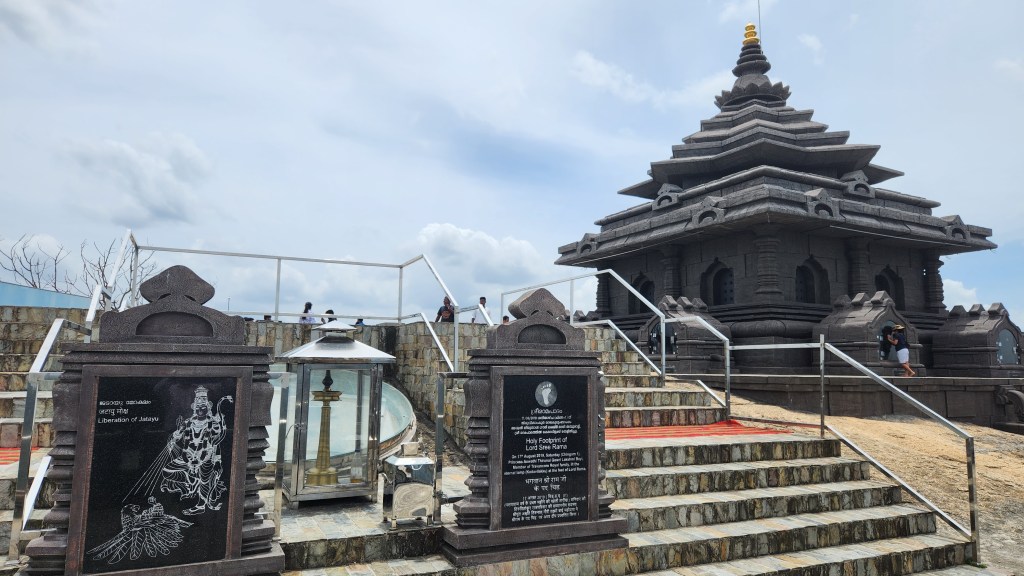
I was raised in a county that is supposed to (and often fails to) reject any government financial support of a particular religion. Given my age (70), I grew up in the 1950-1960s when school prayer was a daily part of public education, so I understand that there can be some erosion of that intent. Still, it is difficult to imagine a similar US “tourist attraction” supported by public funds that also includes on its grounds a practicing religious buiding and a momument to a religious story. But the local town is named Chadayamangalam (translated as “auspicious lord Jatayu”) since this rock is where one legend insists that Jatayu died. So it is a tourist attraction. However, there are at least four other locations in Southern India where local legends insist that Jatayu died. But they don’t have a $13 million dollar vulture sculpture.
More of Day 8 to come since we are now back into the “full days” of Kingston travel.
 Ginger Without Borders
Leave a comment