
Our driver on Day 8 was Kingston’s Uncle (Mom’s brother) who has a business that provides transportation, which is why he had a van big enough for all our luggage when we arrived in Kerala. As discussed in my previous post, our first stop on Day 8 was at the Jatayu Nature Park. Interestingly, the guards for the Nature Park allowed me to enter the Park with my reusble plastic bottle (a PET 1), but the others with unopened bottles of water (also PET 1) were not permitted to take those onto the grounds of the park. The guards said the Park policy was not to permit one-use plastic onto the grounds, which was our first encounter with local attempts to address the plastic polution issue.
India is among the most water-stressed nations on the planet. It has 18% of the world’s population but only 4 percent of its water resources. Mumbai’s water system is a mixture of piped supplies (like most places in the US) and tankers that deliver water daily to apartment complexes and slum areas. Kingston’s family apartment complex gets twice daily tanker deliveries. Even though Mumbai maintains that its water is safe to drink from the tap, Kingston’s family boils the tap water which is then used to fill a metal pitcher kept on the dining table. Many other families simply purchase bottled water at their local store, so there is an incredible amount of one-use plastic in the Indian water delivery system. The canals around the Kerala rice paddies are clogged with discarded plastic water bottles. More on this later.
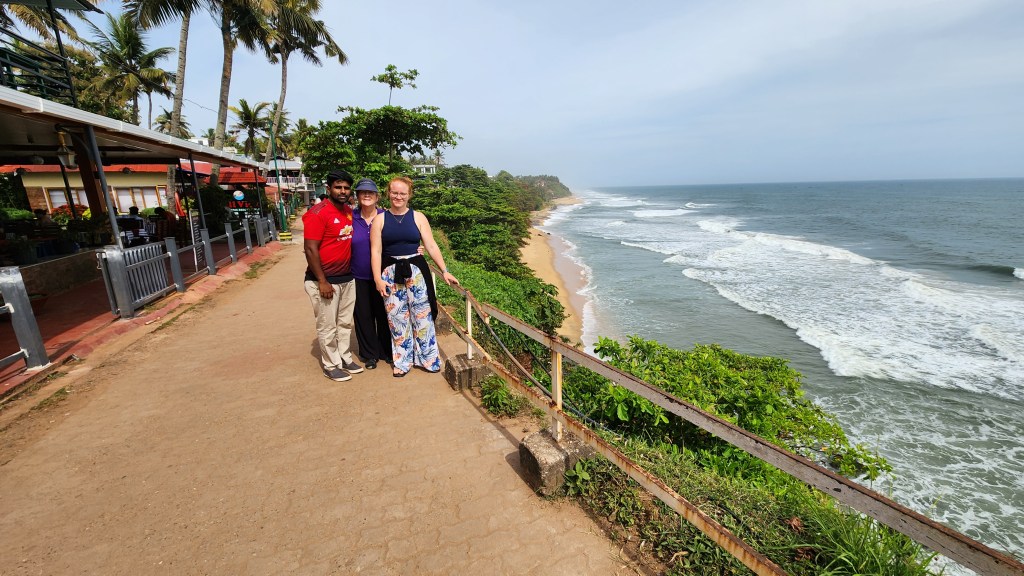
We spent a couple of hours exploring Jatayu Nature Park, then Uncle drove us 30 kilometers west to Varkala Beach. It is the only location in Southern India where there are cliffs adjacent to the Arbian Sea beach. It has been rated as the second most stunning cliff beach in the world and declared a national geological monument by the Geological Survey of India. It is also one of the few beaches in Kerala where it is relatively safe to swim, as long as you do not go too far out. The currents become very aggressive at a distance from the beach. Other beaches in Kerala have currents very close to the shore, so swimming is not recommended. Varkala is also famous for its natural springs which are said to have medicinal qualities. So the cliffs above the beach are now lined with yoga and Ayurvedic retreats, hotels, restaurants, tourist shops and clubs that attract tourists from around the world. There were more Western faces in Varkala than we had experienced anywhere else to that point in India. We toured down the clifftop walkway (shown in the picture) but elected not to eat lunch. We had some family visits to make before the day ended, so we headed south.
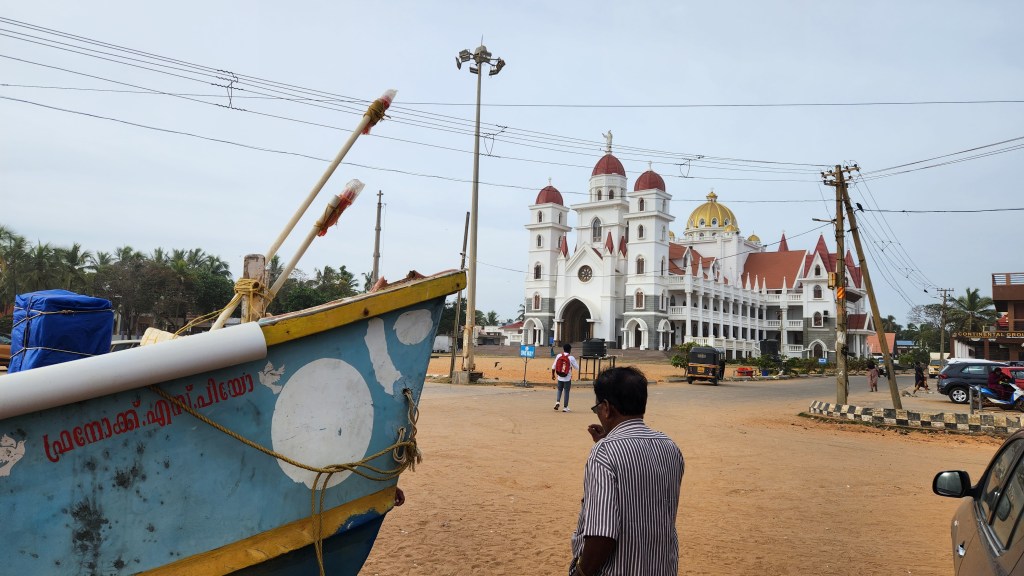
Our next stop was at a Catholic Church on the flat beach near Trivandrum. Due to its temperate location in Southern India, Kerala is the spice capital of India. From the 11th to the 15th Centuries CE, the merchants of the city states of Venice and Genoa, with trade links to Christian Constantinople, monopolized the import of spices from India (ie. Kerala) into Europe, particularly black pepper. Venice built a huge merchant ship fleet and the trade in Indian spices made it the richest city in Europe. Then the Portuguese explorer, Vasco de Gama, discovered a maritime route to India around the Cape of Good Hope (the southern tip of Africa) which the Portuguese were able to keep a secret for over 100 years. With the fall of Constantinople to the Turks in 1453 and Portugal’s discovery of an alternate route to India, Venice was soon in decline as Portugal replaced it as the center of the spice trade.
Vasco de Gama landed in Kerala in 1498 following his initial voyage around the Cape of Good Hope. Luckily for the Portuguese, the Kingdom of Cochin (centered in Kerala) was in great need of allies to preserve its independence. So in 1500, the King of Cochin negotiated a treaty of alliance with the Portuguese navy. And the Portuguese were invited to build forts in India. The Portuguese troops brought Catholic missionaries who soon discovered that there were already followers of Christ in India. Thomas the Apostle, one of the Twelve Apostles of Christ, had arrived in Kerala in 52 CE. In Kerala, Saint Thomas created a community that was “Hindu in culture, Christian in religion, and Oriental in worship.” As the Christian Church began to organize into formal structures, these followers of Christ adopted the Syriac Oriental Orthodox liturgy. They were accused of heresy by the newly arrived Portuguese Catholics when they resisted the conversion of their services into Latin. Despite centuries of difficulties, eventually even Pope John Paul II proclaimed that these “Saint Thomas” Christians had not broken communion with the Roman Catholic Church (unlike the Eastern Orthodox Churches). So even though this community continues to practice East Syriac Rites, they are considered in communion with the Pope and the Roman Catholic Church as well as the 22 Eastern Orthodox Churches. Liturgically and linguistically, Saint Thomas Christians (also known as Syro-Malabar Rite Catholics) represent one of the oldest Christian traditions in world, particularly outside the West. Almost 75% of this commuity lives in Kerala (where they constitute 12.5% of the total population of Kerala and almost 71% of all the Christians in Kerala). It is a very conservative community that continues to encourage marriage only within the community, so the community is nearing a zero growth regime.
But Kingston’s family are members of the Roman Catholic Church. There is evidence of a Roman Catholic parish in Trivandrum from at least 1568. There has been a Feast of Christ the King celebration here for over 400 years. The ten day celebration now occurs at the Mother of God Church (shown in the photo above). The celebration includes a grand procession on the tenth day. The Church is literally within a stone’s throw of the beach, as shown by the other end of the fishing boat in the photo above. Also note the large waves that the currents produce here. No swimmers on this beach.
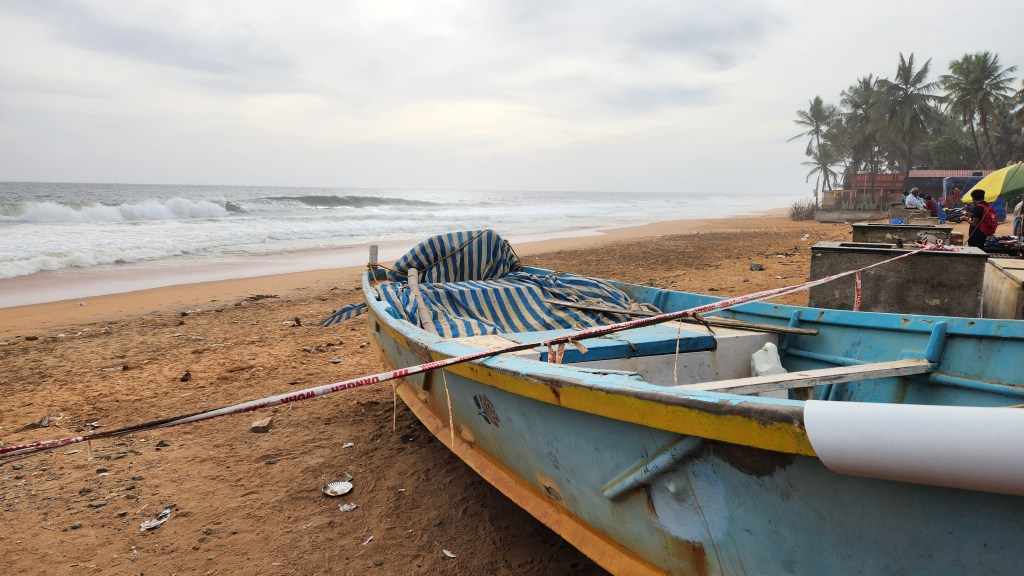
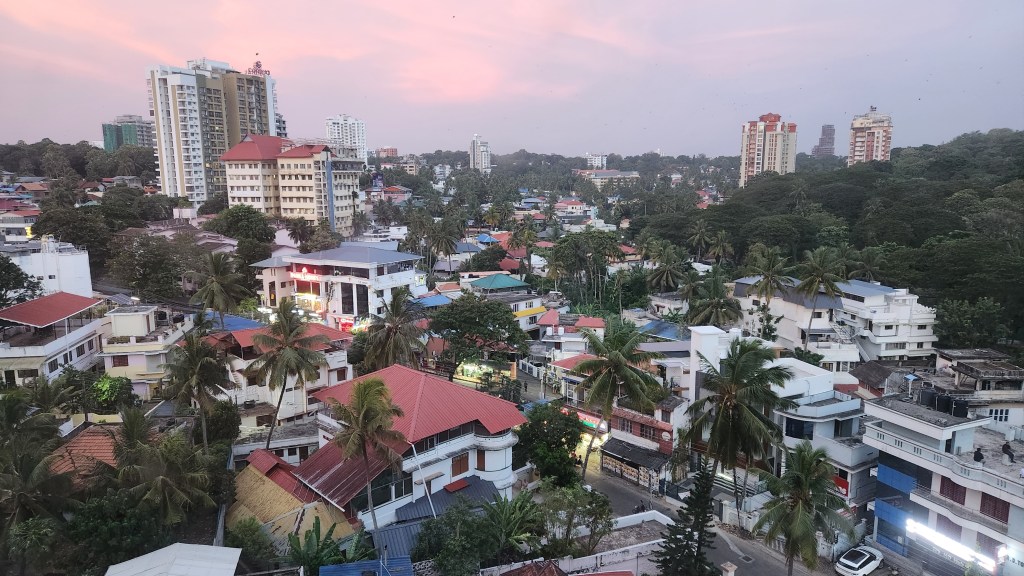
The afternoon was planned to be family visits to introduce Lena to Kingston’s extended family. But before the visits to family members, we had arranged to visit the parents of the bride of Kingston’s best friend. His friend works in the US (as does she) and attended Lena & Kingston’s Covid Wedding (ie., only ten folks at the service) in Raleigh. We got along great and he was kind enough to invite us to his wedding in Denver this past Spring, which was quite a bit larger. It was also our first Hindu wedding experience. We met his folks at the wedding. They both spoke English and were a pleasure to visit with. They were excited to hear that we would be visiting Trivandrum where they live. So they insisted that we visit. It was arranged. So after we left the beach, we again had to navigate a labyrinth of local roads before Uncle finally found their address near a canal. We were invited inside their spacious home where we were immediatley offered spiced tea (masala chai). Then they brought out numerous Kerala taste treats, including an especially good version of my favorite, Pazham Pori (banana fritters). Of course we ate way too much food because this was just our first home visit. After a very pleasant conversation and photos, we then proceeded to three homes of Mom’s sisters, nephews and neices. Each location provided spiced tea (and coffee) and more taste treats. And most of the younger Indians spoke English, so we had fun conversations about what Kingston was like as a child. However, since he was only in Kerala for short summer visits, there were not as many stories as we would have liked. Our final visit was to the apartment of Kingston’s cousin, which had a great evening view over central Trivandrum (see below). By the time we got back to our beach resort, it was after 10PM and we were quite full from all the visiting.
 Ginger Without Borders
Leave a comment