
The Southern coastal areas of present day Kerala (which we had left behind us once we boarded the train at Trivandrum) were never under the direct administrative control of the British Empire (or its predecessor, the British East India Company). The Kingdoms of Cochin (Kochi) and Travancore (whose capital was Trivandrum) were Hindu monarchies who allied with the armed forces of the British East India Company (which at certain times did threaten to take over administration of these kingdoms but never did). Once the British East India Company was replaced by direct British government control in 1858 (now known as the British Raj), the kingdoms’ control of their territories was not again threatened. The region of the Western Ghats around Munnar, however, was just inside the southern reach of the Madras Presidency, one of three British East India Company’s administrative subdivisions that directly ruled parts of India. At its greatest extent, the Madras Presidency, and the British Raj that repaced it, ruled most of South Western India.
In the 1860s, the British Governor of Madras sent a military party to explore the hill country of the Western Ghats after the loss of Ceylon (now Sri Lanka) as a major source of coffee for the British East India Company. The Company’s development of coffee plantations on Ceylon had resulted in the destruction of the rain forests and the rice paddies in the rice bowl of Ceylon. At 5,200 feet above sea level, the party found the area around what is now known as Munnar suitable for coffee pantations (and later found to be even better for tea plants). It was also ideal for a sanatoria for the British serving in the south of India to escape the oppressive heat of the lowlands. So the Munnar area (meaning “three rivers” because of its location at the confluence of three rivers) became a resort for the British elite. Like the other “hill stations” of the British Raj, they were meant to reproduce the home country and, particularly after the 1857 Revolt (much more later), they served as vital centers of political and military power.

Coffee (along with spices like cardamom and sisal) was the first crop cultivated by the British in the Munnar area beginning in 1879. Then a European planter established a plantation of over 50 acres of tea plants in 1880. Other tea plantations soon developed and by 1894, there were 26 tea estates in the area. But the difficulty of transporting the product from the mountains of Munnar to the lowlands limited profits. So the planters built a ropeway in 1900 to transport their product to the lowlands (the old building for the ropeway is now a tourist site). The town of Munnar was then created in 1901. A railway to Munnar was completed in 1908. By 1911, over 16,000 acres of tea plants were under cultivation. A disasterous monsoon in 1924 destroyed the train track (along with a heavy loss of other property and lives), so the survivors went back to using a ropeway until a road was completed in 1930.
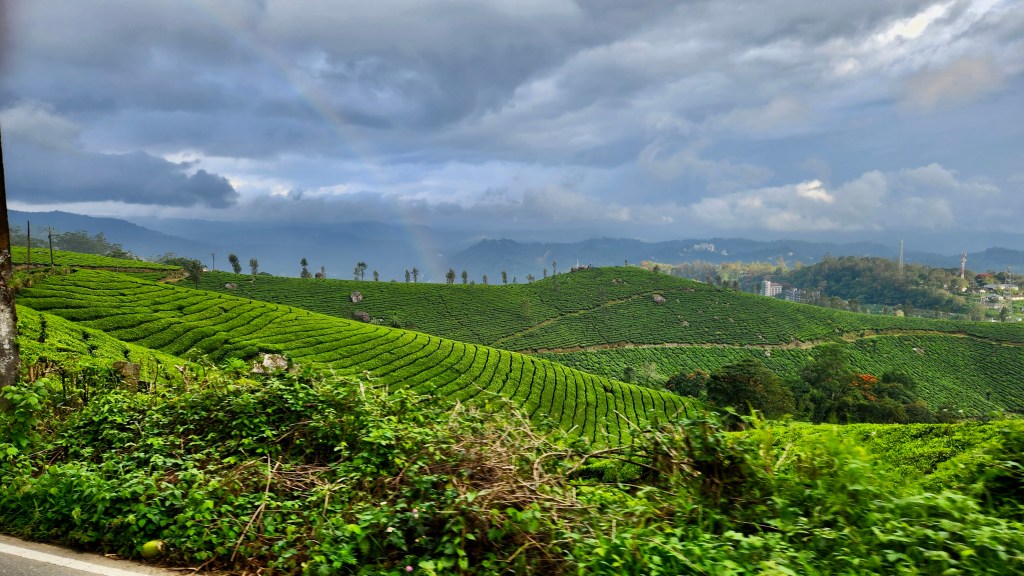
We left the hotel around 10am after the big breakfast buffet. Our first destination this day was through miles of tea plants to a man-made lake in Madupetty, about 13 kilometers from Munnar. The dam for the lake was constructed in the late 1940s for water conservation and hydro-electric power generation. The park created by the lake has become a home for many wild animals and birds. As you can see from the picture below, the monsoon rains that fell on us on our journey to Munnar were gone, replaced by blue sky and perfect cool mountain temperatures (like I remembered from my youth in the Blue Ridge Mountains of North Carolina).

So after our lake ride, we got back in our van and headed to another part of the lake where we came upon some monkeys.
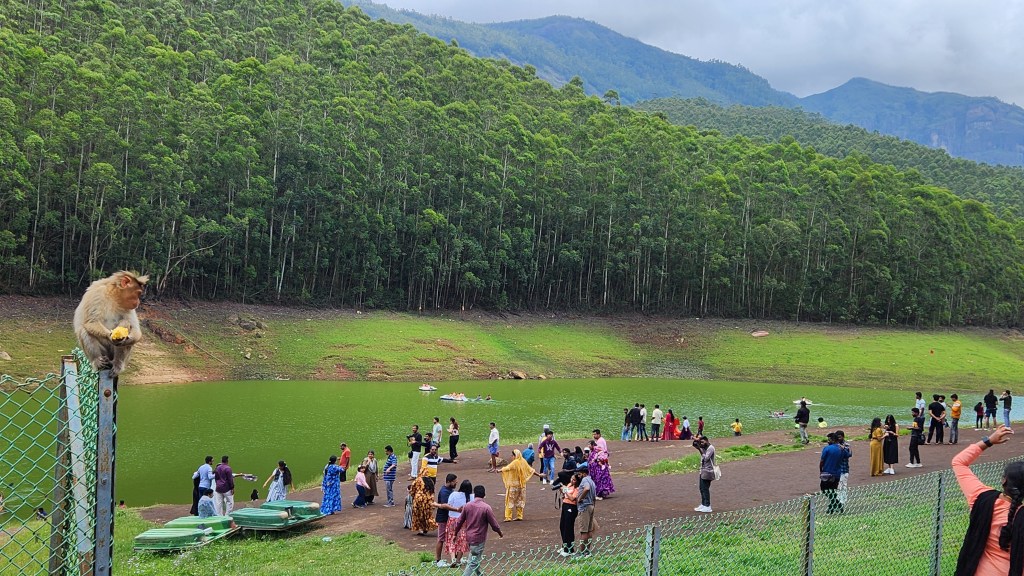
In the area above this part of the lake was a fairly large open air market that had developed in one of the bends in the highway. While we were wandering through the market, Mom found a spice stall that apparently had some good deals on fresh spices. She bought enough to fill two plastic bags (which Kingston said would likely all be used in various dishes in just a few weeks).

We stopped for coffee at a shop in Munnar on our return journey and made it back to the hotel (around 7pm) just in time to beat another hard steady monsoon rain for dinner. There was a large buffet accompanied by the beat of Bollywood dance sequences on the TV monitor.
 Ginger Without Borders
Leave a comment