
The Western Ghats are the oldest mountains in India and have many peaks that rise above 6,600 feet (which is the highest point in the Eastern US at Mt. Mitchell in ancient mountains of Western NC, where I have spent many happy days), so these Indian mountains feel familiar to me. My folks were both raised in Western NC. As a child, our family spent a considerable amount of our vacation time on camping trips in the mountains of Western NC. While there are now a lot of four lane highways in Western NC, that was not true when I was camping there as a youth, so the narrow, winding two lane roads of Kerala also remind me of my younger days. But this morning after our buffet breakfast, we are trading our van for a jeep because we were going to leave the “comfort” of the winding paved roads to explore the less developed roads on the steep mountainsides of Munnar. That is correct, all six of us are loading into one jeep to explore the narrower steep bumpy roads of Munnar. There are lots of jeep rental offices in Munnar and every jeep appears to be stuffed with eight or more folks of all ages, so we were not the only ones overloading a jeep.

I was in the rear of the jeep with two benches facing each other. Kingston and I took opposite sides holding onto the overhead steel frame for the roof covering to keep our balance over the many bumps in the gravel roads. To me, the forests we dived into appeared to be no different from other forests we had seen coming up the mountains. But the jeep driver pointed out that these trees were growing various agricultural products that Kerala has been exporting for millenia. The spice trade from Kerala is believed to be over three thousand years old. Kerala is considered the spice capital of the world. And unlike the Western moncultural plantations (see the pictures of the tea plantations), these spice and fruit trees actually are more productive when grown together, hence the “forest plantations.”


Spices grown in the forests include cardamom, vanilla, pepper, cinnamon, clove and nutmeg. The King of spices is black pepper which has been documented in Indian cooking since at least 2000 BCE. It was traded with ancient Egypt and was the spice that early European traders most favored. In Medival Europe, it was so valuable that it was often used as currency for rent, dowry and tax payments. But the Queen of spices is Cardamom, which is very the essence of South Indian dishes, and is one of the world’s most expensive spices (behind only saffron and vanilla). When Kingston was in graduate school in the US with lots of India roomates, he said their rule was, if a dish is not coming together, just add more cardamom and it will be fine. Tamarind is a tree fruit that is grown here and its unique sweet-sour flavor makes it a common ingredient in South Indian cooking. It has potent dietary antioxidants and therefore many health benefits. For Western readers, it is one of the ingredients that gives Worcestershire sauce its unique flavor. Grown all over Southern Asia, it is apparently the favorite fruit of the ringtailed lemuers of Madagascar. It was brought to the Americas by the Spanish and became a central ingredient for Mexican and Caribbean dishes.
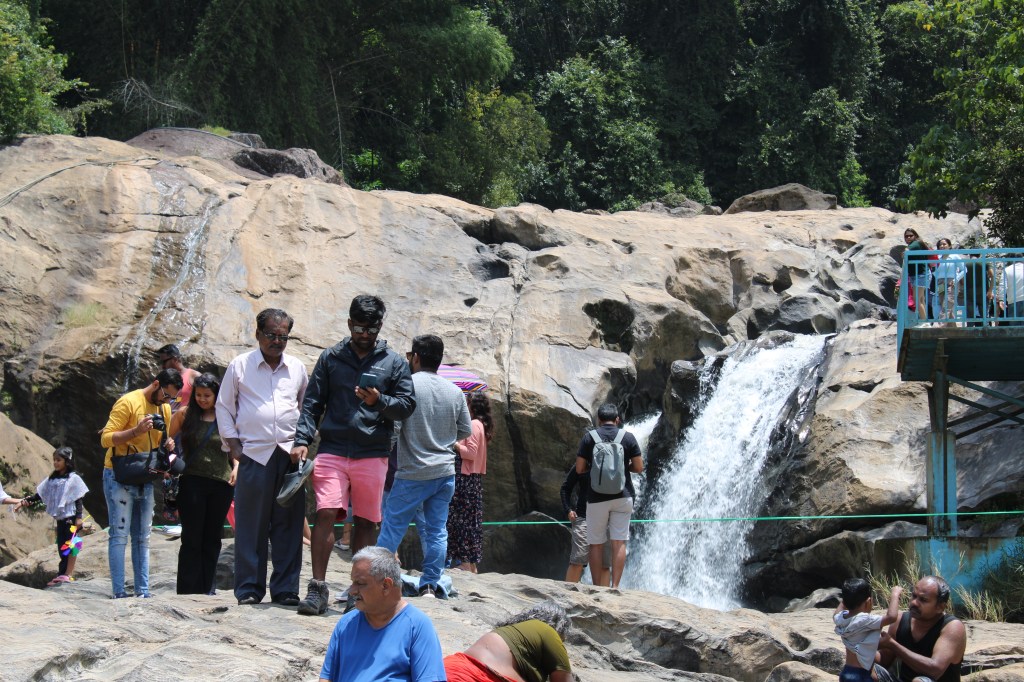
Our bouncing journey through the spice plantation’s steep rocky roads ended at the Ripple Waterfalls, a natural waterfall that was developed by the local government as a tourist attraction. Because of the “August drought,” the waterflow was much less than a normal monsoon season and we could wander around the rock formations that would otherwise be below the river’s waterline. It was another beautiful sunny day and the water was cool, so many of the Indians (we were the only Western faces) took the opportunity to take a dip in the water.

From the falls, we headed further up into the mountains to a steel “swinging bridge” built by the British during the late colonial period to transport materials for the construction of one of the many dams in the Munnar area. It was designed only for one-way traffic but has now reached an age that it is only safe for pedestrian traffic. Nevertheless, it has become a tourist attraction because of its narrow scenic valley and the falls below it. Again, since this August has not had significant rainfall for several weeks, there was not much of a water flow beneath the bridge.
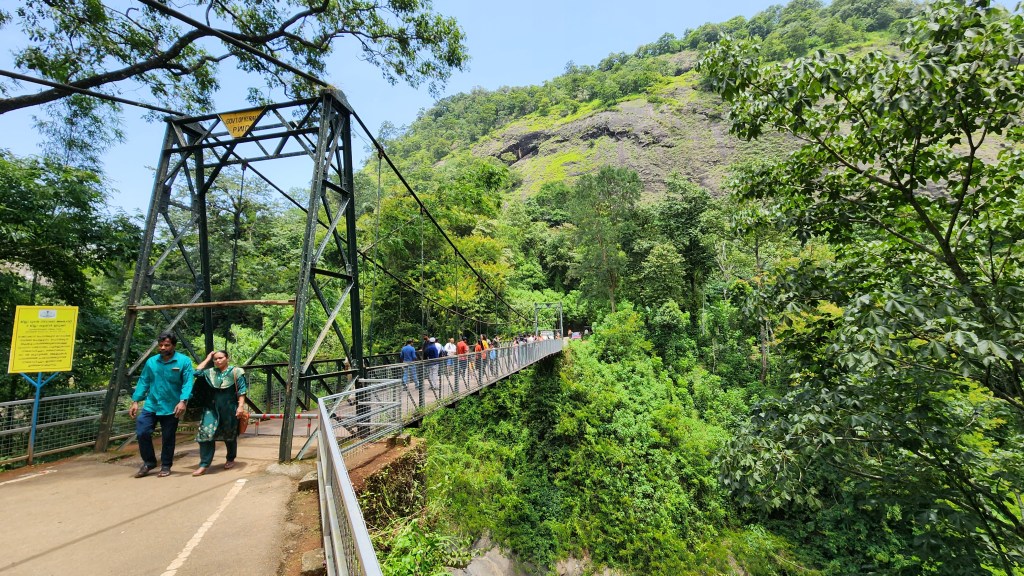
As is common at most tourist sites, there was a makeshift market on this side of the bridge, but our jeep was parked on the far side. Mom checked out the spices but none were to her liking, so we were soon on our way back across the bridge. We loaded into the jeep and headed further up the mountains. We eventually came to a peak area that had a large stone outcrop. The outcrop had become the site of a fairly large informal market, so many folks stopped off for the market and the view of down the valley. Dad particularly liked the fried bread that Kingston is holding in his hand. We must have eaten four or five of these containers of the bread. It was near lunch time, so it was a welcome treat.

The day was only half over and we still had a trip to the oldest National Park in Kerala. So we headed back to Munnar to switch back to the van. Part 2 will be the Park.
 Ginger Without Borders
Leave a comment