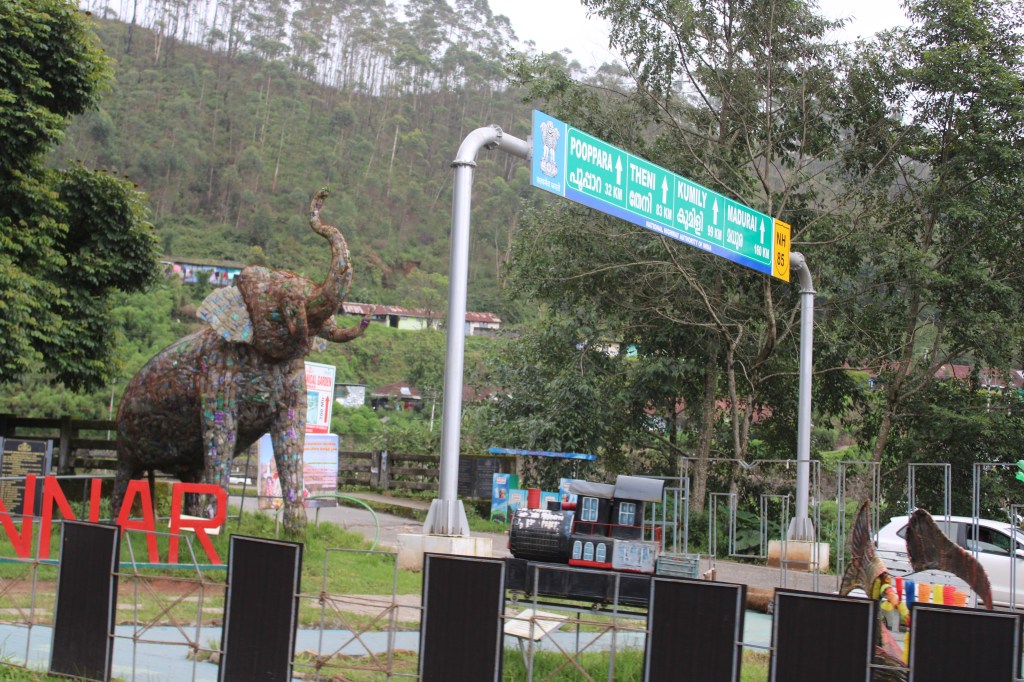
Our time in Munnar’s tea plantations had come to an end. But before we leave Munnar, I should highlight the efforts of the town to address plastic bottle waste. This was the first town in India where we experienced municipal signs encouraging the recycling of water bottles.
Kerala is a melting pot of various religions with 55% Hindus, 27% Muslims, 18% Christians and the remaining 0.5% classified as other. So we passed a lot of churches, mosques and temples along our travels. But there are other religious structures we have also frequently saw in India. It is the wayside shrine. These roadside structures appear along the highways and, in most places, no one knows who actually originally established the shrine. They are organic, totally unregulated and would not be allowed in the US or Europe.
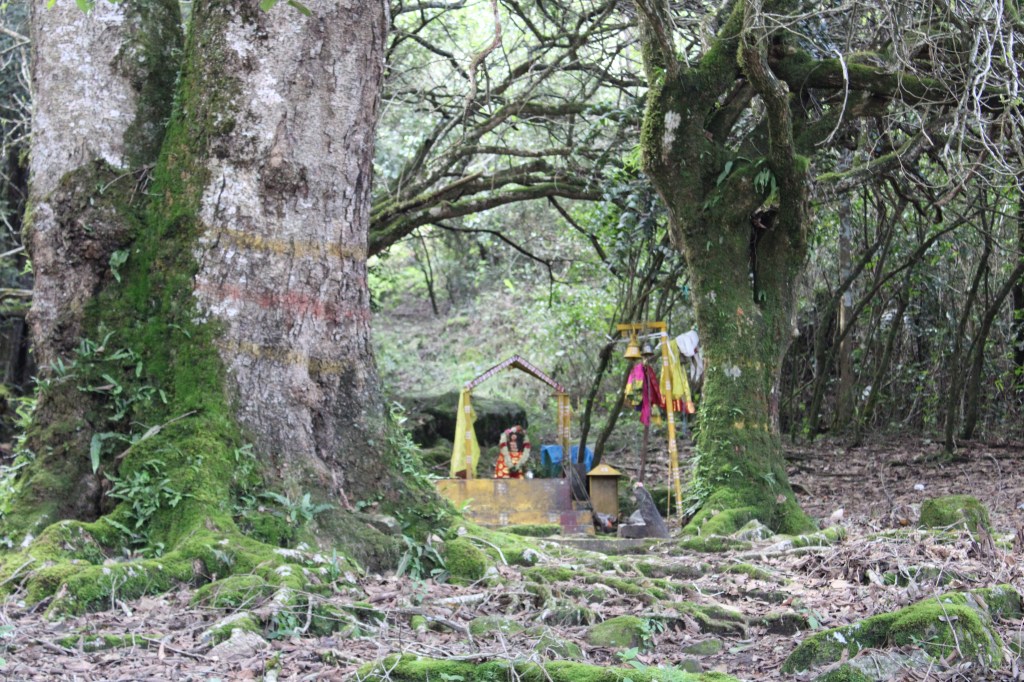

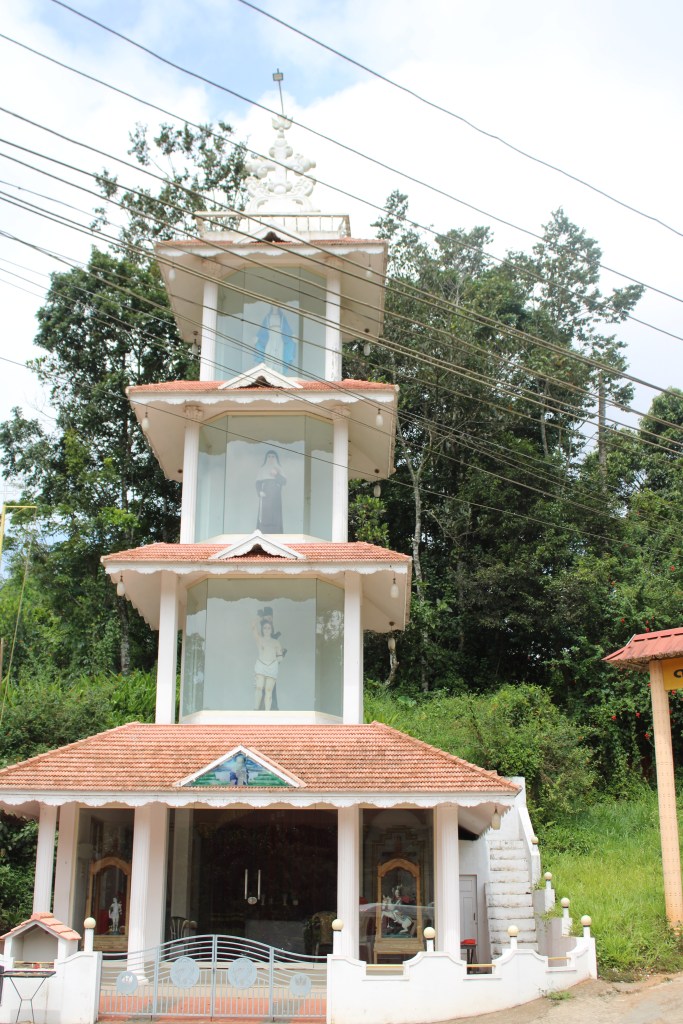
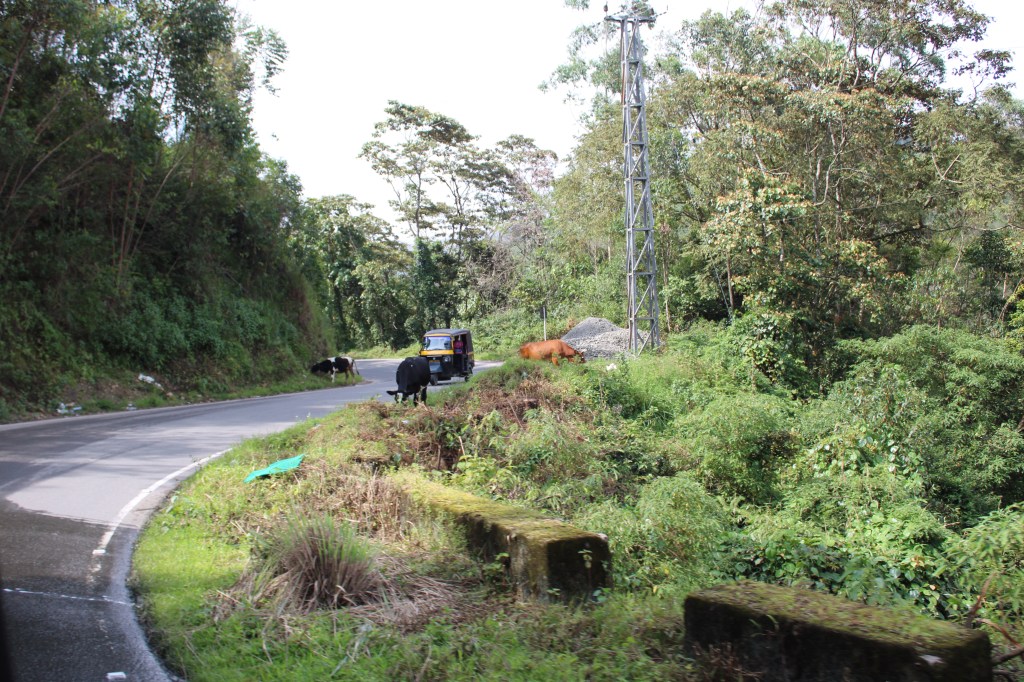
Over the last decade in the US, roadside memorials to people killed in traffic accidents have become common, particularly in rural areas of the South. These are memorials to a lost family member and generally are not maintained for more than a few years. In India, once a location has been identified with cloth, tassels or a crucifix, locals convert it into a pilgrim spot with a substantial structure where locals regularly worship. It may even become the location of a small roadside market. Some become substantial, like the two directly above, and some are simple, like the one in the National Park.
Luckily, the road trip to Periyar did not involve climbing into 6,000 foot mountains, so we made a stop soon after we left Munnar at a spice plantation that was a tourist attraction. Unlike to steep mountainside we had ridden in the jeep, this plantation was on a relatively flat section of the mountains. We took the guided tour. I should have taken notes because I have a bunch of photos of the trees and plants that were used as various spices and alternative medicines. I have no idea what they are now. But we did luck upon a Malabar gray hornbill outside the spice and alternative remedies shop.

So I mentioned the shop, and of course, Mom spent about half an hour buying more spices. I actually considered purchasing an alternative medicine but Lena convinced me that I did not really need it.

Not too long after our Sprinter van left the spice plantation, we arrived in Thekkady, the town near the Periyar National Park. But before heading to the hotel, we stopped in the town’s central market area to but tickets for a traditional Indian dance performance and a martial arts performance that evening. Remember, Kingston likes to fill our days. And this is where we saw our first live elephants. They were a ride attraction beside the shop where tickets were purchased.

Similar to our experience in Trivandrum, once we left the central market area, our Sprinter van had to negotiate a number of narrow residential roads in order to get to our hotel. The last road was only wide enough for one way traffic at a time, so the several cars that were coming down the road had to turn off before we could go up the road to the hotel. It was worth the trouble because the hotel staff welcomed us with cold juice in their open air reception.

After a nice dinner to no Bollywood songs, Kingston, Lena, Dawn and I jumped back in the Sprinter van back for the short hop to the business center. There was a lot of traffic by now, so we elected to leave the van and walk the several blocks to the area where our shows would occur. Kathakali is one of the major forms of Indian classical dance. Each performance tells a story from one of the many ancient Hindu tales using elaborate costumes and makeup, sung in Malayalam. It is believed this art form was developed in Kerala in the 17th Century. Traditionally, the performance lasts all night but ours was only one hour long. The “music” was just voice and a drum and the dance was very ritualized (and apparently based on martial arts movements). Our story was about a demoness, Nakrathundi, who fell in love with Jayantha, the son of the Hindu god of rain, and disguised herself as a lady. She tried to trick him into marriage with her charms. Then when he refused to marry her, she revealed herself as a demon, so he cut off her nose and breasts and she ran away to the underworld. A paper mache of Jayantha’s head was given to me many years ago (I believe I still have it somewhere), so to see his story was quite entertaining even if I don’t understand Malayalam.

Leaving the auditorium was interesting. They only had one exit (would that work with a US fire marshall?). Everyone seemed to be in a hurry to get somewhere, so there was a crush at the door. We did need to get to our martial arts performance but had no desire to participate in the crush. Good thing too. Once we got to the martial arts auditorium, the crowd for the first show of the evening was still exiting. That process took at least another 30 minutes before the auditorium was cleared to allow us to enter. Turns out that the martial artists allow the audience to take pictures with them on the floor of the auditiorium after each show. That contributed significantly to the delay.
Kerala’s martial arts form, Kalaripayattu, is dated to at least the 11th Century CE. It is believed to be the oldest surviving form of martial arts in the world. Legend says it was brought to Kerala by Vishnu (the Hindu god of Preservation) in the form of his sixth avatar, Parashurama, who learned the “arts of the battlefield” from the second god of the Hindu trinity, Shiva (Hindu god of destruction). The third god of the Hindu trinity is Brahma (the creator). Before each training session (or performance), salutations to the local Hindu deities is required (see incense burner in photo below).
In the 15th Century, local schools taught the full-contact martial arts to all students, regardless of caste, community or sex. But the Hindu martial castes, the Nairs and Thiyyas, placed a particular emphasis on the training. The course of study took up to 12 years to achieve the highest level of proficiency. Experts (and mercenaries hired by families) would sometimes use it as a way to settle local disputes. But with the introduction of guns and cannons in the 17th Century, swords, bows and arrows, and spears were not as successful in combat, so interest declined. The British East India Company then banned the practice in 1804 and required the closure of all the Kalari training facilities. But with the worldwide interest in martial arts in th 1970’s, Kalari training facilities were reopened. In 2021, the Kerala state government opened a training academy in Trivandrum under its Department of Tourism.
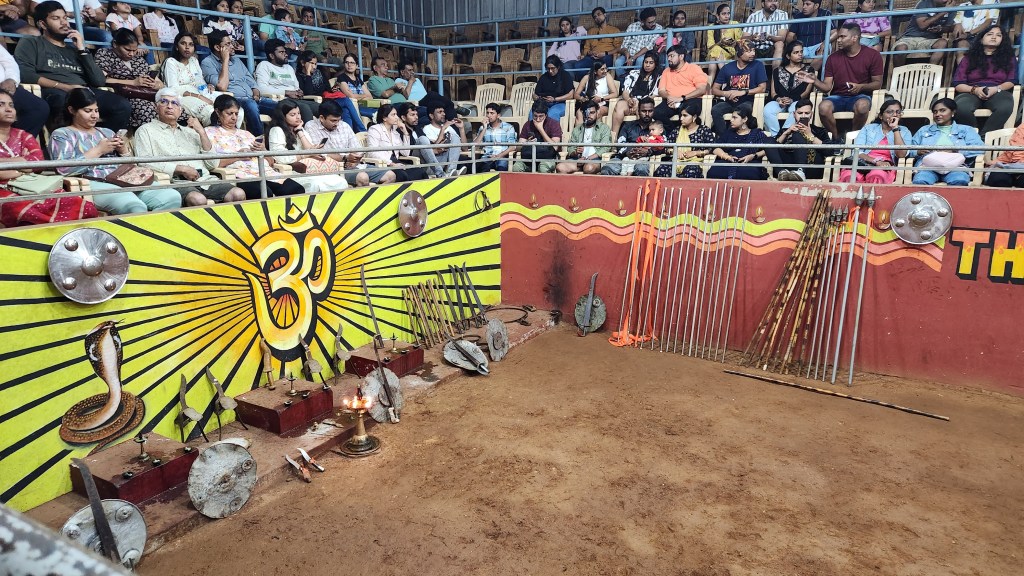
With the show ended, seemingly half of the audience rushed to the floor to have pictures taken with the artists. The other half rushed for the exit door (there was not another show so I don’t understand why we could not also exit by the same door we entered). We had no interest in fighting the crush to exit, so half an hour later, we finally left the arena. We found our Sprinter van driver just outside the auditorium and got back to the hotel very late. And we had a big day planned for tomorrow, Indian Indepedence Day, August 15.
 Ginger Without Borders
Leave a comment