
We went down to a very colorful breakfast buffet. It was August 15, Indian Independence Day, and the cooks had prepared various dishes (the Southern Indian speciality of round steamed idli lentil and rice cakes in particlular) in the three colors of the Indian flag: green, orange and white. At 9am, all the guests were invited to join in a ceremony to raise the national flag on a pole that had been erected in the hotel’s courtyard for that purpose. We joined in the ceremony with Kingston’s family as a retired military guest was asked to raise the flag and all the assembled guests sang their national anthem. Interestingly, Kingston said that display of the Indian national flag had been restricted to government buildings and national holidays until 2002. Now the flag is permitted to be flown anytime and anywhere “consistent with the dignity and honor of the National Flag” (as required in the flag law). After that, I decided to make a note of where the flag was displayed and found it quite often in residential areas (though not as often in commercial areas as in the US). Kingston also told us not to expect evening fireworks. Fireworks were reserved for religious holidays.

The name of the town we were visiting, Thekkady, is derived from the word “thekku” which means teak. Today we to explore the Periyar National Park that featured a lot of teak forests. Periyar was declared a National Park in 1982 and is noteable as both an elephant and a tiger preserve. The Park’s core area is 118 square miles but the adjacent protected area is 357 square miles. It is one of the top tourists attractions in India and the largest wildlife sanctuary in Kerala.
The Park surrounds a man-made lake that was built by engineers from the Madras Presidency between 1887 and 1895 after an intial attempt in 1850 was abandoned. The dam is at the confluence of the Mullayar and Periyar Rivers and was constucted with limestone masonry (which has become a serious issue now given the age of the dam). It was a very difficult project with the temporary embankments frequently swept away by monsoon floods and rains and high worker mortality from malaria (483 died and are buried on-site). The Madras Presidency even stopped funding the project due to its difficulties. So the chief British engineer for the project returned to England and sold family property to fund completion of the project. Well into the 20th Century, the dam complex was considered “one of the most extraordinary feats of engineering ever performed by man.” A memorial to the engineer was unveiled locally in 2013. He is honored at traditional harvest festivals in the area and some farmers in Tamil Nadu keep and worship his portrait alongside their local gods.
Controversy has followed the project since its completion. Prior to its construction, the Maharaja of Travancore (which is now southern Kerala but also part of southern Tamil Nadu) negotiated a lease with the Madras Presidency for 999 years for the right to manage the dam and obtain all the water from the impoundment (which was diverted by a canal into the Travancore area that is now Tamil Nadu). The division of Travancore created an issue. All of the lake lies within present day Kerala but the water is used exclusively by residents of Tamil Nadu and the dam is mangaged by Tamil Nadu. After Independence, the validity of the lease was challenged by Kerala since the dam and all its watershed are within Kerala (and the water basin transfer to Tamil Nadu limits economic growth in Kerala). Adding further controversy, the 19th Century dam technology of limestone masonry is now considered archaic and susceptible to failure. Serious seepage and leaks from the dam have begun to cause concern, particularly due to seismic activity in the area and the failure of similar dams in other parts of India. Tamil Nadu, in spite of the concerns about the age of the dam, has insisted on raising the lake’s water level to compensate for crop failures in Tamil Nadu. While Tamil Nadu authorities have made some repairs to the aging dam, Kerala remains concerned about the added stress additional water levels would put on an already aged dam. The two states are now constantly before the Indian courts to address these concerns.
In 1934, the Maharaja of Travancore declared the forests around the Periyar lake to be a private game sanctuary to stop the encroachment of tea plantations into the forests. The area became a wildlife sanctuary in 1950 after Independence. It was declared a tiger sanctuary in 1978, a National Park in 1982 and then an elephant sanctuary in 1991.
Like the Eravikulam National Park, access to the Periyar National Park is only by government operated buses. The tickets are sold in a parking lot in downtown Thekkady where you also board the buses. Kingston purchased our tickets and we waited to board the next bus. But when Dawn, Lena and I tried to board, the conductor refused our tickets. Kingston had purchased regular tickets, not the non-Indian tourist tickets. As with many tourist spots in India operated by the local or national government, there is a higher price for non-Indians. So we had to leave that bus and go back to the ticket office to purchase the correct tickets. Higher ticket prices for non-nationals is common in many of the countries we have traveled and is appropriate given that many of these facilities are supported with local tax funds. But the next bus took a little longer to arrive.
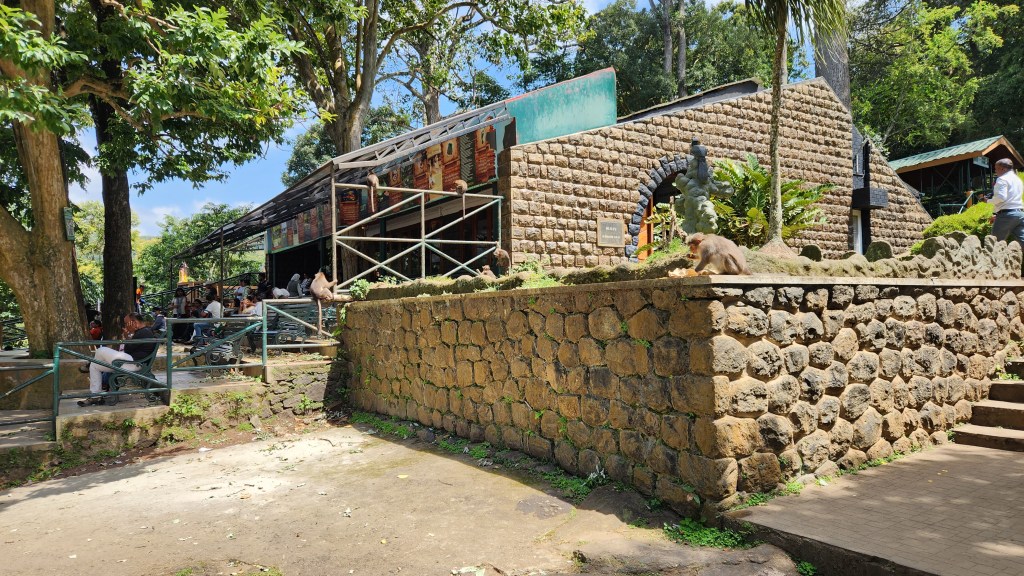
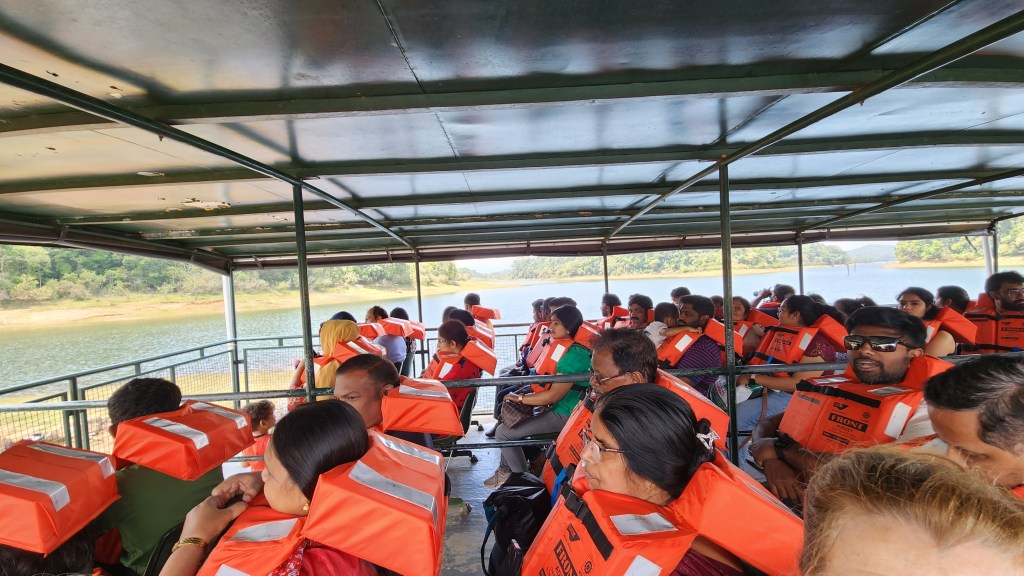
After a 30 minute wait in the parking lot and a 30 minute drive into the Park, we arrrived at the waiting area. It had one of the largest groups of bonnet monkeys we were to experience in India and they were aggressive about food. But there were several youngsters in the group that were quite amusing. We had another 30 minute wait until the arrival of the next boat. Most folks just sat in the bench seats until just before the boat arrived while we explored the area. Shortly before the entrance gate opened, a crowd formed in the boarding lane similar to what we had experienced the night before when exiting both the performances we had attended. Even Kingston questioned why there was such a rush to get on the boat first since all the seats were already assigned. So we avoided the quash and were some of the last folks to board the boat. Due to an accident several years earlier invloving the tragic loss of life (which we did not know at the time), the boat’s crew was very strict about enforcing the use of life vests (which thankfully were a lot newer than the ones we had used in Munnar). The deadly accident was triggered when passengers suddenly shifted sides to view wildlife and was cited in the disaster report as one of the causes of the boat sinking. So the passengers on our trip were required to remain in our seats which limited the sight lines when wildlife was spotted. But safety is more important than pictures.

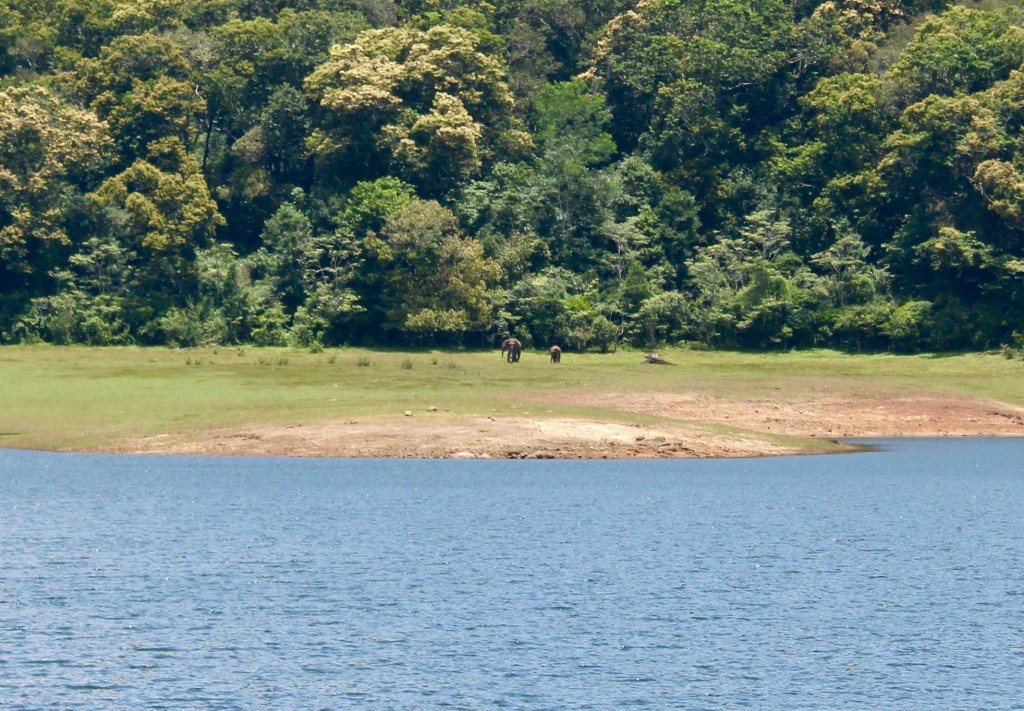
We saw the Sambar deer at a number of places, a warthog, and a few cormorants, but what we really came to see was a wild elephant. We knew that seeing a tiger was very remote since they hunt mostly at night and sleep during the day. As the boat turned back for the loading area, we had pretty much decided that it was not our day to see a wild elephant. But shortly before we were to enter the cove for unloading, the monsoon drought worked for us again. The Lake’s waterline at a normal lake level is almost adjacent to the forest edge. The lack of rainfall had left a fairly wide open area around the Lake’s edge. In search of water (?), two adult (female?) elephants and one adolescent elephant wandered into the open space. They were quite a distance away but easy to spot. The boat turned and headed (only slightly) closer for us to get a better view. Success, we had seen three wild elephants.
But our day was not over once we got back to the loading area. Kingston likes to fill our days so he convinced Dawn, Lena and I to take a forest treck. His Mom and Dad politely declined. In spite of the lack of rain, the rangers insisted that we wear leggings to protect us from the forest’s leaches. They turned out not to be necessary.

Our ranger guide grew up in the area and is a member of the local tribe. He said we were very lucky to see elephants at this time of the year. Once we crossed the river on a bamboo ferry and entered the forest, he very quickly spotted one of the more colorful local wildlife, the Malabar Giant Squirrel. These squirrels can have up to three colors of hair with a tail that is as long as its body. They are upper-canopy dwellers, rarely come to the ground and are found only in India. They can jump up to 20 feet from tree to tree. It is one of the world’s four giant squirrels and is two to three times the size of an Eastern US grey squirrel.

Then we had quite a lot of fun with one of the primate forest dwellers, the Nilgiri langur. It inhabits the middle and lower canopy of the forest. But the forest also hosts another primate, the lion-tailed macaque, which occupies the upper canopy and does not come down to the ground even for water. There is no evidence that these two populations of primates are able to cross breed. Both species are unique for their black fur. The langur has a longer tail and golden brown fur at its mane. The macaque has a grey or silver mane. These primates are found only in the Western Ghats (where less than 25% of the mountain slopes are still forested). Only active during the day (diurnal as opposed to nocturnal), they spend most of their life in the canopy of the forest. Unlike the bonnet monkeys, they typically avoid humans. Langurs are the most frequent “hoo hoo” callers in the forest while macaques rarely makes any sound, making them much harder to locate in the trees. The Langur is considered vulnerable due to habitat fragmentation. Macaques, however, are the world’s rarest and most threatened primates, again because of the fragmentation of their forest habitat by the construction of spice, tea and coffee plantations and human settlements, which isolates breeding groups resulting in damaging inbreeding. Periyar National Park is one of the protected areas for both species.

Given their usual habit of avoiding humans, we encountered at least three individuals during our treck who the ranger guide identified as langurs because of their longer tail. The one in the photo above actually appeared to follow us above in the trees for some distance after posing for our pictures.
As I alluded to with the reference to Thekkady’s name origin, the forest we explored was full of teak, rosewood, sandalwood and ebony. So it was a wooden intrument builder’s dream. Most of these woods are considered endangered and may not be imported to the US.

Not long after we crossed the bridge above, we passed another group of about 10 European folks who were going deeper into the forest to spend the night. They had several rangers with them including a female ranger with a rifle. After they passed, I asked our guide about the rifle and he said it was not intended to protect the group from tigers (although he admitted it might be useful if they did happen upon a tiger), it was specifically for warning away a too inquisitive elephant. The ranger had shown us several trees where the local tigers had left their markings. We did not happen upon any.
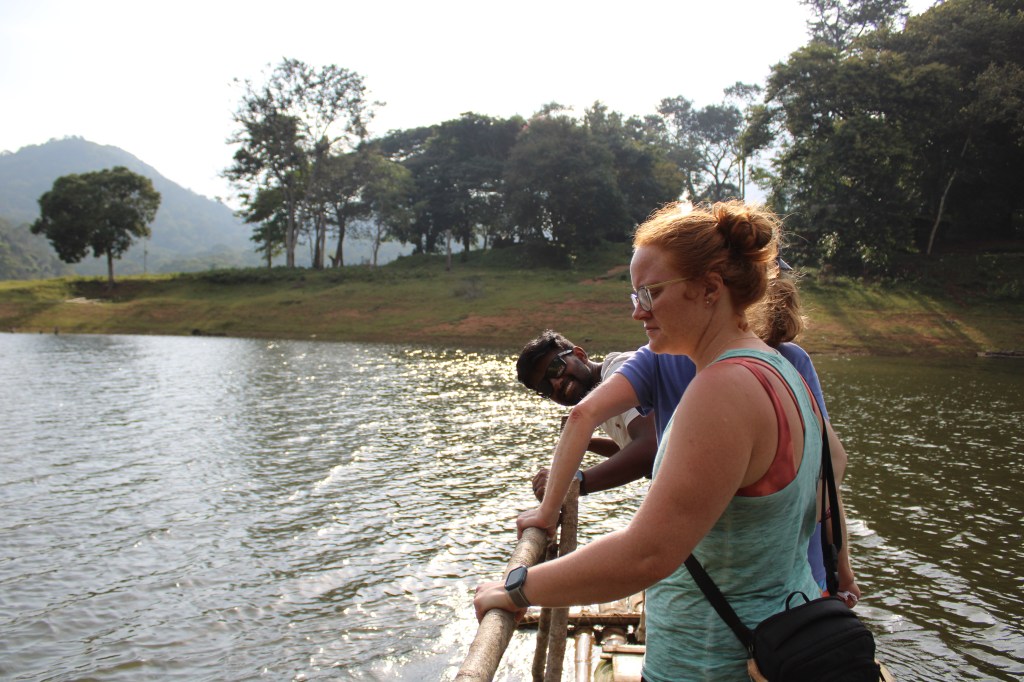
Once we crossed back over the river on our rope powered bamboo ferry (above photo), we picked up Mom and Dad and headed back to the hotel. I changed into my swimsuit and headed to the pool for a well deserved soak. Since there were no fireworks to see, we were able to get to bed early after a nice dinner buffet.
 Ginger Without Borders
Leave a comment