
Today and yesterday, the International Court of Justice held hearings in the Application of the Convention on the Prevention and Punishment of the Crime of Genocide in the Gaza Strip (South Africa v. Israel). Given the fact that I am currently in a Masters program (LL.M.) focused on international dispute settlement, my WhatsApp has been flooded with messages from friends asking me to explain some of the issues raised by the case. So, to help those with similar questions, I’ve answered some preliminary questions, as well as some questions from my dear friend, Elena, below:
1. Context
(a). What is the International Court of Justice and why does everyone keep saying “International Criminal Court”?
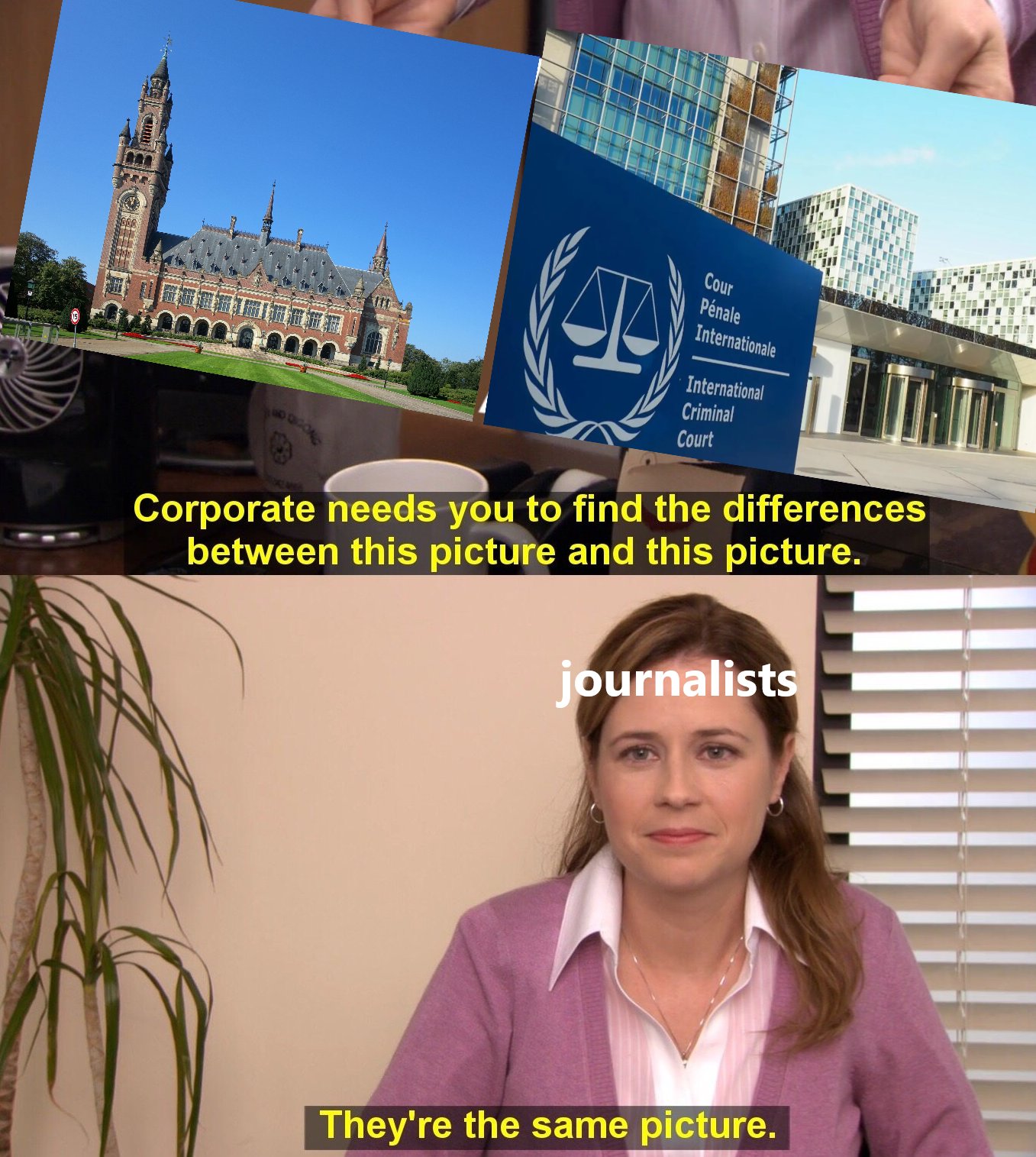
This question stems from a common misunderstanding. There are two “International Courts”: the International Court of Justice (ICJ) and the International Criminal Court (ICC). The fundamental difference between these two is the first–the ICJ–settles disputes between countries. On the other hand, the second–the ICC–prosecutes individuals for war crimes, crimes against humanity, and genocide. So what does this mean for this case? This case is between two countries, South Africa and Israel, which means it is within the scope of the ICJ. The ICC, on the other hand, is currently investigating the Gaza conflict to see if that court may take action against any specific individuals (which is a whole different can of worms that I can tackle in a follow-up post if anyone is interested).
(b). What are the main claims of South Africa. What are they asking the ICJ?
Right now, South Africa is asking the court for something called “provisional measures“. Provisional measures function as a type of injunction, preventing a country from acting in a specific way until the court can make a judgment on the full dispute (what lawyers call the “merits” of a case). The interesting thing about provisional measures is that, because the court is not hearing the full merits of the dispute, it does not need to fully decide on the claims of the parties. The court only needs to determine whether five things (in legalese, “elements”) exist:
- (1) based on a first impression (in legalese, “prima facie” or “on its face”), the court has jurisdiction & the case is admissible;
- (2) there is a “link” between the action requested as a provisional measure and the overall claim in the merits of the case;
- (3) a quick review of the merits suggests that the party making the claim has the ability to succeed on their claim (in legalese, the court conducts a “prima facie” review of the merits);
- (4) irreversible harm will occur unless the court agrees to order a party to implement the requested measures (in legalese, “irreparable prejudice”); and
- (5) the matter is urgent.
Here, South Africa is basically asking the court to order provisional measures which require Israel to stop attacking Gaza (see pages 82 to 84 of South Africa’s submission to the Court). The ICJ can order these provisional measures based on a lower threshold of “proof”, which means South Africa doesn’t need to prove beyond a shadow of a doubt that they are correct and Israel has acted in violation of international law–they’ll need to do that during the merits stage, which will occur later. So, at this moment, as long as the Court agrees that South Africa’s arguments are feasible, using the five elements above, the ICJ will order Israel to stop attacking Gaza.
(c). What are Israel’s main counterarguments?
To put it simply, Israel is making three points:
- Hamas is to blame for the violence;
- Israel is exercising their inherent right to self defense (see below, question 6, for why this argument should fail);
- South Africa has “regrettably put before the court a profoundly distorted factual and legal picture, [and] the entirety of its case hinges on a deliberately curated, decontextualised and manipulative description of the reality of current hostilities“.
So, in summary, Israel claims they are acting within what is allowed under international law, so the court should deny the request for provisional measures.
2. Can South Africa raise this claim if it’s not an involved party? Did South Africa have an obligation to meet with Israel ahead of the hearing? Will it hurt them that they didn’t?
South Africa is exercising a really interesting power called standing erga omnes partes. This basically means that any state who is party to a treaty with multiple “states parties” (legalese for many different states that agree to comply with the obligations written in the treaty) may invoke their status as a state party to bring a case against another state party who is allegedly violating their obligations under that treaty.
So basically, South Africa has the ability to raise this claim because both Israel and South Africa are states parties to the Genocide Convention and South Africa alleges that Israel is violating their obligations under the Genocide Convention. This is the same basis that allowed The Gambia to bring a similar case against Myanmar for the alleged genocide of the Rohingya people, even though The Gambia was in no way involved in that conflict (if you want a scholarly article on this issue, click here). It therefore does not matter whether South Africa is directly involved.
As for an obligation to meet with Israel, the answer to this question will vary case-by-case. The ICJ is a consent-based judicial body, meaning it can only hear a case if the parties involved consent to its’ jurisdiction to hear that case. Here, to get the consent necessary to bring the case to the court, South Africa is invoking something called a “compromissory clause” in the Genocide Convention. This is basically a provision of the treaty that grants states parties the ability to seek dispute resolution in the ICJ when there is a disagreement about the interpretation, application, or fulfillment of the treaty. In some treaties, the compromissory clause includes a pre-condition requiring that the states involved first discuss their disagreement before seeking the ICJ’s help in resolving it. The Genocide Convention, however, has no such pre-condition. So, the failure to meet to negotiate should not affect South Africa invoking the Genocide Convention’s compromissory clause.
3. What is South Africa trying to prove? Can the ICJ sentence Israel with genocide now?
At the moment, South Africa is only seeking provisional measures. During this phase of the proceeding, the ICJ is not hearing arguments related to “sentencing” Israel (in ICJ speak, it is not “sentencing”; that terminology is more for the ICC, which properly “sentences” people to jail. Unfortunately, though, there is not really an equivalent term for the ICJ).
In later proceedings, the ICJ will hear the full merits of the dispute, at which time the court will determine whether Israel violated international law. At that time, they will also examine whether the violations of international law (if any are found) are justified through any “circumstances precluding wrongfulness” (basically the equivalent of justifications for violating a law). It is only after the ICJ finds that Israel violated international law and the violation was not justified, that the ICJ would “sentence” Israel (e.g., find them liable to Palestine for the violation, and order reparations–again, another topic that I will happily address in a future post if there is any interest).
4. What are the differences with proving genocide versus genocidal intent?
Oof. Okay. The long and the short of this one is genocidal intent is an element that must be proven to prove genocide occurred. Genocide is what is called a “mens rea” offense, meaning the individuals committing genocide need to have the specific intent to commit genocide. In practice, this means that a state may commit the mass murder of a group of people (think WWII mass bombings of Japan) without committing a genocide, as long as the state did not specifically intend to kill off that specific group of people. Now, that does not mean that mass killing of a group of people is legal. In fact, it is a war crime, which is equally as illegal under international law as genocide, but nevertheless a different crime.
5. Can the ICJ say its war crimes and not genocide?
Fun question! With a sad answer: no.
South Africa brought the dispute to the ICJ using the compromissory clause of the Genocide Convention. As the name suggests, the Genocide Convention is focused on genocide; it does not include a prohibition on war crimes. War crimes are instead prohibited by four separate Geneva Conventions. Interestingly, the international community agreed war crimes were illegal long before they agreed genocide was illegal (largely because prior to WWII, the term “genocide” did not exist. It was only after Raphael Lemkin, a survivor of the Holocaust, created the term and lobbied the international community post-WWII that genocide became an international crime). However, because the treaty that South Africa invoked to bring the case does not include a prohibition on war crimes, the ICJ cannot address whether war crimes occured.
Follow up question, can a state bring a similar case using the treaties prohibiting war crimes? Great question! Equally sad answer: no. Unfortunately, though war crimes are just as illegal under international law as genocide, the Geneva Conventions do not include an equivalent “compromissory clause” that allows the ICJ to hear a dispute involving war crimes. Instead, the Geneva Conventions have an optional referral mechanism encoded in “Resolution No. 1”, which would not be sufficient to force Israel to justify themselves before the ICJ. (This is because the ICJ functions on the basis of consent–again, another blog post I will happily write if someone expresses interest).
So, in summary, because South Africa used the Genocide Convention to bring the case to the ICJ, and the Genocide Convention does not include a prohibition on war crimes, the ICJ cannot address whether Israel committed war crimes–or find them liable for any that have been committed.
6. Doesn’t Palestine have a right to self defense as an occupied land?
This question is a whooper. It reaches into wildly complicated areas of public international law that are not in the least bit settled or firm, but I will try to give an answer. Unfortunately, that answer is unpalatable to pro-Palestinians: no.
First, traditionally, the right of self defense (per UN Charter Article 51) is a right granted only to states, and technically Palestine is not a state (though this is a heavily debated assertion). So what is Palestine? That is a complicated question, but arguably the territory where the majority of the violence is occurring–Gaza–is an occupied territory of Israel (again, highly debated). An occupied territory is also not granted the right of self defense (thanks to the colonialist roots of modern international law). Thus, neither Palestine nor Gaza can claim a right to self defense.
Even if Palestine is considered a state, technically, Israel’s original attack on Gaza was ‘justified’ as an act of self defense because of Hamas’ corresponding original attack. Self defense requires an armed attack of sufficient gravity that justifies a military response; the response must be necessary to prevent a future attack; and the response must be proportional to the initial attack. Now, ‘justified’ is in quotes for two reasons:
- First, an armed attack must be by the regular armed forces of a state, or by a non-state actor sent by a state and whose actions are of such a gravity as to amount to an actual armed attack conducted by regular forces. Israel will have to prove Hamas qualifies under the latter to properly invoke “self defense”.
- Second, the original Hamas attack resulted in the death of approximately 1,150 people. The Israeli response, on the other hand, resulted in the death of approximately 23,700 people as of 12 January 2024. While Israel has every right to defend itself within the confines of international law, it is highly unlikely that any court will agree that Israel’s response is proportional. Therefore, because Israel’s response is not proportional, the continuing military attack on Gaza is not a valid exercise of self defense.
So, in summary: no, Palestine does not have a right to self defense. But equally, Israel’s ongoing military attack in Gaza is not a justified act of self defense either.
One last note: the Israeli military strikes on Lebanese and Syrian territory technically grant these states the right to self defense against Israel. However, it is unlikely that either would exercise this right because doing so would piss off some very powerful allies of Israel (case and point, Lebanon reportedly “prefers diplomatic means” to settle these violations of international law, according to the United States diplomatic official).
7. What are the next steps? What happens if the ICJ agrees with South Africa? How long has the ICJ to decide?
At this point, both Israel and South Africa have submitted their written arguments on the implementation of provisional measures. As of Friday, January 12 at 1pm, the parties equally submitted their oral arguments on provisional measures. Now, the decision is in the Court’s hands. The judges will deliberate within themselves until they can reach a decision, and eventually release the judgment.
Provisional measures are, by their very nature, for questions that need immediate answers. “Immediate”, however, is subjective. Given the gravity of the case before the court, the judges may take until the end of the week to decide on South Africa’s request–or they could take until the end of the month. In the recent Ukraine v. Russia case, the oral hearings for provisional measures occurred on 7 March 2022, and the court released their decision on 16 March 2022. Given the similarities of the two requests (e.g., ceasing military action), the court will likely take about a week to reach a decision.
8. Why did Israel’s lawyer, Malcolm Shaw, not organise his pages before speaking before the court?
This goes to a lawyer’s style. Personally, I’d make sure all my papers are meticulously organized so I’d know exactly where to look for each question. I also know some lawyers who have memorized their entire presentation and materials to the point that they do not need external materials, and instead bring an empty binder for appearances sake.
But this brings up an interesting point about the case. Until last week, a different lawyer–Alan Derschowitz–was rumored to be representing Israel in this case. However, after the latest round of Epstein papers implicated Derschowitz in the alleged sexual assault of minors, Israel was allegedly forced to find another lawyer. So it is entirely possible that Mr. Shaw did not organize his papers because he did not have time; he may have only had the last seven days to prepare when most lawyers would need months.

9. Is Public International Law as useless as it seems? How can the ICJ influence this conflict?
So many thoughts on this one. We’ll start with the fundamental point I make every time someone asks the first question: the prohibition on murder is a fundamental principle in all legal systems, but people still murder. Does that mean law is dead? No. The same applies to international law. The entire system is not dead just because a few countries violate some of the fundamental principles of international law. International law largely functions as a deterrent to state action. Moreover, international law is not just law; it is a mix of politics and law. As a result, the vast majority of the system occurs behind closed doors in discussions between diplomats (cue Hamilton’s “Room Where It Happens“).
There are many who argue that the ICJ’s involvement in the dispute will make no impact because Israel will not comply with whatever the ICJ says. They may not be wrong; Israel may not comply. Nevertheless, everyone will know Israel did not comply, and that will inherently remove legitimacy from the state. Does that mean the state will stop functioning and other states will no longer recognize Israel on the international stage? No. Obviously not. But, at the same time, other states will need to justify their continued interaction and support for Israel. Only time will tell exactly how that affects the state overall.
There is one other note: technically, countries cannot act in a manner that supports another country’s violation of international law. This means that, if the ICJ orders Israel to stop bombing Gaza and they continue to do so, the United States cannot continue to supply weapons to Israel that are used in the bombing of Gaza. An entire dissertation could be (and likely has been) written on this topic, but I will happily write a follow-up post on this issue if anyone is interested.
10. What happens if Israel does not respect the ICJ’s decision?
One of the most frustrating aspects of international law is that, unlike domestic systems, there is no “enforcement body” that can force non-complying states to comply with court decisions. However, that does not mean there is no mechanism to force compliance. Compliance mostly occurs through the “three Rs”: reputation, reciprocity, and retaliation:
- Reputation is a more preventative mechanism, meaning countries will act in a specific manner because they do not want to be labeled as a “law breaker” (which, by implication, would mean other countries in the future may be less willing to engage with them).
- Reciprocity means the country will act in a specific manner because it is scared another state will act in the same way (which is fundamentally a “I won’t punch you if you won’t punch me” justification for compliance).
- Retaliation means the country will act in a specific manner because it is afraid another state will harm them if they do not act in that specific manner.
For Israel specifically, reputation is unlikely to be persuasive–in 2004, the ICJ gave an advisory opinion on Israel’s construction of a wall, stating that Israel’s actions were in violation of international law. This did not stop Israel from building the wall, though. But there is one note here: unlike a state-to-state dispute, advisory opinions are not binding so Israel technically was not required to comply with the ICJ’s judgment. In the South Africa case, any decisions and orders for provisional measures will be binding, so Israel will be required to comply.
Likewise, reciprocity is unlikely to be persuasive because it is unlikely another state will physically attack Israel for bombing Gaza (if they haven’t up to this point, they probably won’t after now).
But the third basis–retaliation–is more likely to be persuasive. Under this basis, states can cut ties with Israel; kick Israeli diplomats out of their country; kick Israel out of international organizations; remove support for the state; etc. Also, if Israel refuses to comply with an ICJ order of provisional measures, under UN Charter article 94, South Africa may request that the UN Security Council “make recommendations and decide upon measures” to “give effect to the judgment”. This basically means South Africa can ask the UN Security Council to pass a resolution ordering Israel to comply with the ICJ. Ultimately, this is a political issue more than a legal one. However, because of how the international legal system is set up, the institutional mechanisms of the UN are more likely to enforce compliance than the ICJ itself.
11. Can countries veto ICJ’s decisions? (i.e. the US)
So I have some good news and some bad news. Good news: no! The ICJ is an independent body that is not subject to veto power by any country. Bad news: if Israel refuses to comply with the ICJ decisions, the “solution” is asking the UN Security Council to take action ordering Israel to comply (per UN Charter, article 94). Unfortunately, that part is subject to veto power.
Additionally, at the end of the day, ICJ judges are elected to the court via UN Member State votes, which means that they are somewhat subject to the veto of powerful states (so, if they make a powerful state angry, they may not get re-elected). Thankfully the ICJ elections just happened, so hopefully this last point will not play a part in the judge’s decision, but you never know.
12. Why is Israel unable to properly pronounce Hamas?
Ha. I wish I knew the answer to this one, but unfortunately that is beyond the scope of my knowledge. 😂

I hope that helped answer some questions! And if anyone else has follow up questions, feel free to add them in the comments to this post or submit a question using the new feature I’ve recently added, “Ask a Question“.
P.S. Dad — It looks like the LL.M. is paying off; I am learning more than the two previous law degrees taught me.


 Ginger Without Borders
Leave a comment