
Kochi was only an hour ride from our resort on the backwater in Alleppey and it would be the shortest ride during our tour of India. Our first stop was the Dutch Palace that I mentioned in the last post. Officially the Mattancherry Palace, it was built by the Portuguese in 1545 as a gift to the Raja of Kochi to thank him for allowing the Portuguese to build a fort, factories and storehouses in Kochi (known as Fort Kochi). The Palace is considered one of the finest examples of the Kerala/colonial mix of architecture. It underwent significant remodeling by the Dutch when they defeated and removed the Portuguese in 1663, when it began to be referred to as the Dutch Palace. However, despite the name, throughout the colonial period it remained the property of the Kochi royal family, is the home of the deity of the royal family, and was used by the royals (largely for ceremonial purposes). It is famous for its two story, long spacious halls that are decorated with murals of the great Indian Hindu epics, which are still largely preserved (by the Archaelogoical Survey of India). Still not subject to modern air-conditioning, the thick walls keep the rooms surprisingly cool even in the hot humid air of August in Kochi.
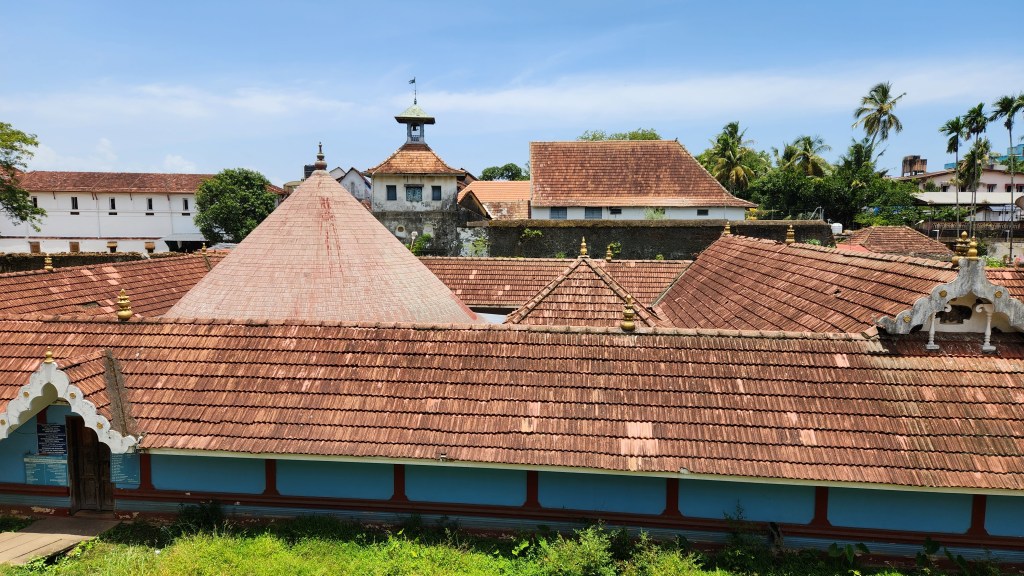
Our next stop was the nearby old Jewish quarter. Kochi has long been a diverse, multicultural society as befits its history as a significant trading port. It is claimed that the first Jews came to the Malabar Coast of India at the time of King Solomon. Records from 70 CE (after the destruction of the Second Temple in Jerusalem) attest to Jewish exils arriving in Cranganore (the ancient port silted in by the flood of 1341 that created the port of Kochi). The Hindu ruler of Cranganore gave Jews permission “for as long as the world, sun and moon endure” to live freely, build synagogues and own property without conditions in his kingdom. They were the first Jews in India. In 1524, Muslims backed by the Calicut ruler attacked the Jewish traders of Crangamore, who then fled to the protection of Calicut’s rival, Kochi. Kochi’s Raja not only gave them asylum, he exempted them from taxation and gave them all the privileges of taxpayers. But as the Portuguese tightened their control of Kochi, they began discrimination against Jewish traders (as a part of their hated Inquisition). When the Portuguese destroyed the first synagogue, the Kochi Raja gave the Jewish community land adjacent to Mattancherry Palace to build a synagogue (and allowed the synagogue to share a common wall with the Palace to discourage further Portuguese attacks). So the Jews supported the Dutch when they began the siege of Fort Kochi in 1660. The Dutch were tolerant of the Jewish traders and the Kochi Jewish community added a clock tower to the Paradesi Synagogue in the square Dutch architectural style. At the same time in the Netherlands, many Spanish Jews were fleeing to Amsterdam to escape the Inquisition’s persecution in Spain. They prospered in the tolerant Dutch Republic and some of these exiles would become prominent enough to sit on the board of the Dutch West Indies Company. The Jewish commuity would continue to flourish in the Netherlands until the German occupation during the Second World War, when over 75% of the Dutch Jewish population was murdered in the Holocaust. Kochi would also host a large and prominent Jewish community until the founding of Israel in 1948, when the largely Orhodox Jewish population immigrated to Israel. The last Jewish wedding at the Paradesi Synagogue took place in 2008. “Jew town,” as the quarter is now known, is now largely a tourist attraction with only a few Jewish families still resident in Kochi.
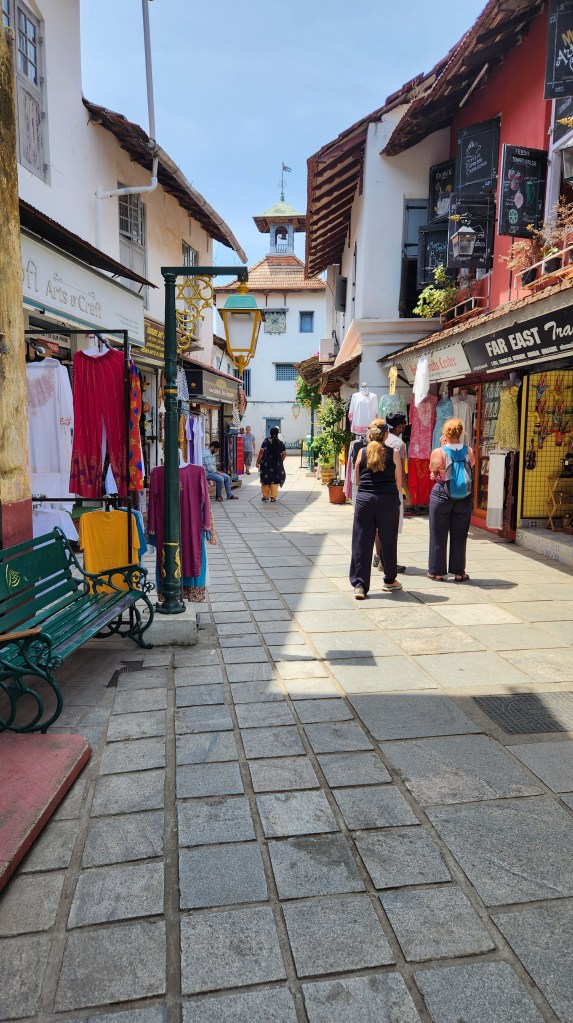
In the streets around the Jewish Quarter, we also came upon a storefront that featured one of the snake boats that are a traditional feature of the harvest season festival known as Onam. These are paddled war canoes that are brightly decorated during the races.
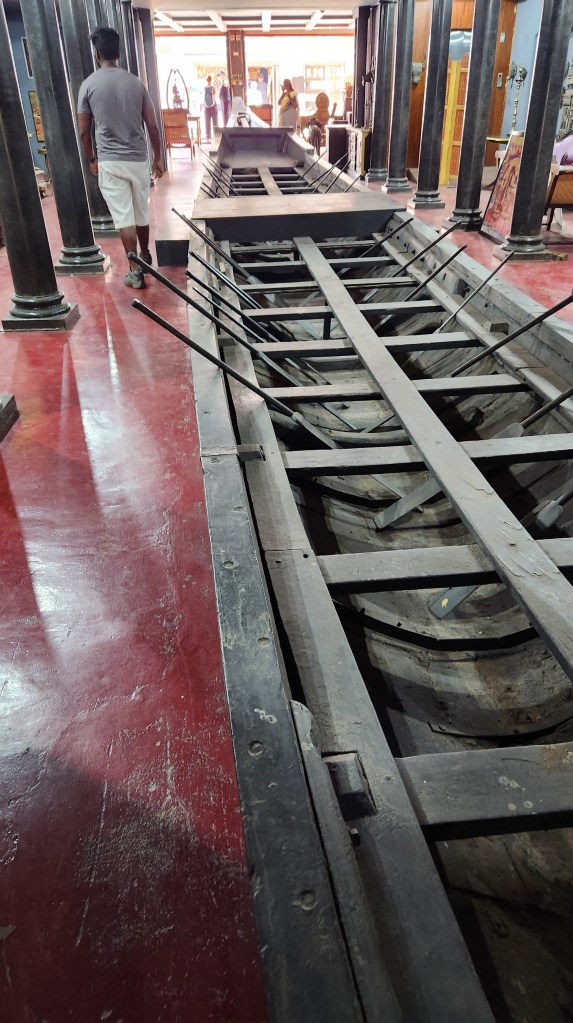
We then visited the only Portuguese Catholic church building in Kochi to survive the Dutch occupation. All the others were destroyed. The building was the site of the temporary burial of Vasco Da Gama (who discovered the route around Africa’s Cape of Good Hope to Kerala). The building was converted to a Protestant Church by the Dutch and continued as such under the British who named it the St. Francis Church. There is a photo of the exterior of the church in my previous post.

No visit to Kochi by a Catholic family (like Kingston’s) would be complete without a visit to the “Lourdes of Kerala,” officially the National Shrine Basilica of Our Lady (Mary, Mother of Jesus) of Vallarpadam (the name of the Island on which the church is built). Vallarpadam is a six kilometer square island that until 2004 was only accessible by boat through the backwaters of Kochi. There is now a bridge, which took some time to cross (given the traffic to the outer commercial islands it also serves). The original Vallarpadam church was destroyed by a flood in 1676. The Portuguese Portrait of Mary was rescued from the flood waters and the Prime Minister of Kochi Raja donated new land on the island for the present building site. He also donated a Sanctuary Lamp that has been kept continuously burning since 1676. In 1752, a mother and child were capsized in a gale but somehow survived. When they attributed their survival to their prayers to Our Lady of Vallarpadam, many others began coming to seek the blessing and protection of Mary. So the Church became a prilgimage center. Even local Hindus now seek the blessings of Mary on behalf of their newborns during the annual Feast of “Our Lady of Mercy.” In 2004, the Church was elevated to a Shrine and then Pope John Paul II elevated the Shrine to the status of a Basilica.


The visit to the Basilica was the end of our tour of Kerala. We crossed the bridge to the island that borders the Arabian Ocean for our hotel stay. Note the twin towers of the Basilica in the upper left. To the right across the street from the hotel is the main fish market in Kochi. You can see the brightly colored high brow fishing boats on either side of the bridge.
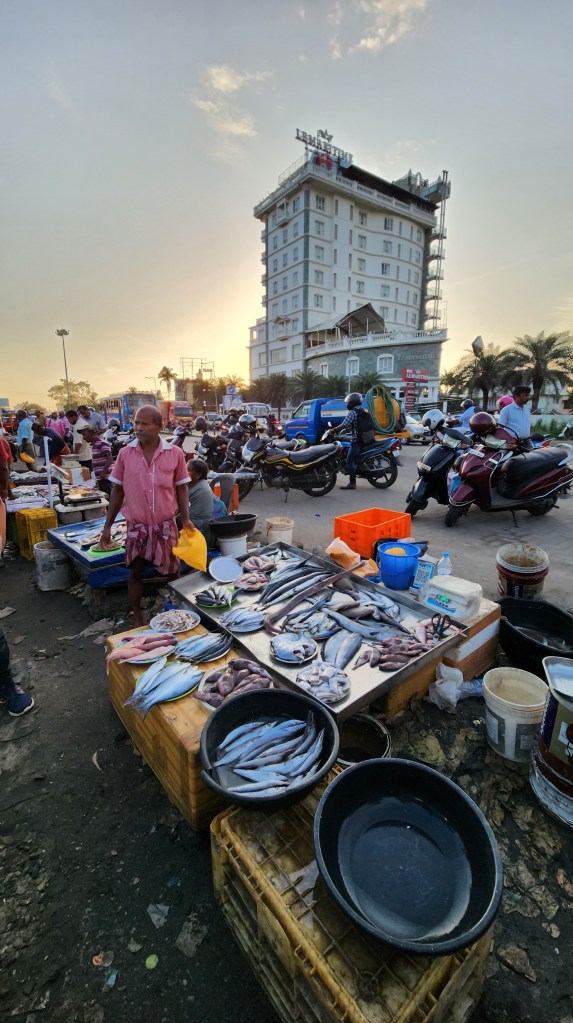
We had some time before dinner, so Dad and Kingston wanted to wander through the fish market.

Then I returned to the bar at the top of the hotel while Kingston and Dad went to get a coffee. One of my favorite things to do on a vacation is to get pictures of the sunset. Kingston’s travel plans had not really given me that opportunity, so I ordered a beer and began to take pictures as the sun set over the Arabian Sea.

First I wanted an aerial view of the colorful fishing boats at anchor at the seafood market. Note the many white egrets fishing the shores of the small island behind the fish market, with Kochi on the horizon. Then the sun began to set and I got to photograph an Indian sunset.

It was time to pay the bar bill and head to dinner. To this point in India, Kingston was always with us and paid any bills. Before we left the US, he joked about giving us a rupee allowance. I still had not gotten my rupee allowance but assumed that I could just put the beer on my room. Turns out that a bar in a hotel in India is not necessarily operated by the hotel. This bar was a separate business and I needed to pay in rupees. I was the only patron in the bar so the bartender came with me down the elevator to our hotel rooms. Kingston had returned from his coffee search and was quite amused that I had ordered a beer with no money in my pocket. My bar tab was settled and we went to dinner. We were one of the few groups in the hotel and there were not enough hotel patrons for the dinning room to prepare a buffet. So for the one and only time during our Kerala tour, we were able to order off the menu. Being across the street from the fish market, I ordered fish. I also had what had become my favorite bread of India, the Kerala Paratha. The only way I know to describe this delicious flat bread is to imagine the flakey crusts of Greek baklava curled in the shape of a cinnamon role (“parat” means layers). You can acutally uncurl the layers of the bread as you eat it. Like baklava, the preparation uses a lot of oil or ghee, so it is not a health food (but what bread is?). It is a Kerala speciality that is so complicated to prepare that even Kingston’s Mom will not make it at home. She orders it from her local bakery.
And this was our last night in Kerala. Kingston’s folks will take the train back to Trivandrum while we are headed to India’s Golden Triangle of New Delhi, Agra and Jaipur. But first we sleep.
 Ginger Without Borders
Leave a comment