
Mumbai is the largest city in India by population but its geographic location on islands along the western coast limits it to a 169 square mile area. A new city, New Mumbai, was built on the mainland across the inlet from Mumbai to allow for further growth. Delhi, in north central India, covers an area of over 573 square miles, the second largest in the world. Only Tokyo is bigger. It is also ancient. Traditionally, seven cities have been associated with the area known as Delhi. The earliest known city mention of a city at the location is found in a Sanskrit epic composed in 400 BCE but describing an earlier period. The oldest architectural relics date to 300 BCE. Legend says the name is derived from a 1st century BCE king named Raja Dhilu.
Shah Jahan, the fifth emperor of the Mughal Dynasty, built the seventh city at Delhi (named Shahjananabad) as his capital in 1638. It would revert to the name Delhi and serve as the capital of the enormously wealthy Mughal Dynasty until 1857. 1857 is a very significant date in Indian (and British) history. The British still refer to it as the Mutiny of 1857, because the war began when the native Indian troops, called Sepoys, rose up against their English officers. India calls it the First War of Independence, since the goal of the rebellion was to return the governance of India to Indians. Other historians call it the the Sepoy Rebellion or the Indian Rebellion of 1857. More details on this chapter in history will come later. One of the major battles was the Siege of Delhi. The British, after extremely hard fought action by both sides, eventually took the city by reducing much of it to rubble with artillery. As “punishment” for the mutiny, what remained of the city was destroyed by British army looting. Well over 40,000 people, including virtually all the male residents of the city, were killed (even many who had remained loyal to the British). British historian William Dalrymple calls it the one of the “worst war crimes ever” committed by the British army. Some British newspapers even called for Delhi to be erased from the face of the earth. Cooler heads prevailed as British authorities searched for ways to regain Indian support. The largely female survivors were allowed to rebuild what they could with the rubble, but proud Delhi, once the magnificent royal capital of India, was reduced to a drab minor regional city.
That would begin to change in 1911. Calcutta (now renamed Kolkata) was the seat of the British authorities in India since 1773. It had become the second largest city in the British Empire (after London). It had also become a hotbed of the Indian nationalist movements. Political assassinations of British officials and boycotts of British goods originated from there. Calcutta’s location on the east coast (only 50 miles from modern day Bangladesh) was also less than ideal for administration of a restive population. Delhi, in the center of northern India, was proposed as a logistically surperior site for administration of the British Raj (officially named the British Indian Empire). Land was acquired about 3 kilometers from the Red Fort, the ancient capital of the Mughals built by Shah Jahan, in the center of Old Delhi. This area was christened New Delhi. King George V, in his role as Emperor of India, personally laid the foundation stone for the Viceroy’s residence on December 12, 1911. Construction began in 1912, but was delayed by the First World War. Construction of the extensive buildings needed for this new capital took over 10 years. New Delhi was formally dedicated in 1931. From a population of 0.24 million in 1911, Delhi’s new role as the capital of British India attracted over 1.44 million residents by 1951.
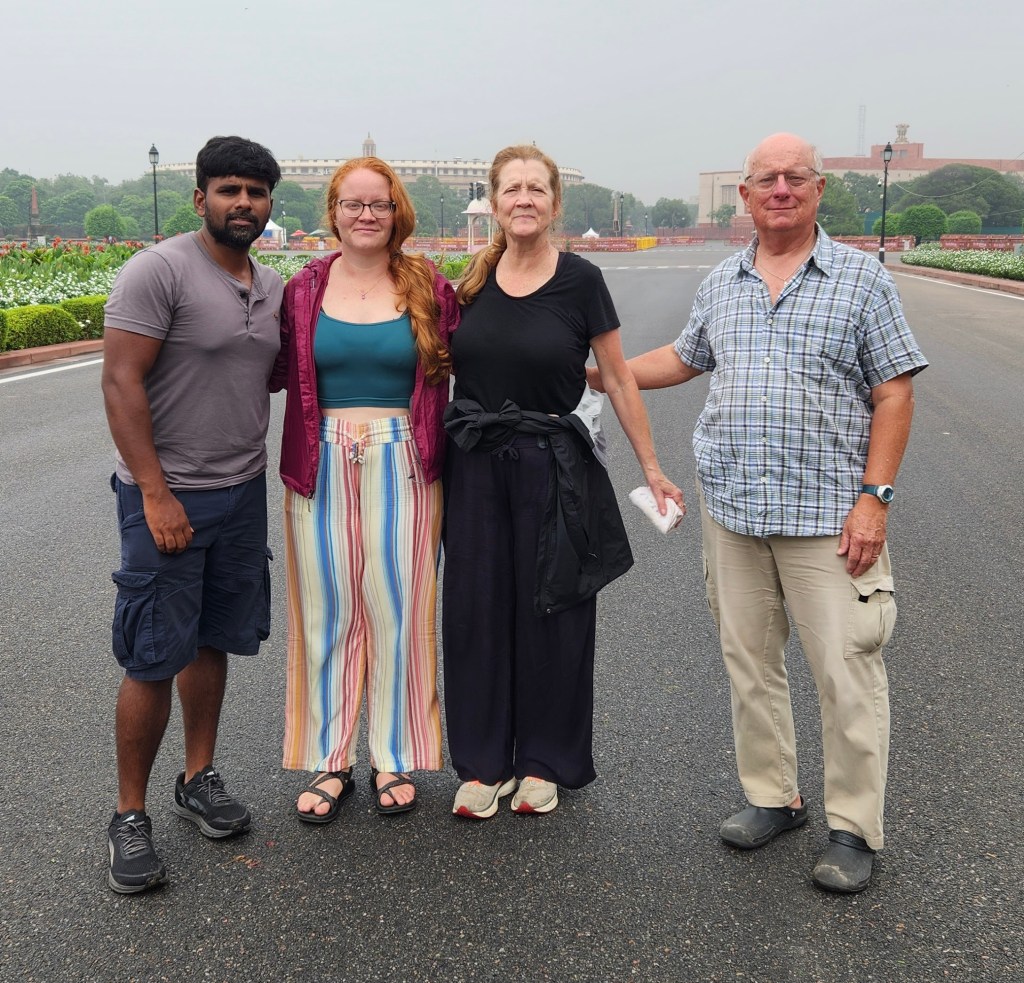
Sir Edwin Lutyens, a leading 20th Century British architect, was largely responsible for the layout and architectural design of New Delhi. His influence over the design group of architects was so strong that New Delhi soon became known as Lutyens Delhi. New Delhi was intended to be an administrative center and the design group was challenged to retain one-third of the area as green space. Even today, it is still a largely open space with broad uncongested roadways (unlike Old Delhi, which can resemble Mumbai’s crowded streets). Lutyens wanted a modern imperial city centered around the ceremonial axis of a large boulevard. The central boulevard was named the Kingsway. After Indian Independence, it was declared the Rajpath (Hindi for “Kings Path”).
Unlike New Mumbai, New Delhi is not a separate city. It is an urban district in the National Capital Territory of Delhi. So although New Delhi is frequently called the captial of India, it is actually a subdivision of Delhi. India recognizes two political subdivisions: a state and a Union Territory. A Union Territory is similar to the District of Columbia. DC has local officials but is subject to supervision by the US Congress. A Union Territory has a local government but it is subject to administration by the National Government of India. As of 2022, India has eight Union Territories, including the Capital Territory of Delhi.
New Delhi is the site of all three branches of the Indian democracy, the Presidential Palace (“Rashtrapati Bhavan”), the Parliament House (“Sansad Bhaven”) and the Supreme Court. The buildings that were built for the British Raj were converted into offices and residences for the newly independent Indian state.

After Independence, the Viceroy’s House became the Presidential Palace. The Presidential Palace is the second largest residence of any head of state in the world. The current President of India is a woman from the lowest Hindu caste.
India has a parliamentary form of government, so the President has only largely ceremonial roles. Prime Minister Modi, who leads the Indian Parliament, has a house in another part of New Delhi. His offices are in the South Secretariat Building.

South Secretariat Building hosts the offices of the Prime Minister, the Ministry of Defense and the Ministry of External Affairs (similar to the US Secretary of State).
Following Indepence, New Delhi was expanded beyond Lutyens Dehli to host a diplomatic enclave for embassies and ambassador residences around another central vista, the Shining Path. In 2019, the Indian government began a redevelopment project for New Delhi, including the construction of a new parliament building to replace the aging building designed by Lutyens. The new building resembles the Vijaya Temple of Vidisha, is earthquake resistant, and incorporates architectural styles from different parts of India. It was built beside the old parliament building but is slightly smaller. Official business began there in September 2023.
 Ginger Without Borders
Leave a comment