
Our departure from the Delhi airport was delayed while we waited for our baggage to come off the baggage carousel (my least favorite part of checking baggage). My bag was the second to come off the baggage carousel. Even though we had checked in at the same time in Kerala, Kingston’s bag was the very last to come off the carousel (just another of the many vagaries of air travel). And once in Delhi, we were going to experience the vagaries of travel guides. Kingston was our able guide in Kerala. Since he had never been to northern India, we elected to have our travel agent arrange several guides for our tour of the Golden Triangle.
Since there were only the four of us, we rented a van for our travels in the Golden Triangle. No sooner than our driver picked up our first guide and the guide said hello, the guide launched into his summary of the royal lineages of Delhi. Even with my backgound as an undergrad history major, it was dense and not easy to follow (very similar to trying to explain the succession of English royal families to someone unfamiliar with British history). I tried to ask questions to clarify parts of the story, but his answer was to repeat what he had just said. His english was good, so I quickly discovered he didn’t want a conversation interrupting his presentation, and I stopped asking questions. When I got back to the hotel, I jumped on Wikipedia with my notes to get my answers.
And the history of northern India is very complicated and filled with amazing stories. ”Hindustan” was the name given to the lower Indus River region by the Persians in the seventh century BCE. The region gave birth to one of the oldest civilizations in the world. Its inhabitants called the river “Sindu” in their Sanskrit language. Historians suggest that linguistic changes converted Sindu to Hindu in Persian and then the Greeks and Romans further corrupted that to India. The religious practices of the area were also named after the river, Hinduism. Hinduism is considered the oldest religion still being actively practiced today (with approximately one billion followers), with scriptural texts dating back 3,000 years.
Delhi’s first rulers were the Hindu Rajput (Sanskrit for “son of a king”) dynasties. They rose to prominence during the 6th Century CE. Begining around 1175 (the Norman King William the Conqueror invaded Anglo-Saxon England in 1066), the Persian Tajik Ghurid Empire, centered in modern day Afganistan (today only Tajik in the north-east and largely Pashtun in the south and east) invaded the Indus River valley. They had converted to Sunni Islam around 1020 and their offical language was Persian. One of the Ghurid generals, Qutb ud-Din Aibak, was a child slave trained as a soldier (a not uncommon use of slaves on the condition that the slave agreed to convert to Islam) by the rival Tajik kingdom to the Ghurids. A stable master, he was captured by the Ghurids and then was lucky to find favor with the Ghurid Emperor Ghori (who only trusted his slave generals). Aibak rose to the rank of general and in 1193, his army defeated Delhi’s Hindu ruler. As would be common, the Rajput King was allowed to continue to rule Delhi as a vassal to the Ghurids. A year later, Aibak had to take direct control of Delhi when the Hindu ruler committed treason. Beginning in 1199, to celebrate his victory over the Rajputs, Aibak began to introduce Islam into India by buildiing one of the first mosque complexes in India. He constructed it on the site of the Rajput’s fortified city, Lal Kot (now known as the “first city of Delhi”), the oldest fortification in the area we now know as Delhi.
To reward Aibak’s successes in India, Emperor Ghori gave him command of all these newly conquered Indian territories. Ghori was assassinated in 1206 and Aibak seized the opportunity. He forced Ghori’s successor to grant him freedom and to ceed India to his rule. Unfortunately, fate did not give him long to enjoy his victory. In 1210, Aibak was killed while playing a version of polo at age 60 when the pommel of his saddle pireced his ribs. During his lifetime, Aibak was widely recognized as a generous and fair ruler whose armies included soldiers from many tribes. He was honored as Lakh Baksh (giver of lakhs, the form of money then). This honorific then became a salutation bestowed on later generations who shared his generous spirit.
Following his sudden death, Aibak was ultimately succeeded by one of his former slaves, Iltutmish, who had become his son-in-law. Iltutmish moved the capital from Lahore (where Aibak died) to Delhi where he built waterworks and more mosques for the city. In 1221, his army stopped an incursion of India by forces of Gengus Khan. Khan would never attempt a full-scale invasion of India. (It is believed by some historians that the Great Khan may have heard that even Alexander the Great had military difficulties attempting to conquer India and decided it was not worth the effort to try to cross the Himalayas during his lifetime.) Iltutmish was succeeded by his daughter because he did not believe any of his sons were worthy. She would be the first and only Muslim woman to rule Delhi. Also considered a just ruler, she was killed after just four years on the throne by followers of one of her brothers. After years of contests, one of Iltutmish’s slaves suceeded in capturing the throne and would rule Delhi from 1266 to 1287. The dynasty (officially the Mamluk Dynasty) was overthrown in 1290. It is more commonly known now as the Slave Dynasty. It was the first of the five unrelated muslim dynasties to rule Hindu India as the Delhi Sultanate.
The Khalji Dynasty (a non-turkic people from Afganistan, believed to be ancestors of the Pashtuns) overthrew the Slave Dynasty and built the second fortified city of Delhi’s seven cities, Siri (the “fort of decaptitated heads”), in 1303 to defend the city from the now frequent incursions by the Mongols. In 1305, their army crushed a Mongol invansion of India. In 1320, a vassal of the Khaljis revolted and deposed the Khaljis, and founded the Tughlaq dynasty (named after this first Emperor, not a reference to any ancestral designation). Having to deal with constant Mongol marauders, he began building the massive bastions of the Tughlaqabad Fort (the third city of Delhi) in 1321. To fulfill his dream of an impregnable city, he overworked his subjects, so a sufi saint placed a deadly curse on him. A tent fell on the Emperor and crushed him to death (an event that some historians suggest was arranged by his son). His son, Muhammad, decided to encircle both Lal Kot and Siri with fortified walls. This fourth fortified city at Delhi (Jahanpanah) was begun in 1326 to address the now constant threat from the Mongol descendants of Gengus Khan. But the Mongols were only a distraction from Muhammad’s goal to rule the whole Indian subcontinent. His initial conquests of his Hindu neighbors were initially successful. Unfortunately for his imperial dreams, he increased taxes on non-Muslims to the point that they rose in constant rebellion and his conquests proved short-lived. He also tried to forcibly move the capital from Delhi, earning the epitah “The Mad Sultan.” Upon Muhammad’s death in 1351, his reluctant nephew, Firuz Shah Tughlaq, had to be persuaded by his troops to accept the throne. He would rule Delhi for almost 40 years. Even though his mother was a Hindu princess, he was a fervent Muslim and granted tax exemptions to all Hindus who converted to Islam. He built canals and set up hospitals for the poor, but he also tolerated (some say encouraged) the greatest age of corruption in medieval India. In 1354, he built a fortified imperial city named Firozabad (not to be confused with a later city by that name near Agra), the fifth city of Delhi. Virtually nothing of Firozabad exists today as subsequent rulers used it as building material for their projects. The Delhi Sultanate would further atrophy during the two Dynasties following the Tughlaqs (the Sayyid and Lodi), but they would continue to rule Delhi until 1526. They were defeated by the Mughals, who woud build the sixth city of Delhi.
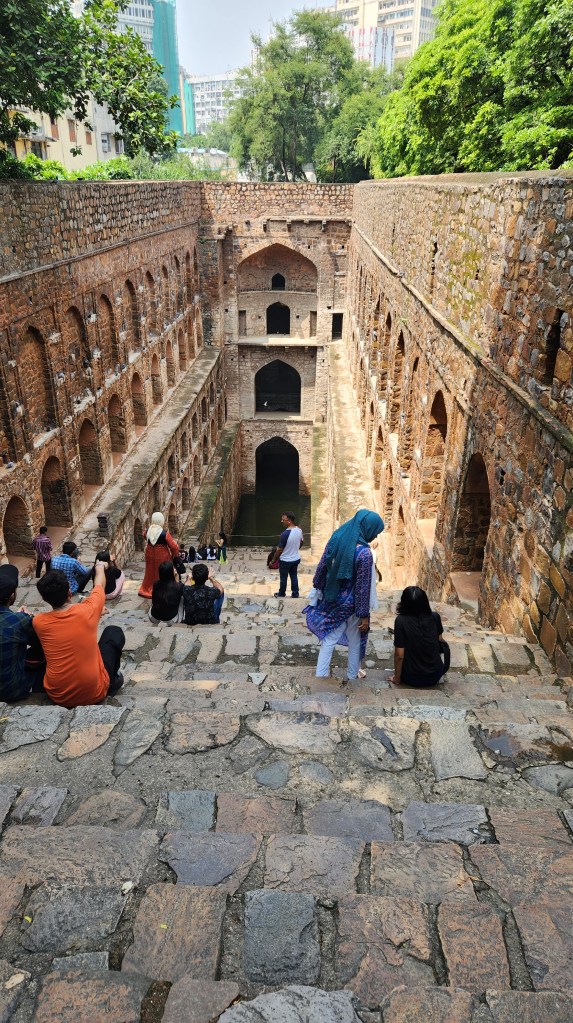
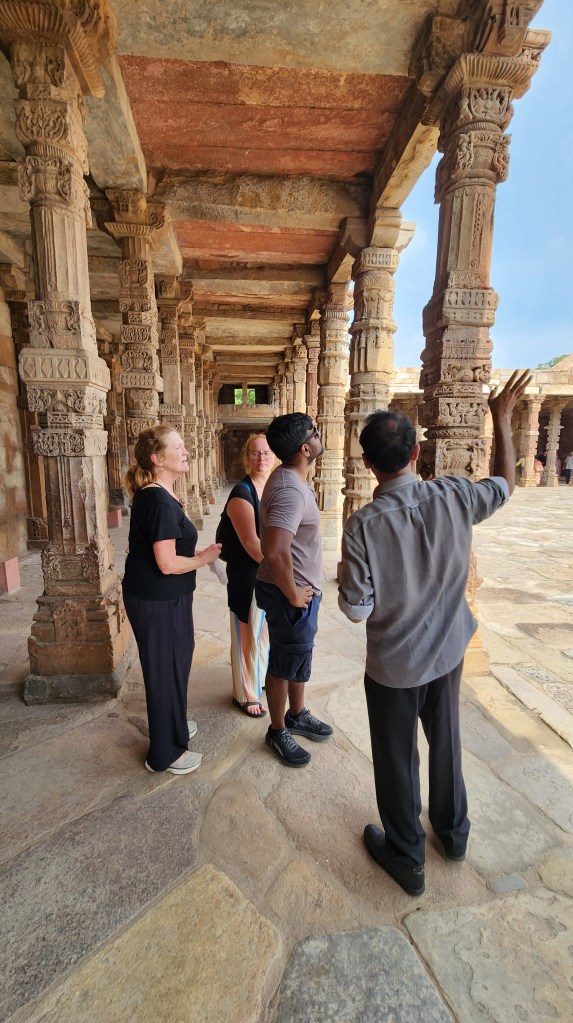
To celebrate his victory over the Rajputs, Aibak built a mosque and compound now named the Qutb Minar (Minar means minaret) complex, named after its distinctive minaret. The mosque’s rectangular courtyard was erected using the columns and architectural details taken from 27 destroyed Jain and Hindu temples (which has become a modern day issue).
South Asian muslim converts were generally slow to add the Middle Eastern minaret to their mosques. The Qutb Minar is the earliest and best example of the fusion of Hindu and Muslim styles of architecture. It is the world’s tallest minaret built of bricks. It also tilts just over 65 cm from vertical, just within safe limits. The spiral staircase has 379 steps. It was originally built entirely of red sandstone. Only the first story was completed during Aibak’s lifetime. Iltutmish added three more stories to the minaret after Aibak’s death. In 1369, lightning damaged the fourth story of the minaret, so the Tughlaq Emperor Firoz repaired it with marble and added a fifth story also made of marble.
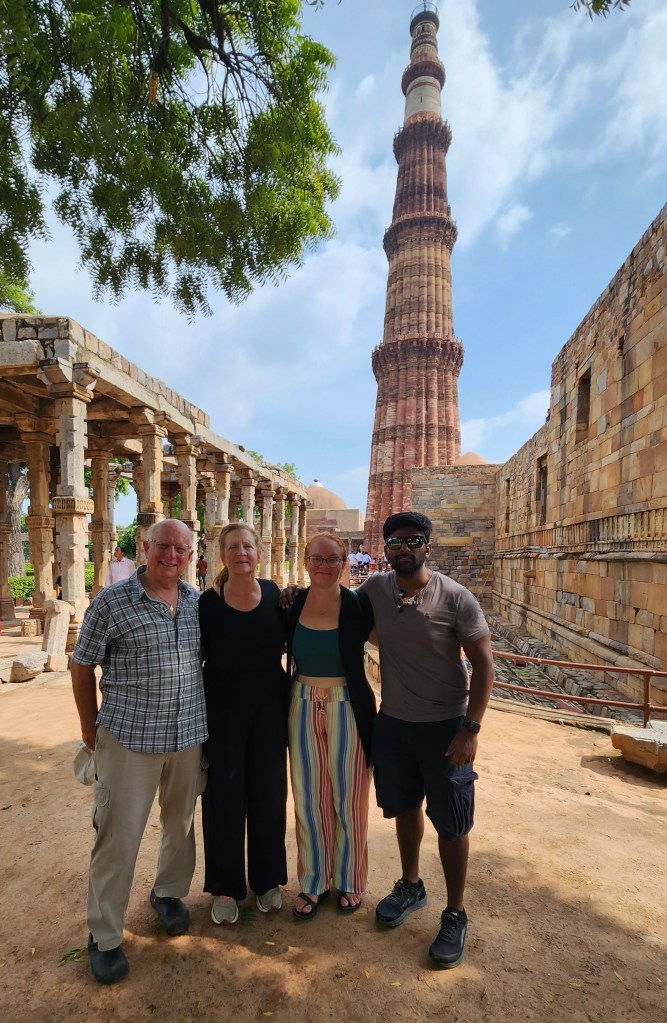
The Qutb Minar (minaret) was built by Hindu craftsmen as Aibak sought to introduce Islam to the local population (historians disagree whether Aibak forced conversions). The craftsmen were unfamiliar with the Quran, so the inscriptions on the stones are disarranged Quranic texts and Arabic expressions.

The Minar is a UNESCO World Heritage Site and one of the most visited tourist attractions in Delhi. Although it is now an architectural museum (run by the Ministry of Culture) and not a functioning mosque, it has become a lighting rod for conservative Hindu nationalists. In 2000, because the mosque complex is built with parts of Jain and Hindu temples, conservative Hindu nationalist groups sought to perform a cleansing ceremony to free the Hindu icons that were “trapped” in the mosque complex. Delhi police were able to keep the activists from entering the Minar, so the ceremony was performed on the streets outside the complex. But that is not the end of this controversy. In 2022, the Ministry of Culture decided to permit excavations within 15 meters of the minaret to search for Hindu relics. This episode is just one of the many fights over holy sites that has divided India, which has a Hindu majority but also the world’s third-largest Muslim population. The Places of Worship Act, enacted shortly after India’s independence in 1947, supposedly froze the status of all religious places of worship in India as they existed on 15 August 1947 and prohibits their conversion to any other faith. The intent of that Act is being challenged with the ascendency of Hindu nationalists.
In 1992, extremist Hindu nationalists illegally demolished the Babri Masjid mosque built by the invading Mughals in 1528. The razing of the Ayodhya mosque led to riots across India that authorities say killed between 2,000 to 3,000 people, mostly Muslims. The Ayodhya site has been disputed between Hindus and Muslims since at least 1853. Hindus claim the site as the birthplace of their Lord Ram, the principal Hindu deity. In 2019, the Indian Supreme Court gave permission for a Hindu temple to be built on the site based upon a report from the Archaeological Survey of India (ASI) suggesting that a “massive structure” below the mosque was found to be non-Islamic while also noting that there was no evidence that the structure was specifically demolished to build the mosque. A site 9 miles away was given to the Muslim community to build a replacement mosque. Construction on the mosque began in 2021. In January 2024, Prime Minister Modi celebrated the consecration of the not yet completed Hindu Ram Mandir temple built on the site of the former mosque. Completion of the tempe is not expected until the end of 2024 at a cost of over $180 million. The huge new temple now attracts large crowds of Hindu worshippers as construction crews struggle to complete it.
Then in late January 2024, the ASI determined that the Gyanvapi mosque, built beside a Hindu temple in the holy city of Varanasi on the banks of the Ganges River (where Hindus from across the country cremate relatives), had been built over a destroyed Hindu temple and that remnants of statues of Hindu gods were found in the basement of the mosque. The Gyanvapi mosque was built in the 17th century by the Mughal Emperor Aurangzeb and has been in constant use by Muslims for prayer ever since. Hindu worshippers claim the mosque replaced a temple to the Hindu deity Shiva (the god of destruction). The court ordered that Hindus be permitted to conduct prayers in the basement of the mosque. Muslims have indicated they will appeal the decision based on the Place of Worship Act.
More on the long story of India’s Hindu-Muslim relations will come later.
 Ginger Without Borders
Leave a comment