
Even with my limited knowledge of Indian history, I was aware that a Muslim dynasty ruled Hindu India for many years from Delhi. But I always wondered what was the difference, if any, between the Mughals of India and the Mongols of Mongolia, whose leader Gengis Khan conquered much of the then known world from China to Romania and Iraq to Russia (while putting great fear in most of Europe). From 1206 to 1227, the Great Khan’s conquests would create and he would rule the largest contiguous empire in world history. The answer to my question is complicated, like most history. So lets return to Delhi almost 200 years after the Khan died and his empire had splintered and been divided between his waring descendents.
By 1398, the Tughlaq dynasty’s territory had been reduced to a shadow of its former range, but still included Delhi, one of the richest cities in the world. The anarchy around the Tughlaq dynasty (and the riches of India) drew the attention of Timur, the founder of the Timurid Empire based in Afghanistan, Iran and Central Asia (modern day Turkestan). Timur was Turkic but had Mongol ancestors from the period when the Khan’s second son ruled Turkestan. He shared a common paternal ancestor with Gengis Khan (some historians believe his mother may also have been a direct descendent of the Khan, who fathered over 2,000 children). Timur boasted of his Mongol heritage and his lifelong goal was to restore the Mongol Empire created by the Khan. Like Alexander the Great and his ancestor the Khan, Timur was undefeated in battle, including decisive victories over the Mongol “Golden Horde” (although he did not attempt to invade Mongolia). He is considered one of history’s greatest military leaders and tacticians. To legitimize his conquests, he relied on Islamic symbols and called himself the “Sword of Islam.”
In 1398, Timur came for Delhi’s riches. When their armies met on the battlefield, his forces panicked the war elephants of the Tughluq army with blazing hay bales mounted on his camels. The elephant panic scattered the Tughluqs and secured Timur an easy victory. He then sacked Delhi, reduced it to ruins (an event to be repeated in 1857), and enslaved its population. It would be over a hundred years before Delhi recovered, and the loss so weakened Tughluq power that they were overthrown by one of their former vassals in 1413 (and became the Sayyid Dynasty). The capture of Delhi was one of Timor’s biggest and most devasting victories. But he did not attempt to rule Indian territory because his ambitions lay elsewhere. He died seven years later during his expedition to invade Ming China in pursuit of his dream to restore the Mongol Empire.
In 1525, a descendent of Timor (paternal side) and Gengis Khan (maternal side) named Babur grew weary of the battles to control his family’s kingdoms in what is modern day Uzbekistan, so he aimed his army of 10,000 well equipped and superbly trained warriors at wealthy India. First, he conquered Punjab. Then following the path of his ancestor Timor, Babur turned his attention to the rebuilt and again wealthy Delhi. His small army had new weapons of war from China that used gunpowder (the cannon and musket). In 1526, this army confronted the Sultan of Delhi, Lodi (the fifth Delhi Sultanate that had overthrown the Sayyid dynasty), and his 100,000 men and 100 war elephants at a flat plane north of Delhi named Panipat. Instead of flaming camels, Babur used his canon to panic the elephants and in the resulting confusion, his muskets killed most of Lodi’s soldiers. Lodi was killed during the battle and the weak and foundering Delhi Sultanate came to an end. Babur occupied Delhi and Agra, where Lodi had moved the Lodi Dynasty capital in 1517. At Agra, Babur was crowned in Lodi’s fort. But the ascendant more powerful Rajput Kingdom of Mewar decided it should confront this foreign non-Hindu ruler. So in 1527 (almost a year to the day after the battle at Panipat), the Rajput army of 100,000 faced the Mughals at the Battle of Khanwa. Babur again used his artillery and muskets to defeat the superior force of the Rajputs. Loses on both sides were extensive, so Babur ordered a tower of Rajput skulls to be erected to celebrate his victory, in the manner of his ancestor, Timur, to terrrorize the surviving Hindus. Like William the Conqueror’s victory at the Battle of Hastings in the history of England, the Battles of Panipat and Khanwa were decisive in the history of India, and not just because they involved the introduction of gunpowder (and artillery and muskets) into India. These victories allowed Babur to found the Mughal Empire that would rule India for over 300 years.
So here is the complicated answer to my initial question. The name Mughal is believed to be derived from the Persian corruption of Mongol. Gengis Khan conquered Persia in 1220. In the process, according to a Persian historian of the period, his forces killed over two million Persians (over 70 % of the population) during his brutal merciless conquest (during his lifetime, the Khan is estimated to have killed 10% of the world’s population with his brutal conquests). Persia regained its independence in 1294 after the Khan died. When Timur began his conquest of Persia in 1383, the Persians wanted to emphasize the hated Mongol ancestry of the Timurid Empire, even though Timur was a Muslim from Turkestan. And Timur proved to be a ruthless conqueror like his ancestor, so the name followed Timur’s army into history. While largely distinct ethnically from the Mongols of northern Asia, most historians consider the Mughals to be one of the last Mongol successor states because of the Mongol ancestry of its founders.
Unlike the five distinct dynasties of the Delhi Sultanate, the Mughal Dynasty’s Emperors were all descendents of Babur. Although the first Mughal capital was Agra, Babur’s son, Humayun, began buliding new fortified walls around Delhi for a city known as Dinpanah, the sixth city of Delhi. After Humayun’s death, his first wife commissioned Persian builders to design and build a monumental tomb for her husband to be built in Dinpanah. Constructed in the Persian style, it was the first garden-tomb in India and the first structure of its size to be built in the red sandstone that would be a Mughal architectural favorite. Humayun’s Tomb is considered the model that Emperor Shah Jahan used for the tomb for his favorite wife, the Taj Mahal. Humayun’s Tomb survived the 1857 destruction of Delhi and was declared a UNESCO World Heritage Site in 1993.
For reasons I have yet to understand, even though it is one of the stars of Delhi architecture, our guide actively persuaded us that since we were going to the Taj Mahal, we did not need to “waste the time” to go out to Humayan’s tomb. I found out later that it was a 15 minute drive from the Red Fort. I guess that experience will have to wait for my next trip to Delhi.
The first four Mughal Emperors ruled from Agra (which we visit next) which is where the last Sultan of the Delhi Sultanate had moved his capital. The Fifth Mughal Emperor, Shah Jahan, decided in 1648 to move his capital back to Delhi. He built a new walled city named Shahjahanabad (“City of Shah Jahan”), the seventh city of Delhi. It would remain the Mughal capital until the Mughal Dynasty ended in 1857. The fortified residence for the royal family that Shah Jahan built inside his new city was also constructed of red sandstone and mable on the banks of the Yamuna River and named the Red Fort. It covers over 254 acres inside 2.4 kilometers of 75 foot tall walls. Like the Forbidden City in China, it was originally a complex of palaces, entertainment halls, baths, canals and geometrical gardens for the pleasure of the royal family. The Fort was bombared by British artillery and severely damaged during the 1857 rebellion. The victorious British exiled the last Mughal emperor and destroyed the Red Fort’s ornate concubine palace in order to build a military baracks. The Indian army still occupies a large portion of the Red Fort. To historians and architects, the Red Fort represents the zenith of Mughal creativity and splendor. It was declared a UNESCO World Heritage site in 2007.

Our guide also did not enourage us to tour the Red Fort since we were going to Agra. The Mughal’s Agra Fort is a smaller and a better preserved version of the Red Fort. Instead, he took us to the mosque built adjacent to the Red Fort and used by Mughal royalty, the Jama Masjid. The mosque was also built of red sandstone and marble by Shah Jahan between 1650 and 1656 using approximately 5,000 workers from around Asia (and even some Europeans). It is the largest mosque in India and its courtyard can hold 25,000 worshipers. It was Shah Jahan’s last architectural extravagance.

Lena and Dawn chose to stay in the van while Kingston, in shorts, and I went inside the walls to tour the massive courtyard. Admission is free but “modest” dress is required so Kingston had to hire his “robe” at the gate. It is an active mosque, so visitation is not permitted during prayers. It is not clear from this picture (since our feet are cut off), but shoes are not permitted. We initially wore our socks but soon found the courtyard easier to walk barefoot. Only Muslim males are allowed to enter the mosque. Note the pool to the middle left in the courtyard.

View to the left of the photo above. In the background is one of the three great gates to the courtyard. The pool in the center is where observant male worshippers wash their feet before entering the mosque (look closely and you can see some men washing their feet behind the standing figure).
There are 396 mosques in Delhi, but almost 1,170 Hindu temples. Our guide was Hindu and felt it only appropriate for us to tour a Hindu temple after we left the Jama Masjid mosque. So the van stopped next at the 100 year old Birla Mandir Temple dedicated to Vishnu (the “Preserver” in the Hindu trinity of gods) and his consort, Laxmi, the Goddess of Wealth. Again, we had to remove our shoes before entering. This temple also prohibited photos inside its walls, so we had to put our phones into lock boxes. Since our guide was Hindu, he was able to escort us on a tour of the interior of the temple and attempted to explain the meanings of the various statutes and paintings. Like his explanation of the Delhi lineages, I was totally lost but knew better than to ask questions. Even though Kingston’s family is Catholic, he has a basic understanding of the Hindu gods and was able to clarify some points for me later.

We only had a day to tour Delhi and I will discuss the other parts of our day in the next post, but since this entry relates to the religious buildings we visited, I will end this entry with our last stop of the day. A member of the Bahai faith from Pakistan willed his entire estate to the faith on the condition that it be used to build a temple. So in 1976, the faith hired an Iranian architect, who now lives in the US, to design a temple that, like all other Bahai temples, is open to everyone, regardless of religion or other qualifications. The award winning design is composed of 27 free-standing marble clad “petals” to form a lotus-like shape, surrounded by nine ponds. It is called the Lotus Temple and has become a prominent Delhi attraction. The shape is nine-sided and round by as specified by Bahai scripture. The lotus has a particular inter-religious significance in India, as it is associated with purity, sacredness, spirituality and knowledge.
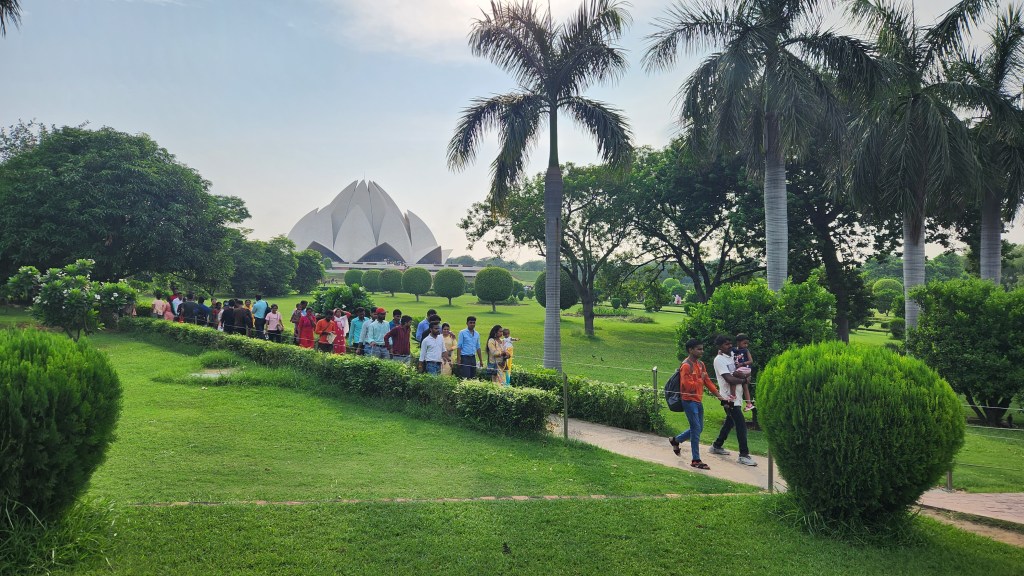
The one main hall inside the temple rises to 111 feet and can seat 1,300 people and hold up to 2,500. It is surrounded by 26 acres of plush gardens of mostly indigenous plants. Kingston and I got in the long line to enter the temple. Groups are timed to reduce over-crowding. The interior is totally open with circular seating in the round. No musical instruments are permitted and no reading or chanting is allowed unless it is religious script. In the Bahai tradition, there is no alter (just a central platform) and no pictures, statutes or images are displayed anywhere in the temple. It is totally powered by solar panels, the first temple in Delhi to do so. While we were inside, most people were sitting in quiet contemplation. Estimates for annual visitation are between 2.5 million to 5 million visitors. CNN has called it “the most visited building in the world.”
In my next post, I will discuss the other Delhi sites our guide decided to feature for us.
 Ginger Without Borders
Leave a comment