
The totally open main level of our hotel in Delhi featured both the reception area (in the front) and the dining room (in the back). The dining area was decorated with large murals on the walls describing the history of Delhi. One of my favourites was the description of Delhi at the time of the Tughlaq Sultan Muhammad. The Western World knows about the Mongol court thanks to the travel journals of Marco Polo. Similarly, much of our present day knowledge of the Delhi Sultanate (and the Islamic world of the middle ages) is thanks to another travel journal written by a North African Berber named Ibn Battuta. He traveled the Islamic world from 1325 to 1354, and arrived in Delhi in 1334. While some Western historians question the validity of the extent of some of his travels, he wrote a detailed account (the “Rilha”) of his almost 30 year and 73,000 mile journey (Marco’s journey was only 15,000 miles). It is considered the most extensive travel journal of any explorer of pre-modern history.

In 1334, Sultan Muhammad was renowned as the wealthiest man in the Muslim world. He was a patron of scholars and Sufis (a mystic body of religious practices within Islam). When Battuta arrived in Delhi, his studies in Mecca prompted Muhammad to appoint him an Islamic judge. But Battuta wrote later that he found it difficult to enforce Islamic law beyond the Sultan’s court in Delhi, because the local population was still largely Hindu. Battuta lived in Delhi for six years. He described Delhi as a vast city, with a great population and bright and colorful markets stacked with a variety of goods from India and abroad. He considered Delhi the most magnificent city in the Islamic world. And word of this wealth would attract Timur some 50 years later.
But our guide never mentioned Battuta. A light rain had started to fall while we were touring the mosque, so we left Old Delhi headed for a tour of New Delhi. Our next stop was still in Old Delhi (in Shahjahanabad) at the Raj Ghat, a memorial garden originally dedicated to Mahatma Gandhi. The black marble table in the center of the garden is on the spot where Gandhi was cremated on January 31, 1948, after his assassination at the age of 78. The location is near the historic ghat on the banks of the Yamuna River. A ghat is a series of steps leading to a body of water for bathing or cremation (usually constructed by Hindu rulers). The Raj Ghat is specifically a cremation ghat. While this is where he was cremated, Gandhi’s ashes were immersed in the Ganges River near where it meets the Yamuna River, a confluence that Hindus consider sacred. A devout Hindu, this is where he wished his ashes to be dispersed. Some of his ashes were also dispersed in other places, particularly in a tomb in the Aga Khan Palace in Pune next to the tomb of his wife, Kasturba.
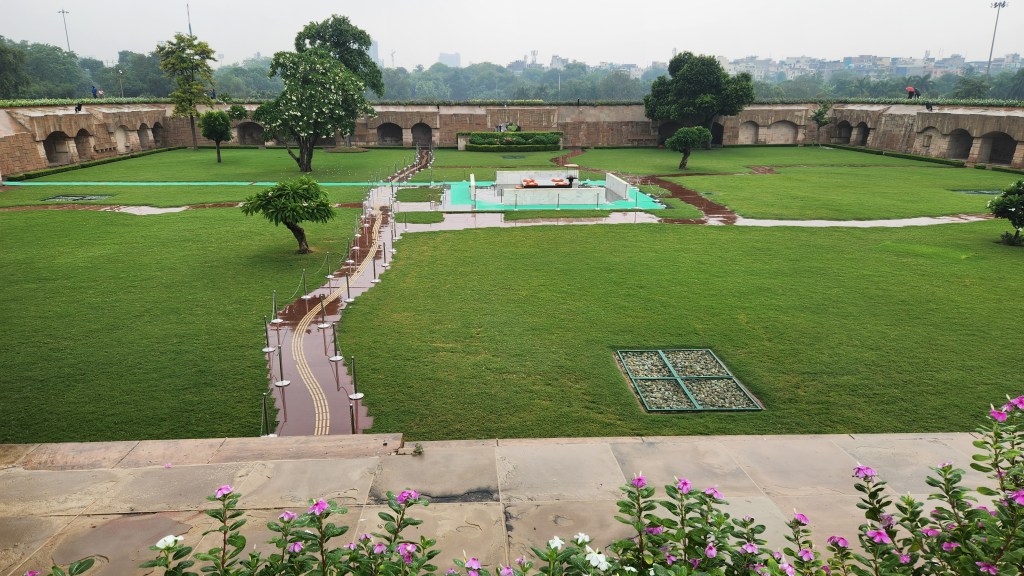
When Gandi’s friend and the first Prime Minister of India, Jawaharlal Nehru, died in 1964, the Raj Ghat was expanded to include a memorial to him. The deaths of a number of other Prime Ministers of India, including Indira Gandhi (3rd Prime Minister) and Rajiv Gandhi (6th Prime Minister), caused additional land to be added for their memorials. In 2000, the Indian Government decided to no longer create separate memorials for different leaders since the existing memorials at the Raj Ghat already occupied 245 acres of prime land in Delhi. The photo above was taken just after about 250 schools girls had left the compound.
We continued to New Delhi where we walked around the government building complex once the rain had cleared (discussed in the post on New Delhi). The guide then was determined to take us to a lunch spot but we had a partaken heavily, as usual, in the hotel’s buffet breakfast and decided to skip lunch. He continued to suggest lunch but stopped once we agreed to allow him to take us to a “government approved” rug shop. We assured Kingston, who was not a fan of stopping at “guide approved” shops, that we do not rely on government labels when we purchase a rug overseas. We have purchased several rugs abroad and understand that the guide usually gets a fee for the referral if we purchase something. Dawn is a weaver and carefully examines anything we are interested in purchasing. We may have gotten a better price if we had waited until our visit to Jaipur but we found a very lovely silk rug. We had it shipped home. Kingston worried during the rest of the trip whether the rug we bought would actually arrive, but it did (and before we even got back to the US).
Nearby the shop was one of the waterworks that Sultan Aibak (of the first Delhi Sultanate) built in Delhi. So we visited that site briefly. But after that, our guide seemed to be running out of landmarks to visit (after passing off the Red Fort and Humayun’s Tomb). Earlier when we were visiting the government buildiings, he had pointed out the India Gate at the far end of Kartavya Path through the fences at the government complex end of the Path. So I suggested that we actually visit that end of the Kartavya Path and the guide acquiesced.
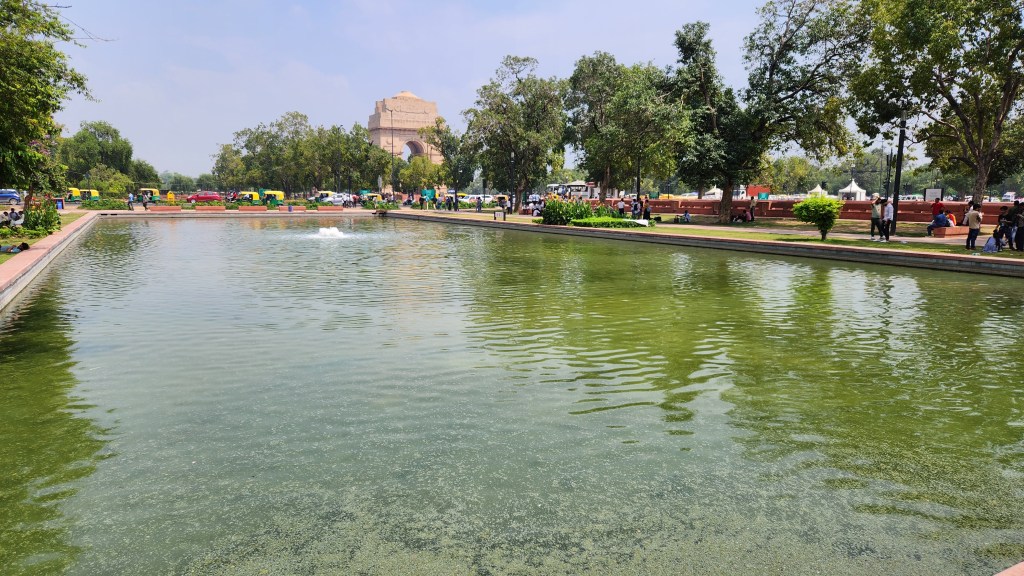
The India Gate was designed by the British architect of New Delhi, Sir Edwn Lutyens. Often compared to the Gateway of India in Mumbai, it is inscribed with the names of 13,300 Indian soldiers (and some British officers) who died fighting in the British Army during the First World War and the Third Anglo-Afgan War (1914 to 1921). Over 84,000 Indian soldiers died during this period. Another 87,000 Indian soldiers died during World War II fighting in the British armed forces. The Commander-in-Chief of British India, Field Marshall Auchinleck, stated that Britian “couldn’t have come through both wars if they hadn’t had the Indian Army.”
Interestingly, there was no move to try to alter the colonial significance of the India Gate for over 20 years after Indian independence in 1947. Then, at the end of the Indo-Pakistani War of 1971 (the third war with Pakistan, which led to the creation of East Pakistan, later Bangladesh, as a separate country), Indian Prime Minister Indira Gandhi ordered the construction of a memorial platform (with an eternal flame), the Amar Jawan Jyoti, beneath the India Gate to honor all the fallen Indian soldiers of independent India. It was her way to move the India Gate past its colonial heritage. This memorial is often referred to as India’s version of the US Tomb of the Unknown Soldier. Since 1972, on Republic Day, before the Republic Day Parade down the Kartavya Path, it is customary for the Prime Minister to lay a wreath at the Amar Jawan Jyoti. A military spectacle, the Republic Day Parade begins at the Presidential Palace, goes past the India Gate and ends at the Red Fort.

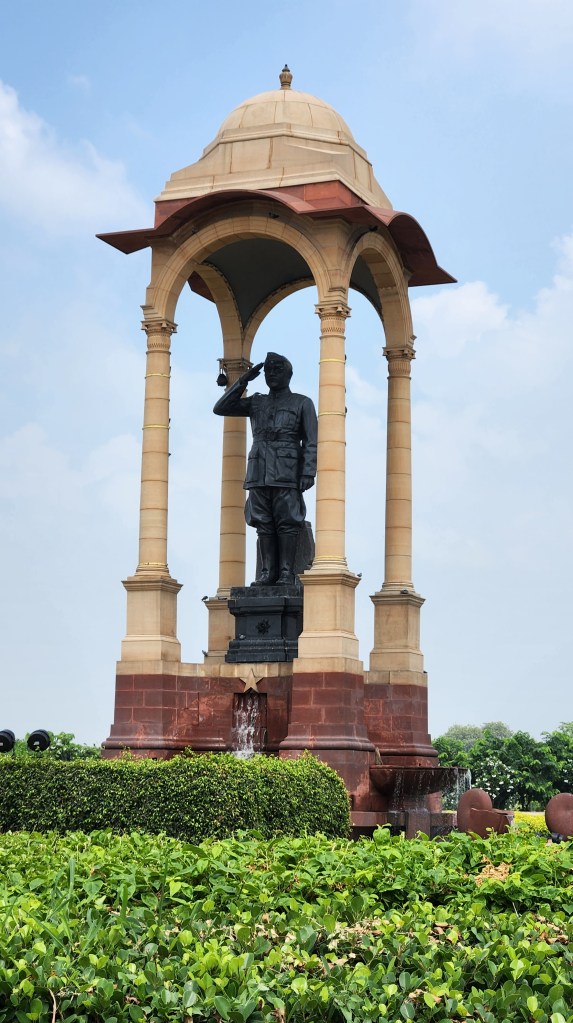
Just beyond the Gate is a cupola that Lutyens intended to be a pavilion. In 1930, the princely states of India erected a statue under the cupola to honor King (Emperor) George V and mark the “loyalty of the Ruling Princes and Chiefs to the Person and Throne of the King-Emperor.” Completed in 1936, it became a lightning rode for the Indian Independence Movement. The statue was periodically defaced (and covered in tar in 1965) and finally removed from under the cupola in 1968. Over the years since 1968, there were suggestions that it be replaced by a statute of Gandhi. In January 2022, Prime Minister Modi announced that a statue of Subhas Chadra Bose would be installed under the cupola.
Bose is an fascinating historical figure. Born in 1897, he was an Indian nationalist (an ally of Ghandi who succeeded Jawaharlal Nehru as President of the Indian National Congress in 1938). His defiance of British rule made him a hero among many Indians. Not a particular fan of non-violence (which cost him this Presidency), his moto became “Give me blood and I will give you freedom.” He traveled to Nazi Germany in 1941 where Hitler provided him with the funds to recruit a Free India Legion, largely from Indian POWs captured in North Africa. But Hilter became distracted by his invasion of Russia and abandoned any plans to invade India, so Bose traveled by German submarine to Japanese-held Sumatra. Again recruiting from Indian POWs (this group was captured during the Battle of Singapore), Bose formed the Indian National Army and created the Provisional Government of Free India. Half his army (along with half of the invading Japanese army) were killed during the Japanese attempt to invade India. Bose died after his plane crashed in Japanese Taiwan in 1945 and he was buried near Tokyo. The Indian National Congress praised his patriotism, but distanced itself from his tactics and alliances with the Axis Powers. In the 2022 January 2022 inauguration ceremony for Bose’s statue (using a hologram statue on the 125th anniversay of Bose’s birth), Modi said “Today we leave the past behind. This statue has given a boost to modern, independent and confident India.” The black granite statue, installed 8 months later, is 28 feet tall and weighs over 65 tons.
We left the India Gate and ended the day at the Lotus Temple. Then our van headed back to our hotel. Our guide asked us how we enjoyed his tour and I responded that we liked it. The custom I am familiar with is that any tip is given when one says goodbye to the guide. Our guide was not willing to wait, because his response was “You need to show me how much you liked my tour.” I resisted the impulse to really show him how much we liked his tour and found a few US dollars, which seemed to please the guide. We dropped him off about ten minutes later. The tour agency did not get a good review.
Lena had a friend from her University days meet her after dinner and left her purse hanging on her chair at the table we were assigned for dinner. As I was about to fall asleep that night, the phone in the room rang and a female voice asked me something in English. The only part of the conversation I understood was a woman’s name, so I responded that I was not the woman whose name she had mentioned. The operator said “That is my name. We have a purse belonging to Lena Raxter.” We were very happy to retrieve it. So a couple of things to note from this story. The first is that the hotel staff were very diligent in following up with their guests. The second is that although many people in India speak English does not mean that an American from the South will understand their accent. Kingston loves this story and had given up on trying to teach me how to pronounce anything correctly in India.
 Ginger Without Borders
Leave a comment