
From the day we agreed to take a week to travel to North India, like almost every other traveler to India, I wanted to see the Taj Mahal. For context, I admit that, when visiting Italy, I almost did not go to the Leaning Tower of Pisa or to the Florence museum that holds the actual Michelangelo statute of David (the one in the Palazzo Vecchio is a copy) because “everyone does that.” There is a reason everyone does that. It is because some marvels are simply beyond the capacity of film to capture, your eyes and body must experience their beauty. So I will show our photos of the Taj Mahal as long as you understand that it needs to be personally experienced to fully understand how magnificent a piece of art and testament to love that it is.
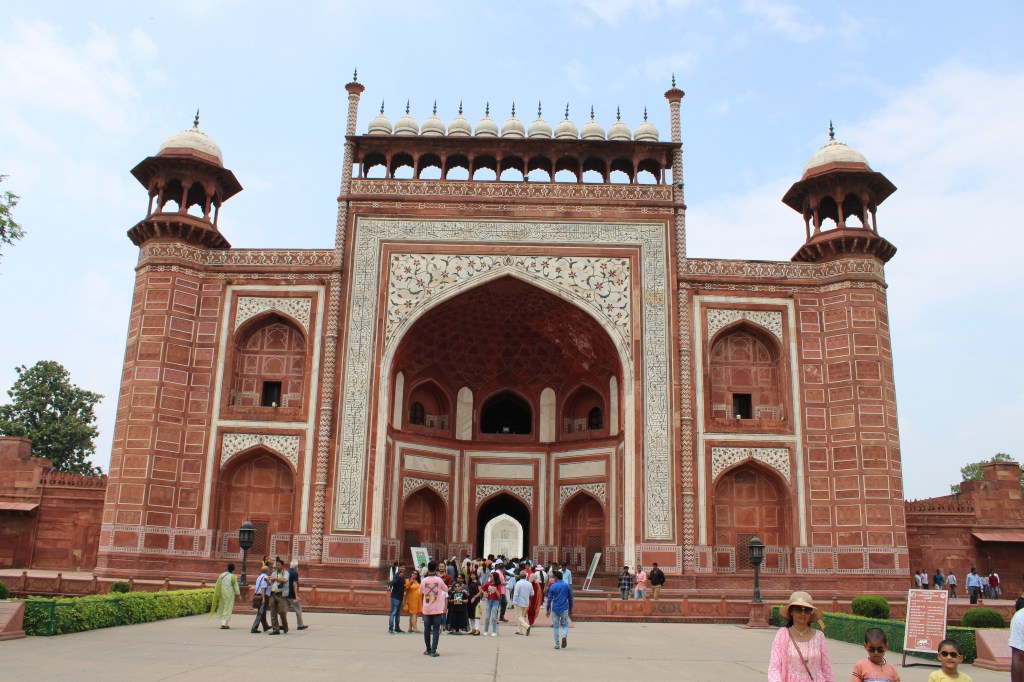
Taj Mahal means Crown of the Palace. It was commissioned in 1631 by the fifth Mughal Emperor, Shah Jahan (meaning King of the World), who also built the Red Fort in Delhi. It is not a mosque (even though there are four minarets, one at each corner), it is a masouleum for his beloved wife, Mumtaz Mahal (her name meant Pearl of the Palace). Construction of the tomb took ten years. On the 12th anniversay of Mumtaz’s death in 1643, even though it was not yet complete, Shah Jahan held the first ceremony at the mausoleum and thousands of mourners were admitted to the site. It took another ten years to complete the complex. 20,000 artisans worked under the direction of the court architect at what is estimated to be a cost of almost a billion dollars in today’s currency. When it was declared a UNESCO World Heritage Site in 1983, it was cited as “the jewel of Muslim art in India and one of the universally admired masterpieces of the world’s heritage.”
The inspiration for the Emperor’s creation was the daughter of a Persian nobleman and niece of one of his father’s wives. Their love story began when 15 year old Prince Khurram (as Jahan was then known) was flirting with the girls of noble families that staffed that part of the Agra bazaar. He spotted her (age 14) selling silks and beads. She partly revealed her face to him from under her headscarf when she laughted at his flirting. Her beauty so dazzled him that he fell in love at first sight. At 15, she was engaged to Jahan in Lahore. Her father was soon to be Prime Minister and his father, Emperor Jahangir, had already promised Khurram would marry the daughter of a prince of the Safavid Dynasty of Persia (to gain influence there). So their marriage was put off until the court astrologers found a more auspicious time after Khurram’s first strategic marriage. After five years (an usually long engagement for the time), they were finally able to marry in 1612 (she was 19), and Khurram changed her name to Mumtaz Mahal (“Pearl of the Palace”). He married a third wife five years later in 1617, another arranged political alliance. Khurram showed little interest in his polygamous rights with these other two wives and only fathered one child with each, as was his duty. He had 14 children with Mumtaz (only 7 survived to adulthood). During her lifetime, poets extolled her beauty, grace and compassion. The court chronicler wrote “the mutual affection and harmony between the two reached a level never seen between a man and woman of the ruling class, or among other people.” She was politically astute, his close confident and trusted advisor and accompanied him on all his military campaigns. In the Mughal Empire, succession was not by birth order, but by princely sons competing for military success and power at court. When his father died in 1627, there was a struggle for the throne between Khurram (the third son) and the fifth (and youngest) son, who was supported by Jahangir’s 20th wife and chief consort (and the power behind Jahangir’s throne for over 10 years). Khurram killed his brother (and imprisoned his father’s widow) and crowned himself Shah Jahan in the Agra Red Fort. Four years later, Mumtaz was traveling with him on a military campaign when she died at age 38 giving birth to their 14th child, a girl (who would live to be 75). On her deathbed, Jahan promised Mumtaz that he would father no more children and build a mausoleum that would be a testament to future generations of the beauty of their love.
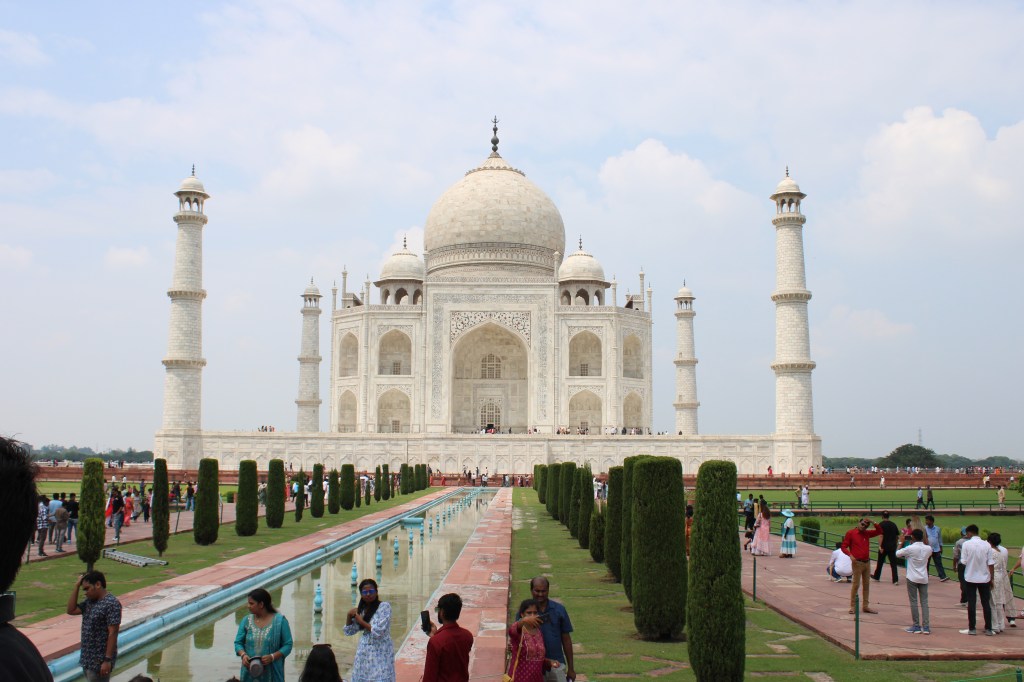
Under Shah Jahan, the Mughal Empire had become a huge military machine (some historians call his rule the Timurid Renaissance). Administration of the vast empire was centralized and court affairs systemized, resulting in general stability for the financial and commercial affairs of his people, even though his taxes were high. During his reign, India’s share of the global gross domestic product grew from 22.7% to 24.4%, surpassing China as the world’s largest. He was one of the richest rulers in the world and a patron to some of the best architects, artisans, craftsmen, painters and writers in the world. He put all this money and energy into the construction of the Taj Mahal. He used the same architect for both the Taj and the Red Fort in Delhi and there are historical hints that he may have personally designed some of its elements. It took 1,000 elephants to haul the white marble from 200 miles away. A ten mile long earthen ramp was created to take transport the marble blocks to the top of the 240 foot high double shelled dome. The white marble is so translucent that the structure actually glows in full moonlight. Go online and search for these images and understand that no artificial lights are ever shown on the Taj Mahal. In the correct moonlight, it may appear to be blue.

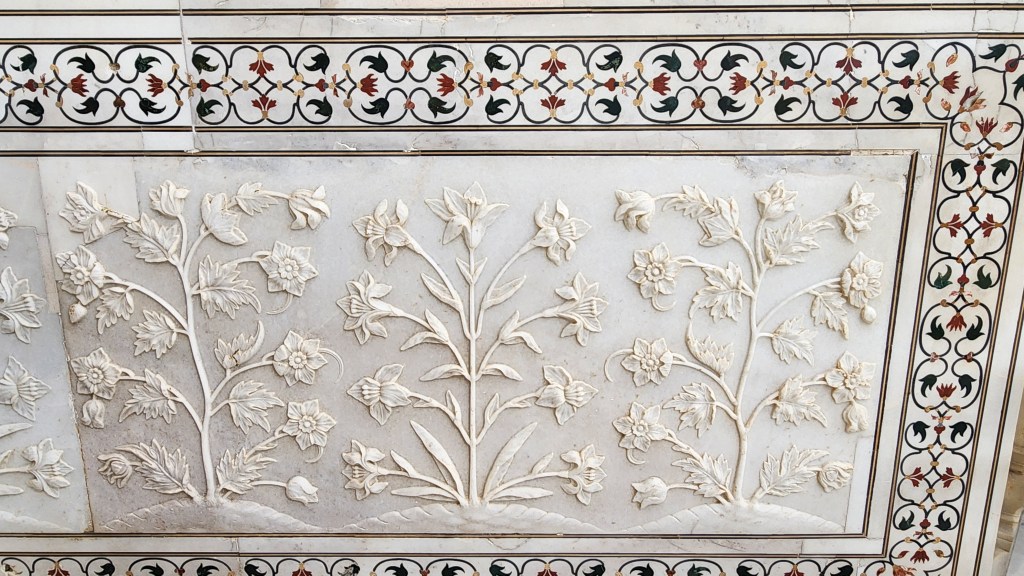
The mausoleum is not pure white marble, it is heavily decorated. The borders on each side feature 22 passages from the Quran inlaid in black marble using script calligraphy (since anthromopomorhic figures were prohibited by Islam). Astoundingly feminine and opulent, the inlaid floral designs above each arch and in the trim borders were made with 43 kinds of precious and semi-precious stone, including jade from China, malachite from Russia and turquoise from Tibet.
Pictures are not permitted inside the mausoleum, but visitors are allowed to enter. The entire structure is a marvel of bilateral symmetry, creating a design that is divisible into two symetrical halves.
Jahan remained in deep morning for two years after Mumtaz’s death. While building the Taj Mahal in Agra, he decided in 1638 to move the capital to Delhi and began construction of the Red Fort and the Jama Masjid mosque. The cost of these buildiing projects put a severe strain on the royal treasury and his increasing use of opium and alcohol caused his actions to become erratic. In 1658, he became ill and named his senior son as his successor. While he was ill, his third son Aurangzeb killed his brothers and usurped the throne. His father recovered from his illness but Aurangzeb made him a prisoner in luxury in the Agra Red Fort that Jahan had almost totally remodelled. He could see the Taj Mahal from the Red Fort (more in the next post), stared at it daily, and is said to have died 8 years later while looking at it. Disturbing the absoulte symmetry of the buildiing, Aurangzeb added his tomb beside hers in the Taj Mahal. Then he moved both their crypts to the basement and built cenotaphs (empty tombs) on the main floor.
In 18th Century, as Mughal power receeded, the Hindu Kingdom of Jat attacked Agra and seized various trophies from the Taj Mahal, including the gold shield that covered the top of the main dome. After the Revolt of 1857, certain British elements cut gemstones from the walls and even tried to sell the white marble abroad until British viceroy Lord Curzon stopped it and ordered a sweeping restoration. He redesigned the acres of Mughal gardens into English style gardens and grass paths. During both World War II and the Indo-Pakistan wars of 1965 and 1971, scaffolding was erected to disguise it and mislead bomber pilots. Today the main threat is acid rain from environmental pollution. The Indian government has created a special 4,000 square mile corridor around it with strict emission standards. Only electric vehicles are allowed to transport visitors to the main entrance from the remote parking lots.

And yes, we let our tour guide take our picture in the spot where every tourist has their picture taken. And yes, it was hot that day. And the minarets don’t just appear to be leaning away from the top of Kingston’s and my head. They were constructed at a slight tilt away from the mausoleum, so in the case of earthquake or other natural disaster, they would not fall into the mausoleum.
 Ginger Without Borders
Leave a comment