
Agra is built on the flat plains near the desert about 140 miles southeast of Delhi on the banks of the Yamuna River. It is an ancient city that is mentioned in the legends of Krishna. It was reestablished as a city during the Lodhi Dynasty of the Delhi Sultanate in 1504. Lodhi made it his capital and it became one of the most important centers of Islamic learning in India. His son was defeated by the first Mughal Emperor Babur in 1526. Babur’s son, Humayun, entered Agra and was maganamous to the local Raja, who gave him various presents, including the famous diamond Koh-i-Noor (which was much later “acquired” by the British, recut and now resides in the Crown of Queen Elizabeth in the Tower of London). Babur made Agra his capital but was annoyed by three things about Agra: “its heat, the strong winds, and the third its dust. Baths were the means of removing all three inconveniences.” And he built the first formal Mughal gardens in India in Agra.
Humayun lost Agra to an Afgan nobleman from 1540 to 1556. Humayun’s son, Akbar regained the city, built the Agra Red Fort, and made the city a center for learning, arts, commerce and religion. The English traveler Ralph Fitch wrote in 1585: “Agra and Fatehpur Sikri (more later on this city) are two very great cities, each of them much greater than London, and very populous.” Akbar’s grandson, Shah Jahan, almost totally rebuilt the Agra Red Fort, much of it with marble. And it was in the Agra Red Fort that Shah Jahan was imprisoned by his son.

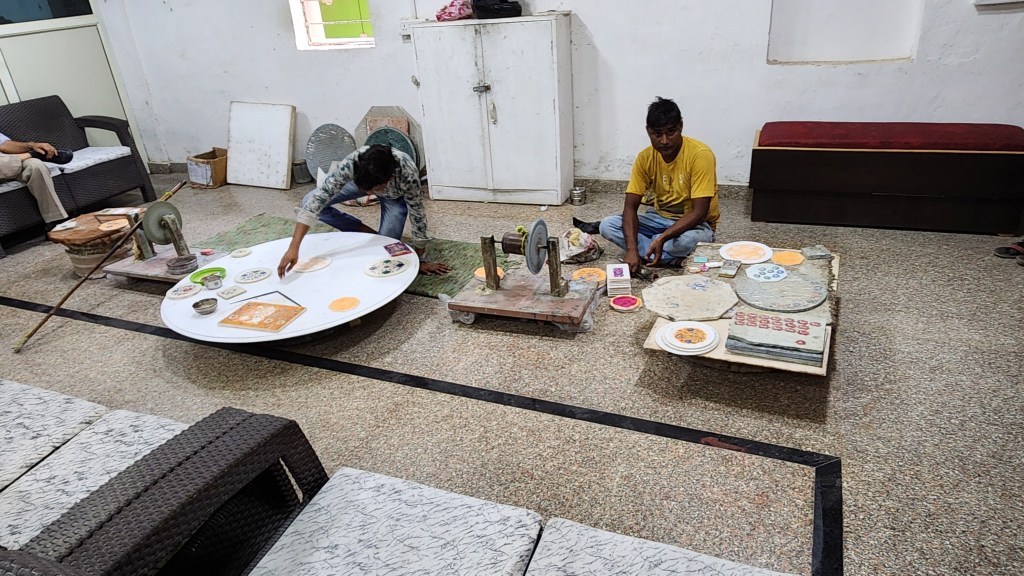
Our guide had encouraged us us to see the Taj Mahal in the morning so we could to escape the mid-day crowds and the heat (sort of – look at my pictures). The Agra Red Fort was our afternoon attraction. But first, our guide had to take us to his favorite marble crafts shop. And yes, we did buy some inlaid coasters. But Kingston and Lena bought some crafts also, so Kingston had to be careful with his comments.
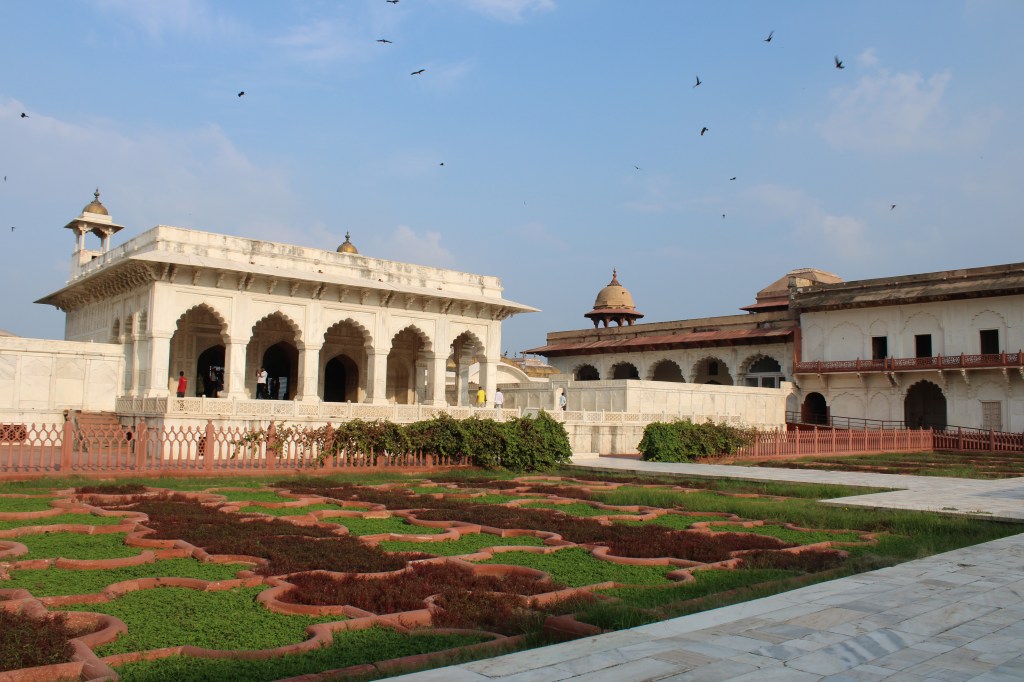

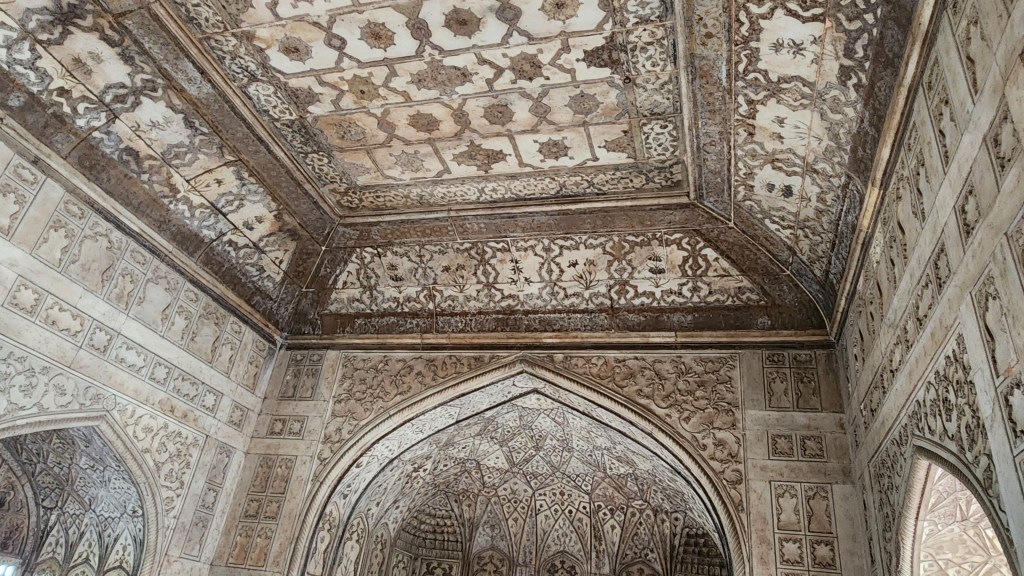
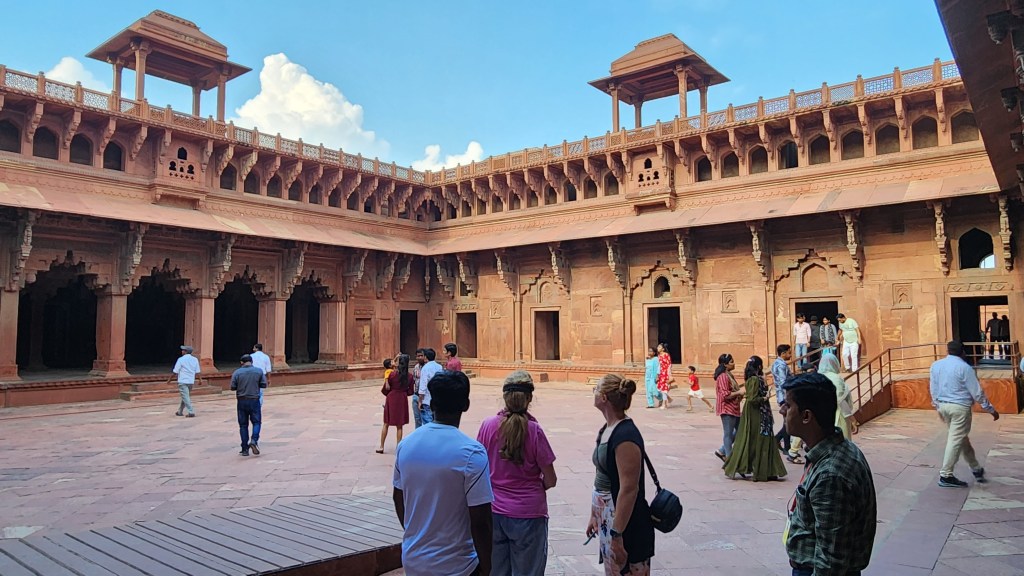
Kingston, Dawn, Lena and our guide in one of the many courtyards of the Agra Red Fort.


The view of the Taj Mahal from the balcony of the Burj.
Shah Jahan shifted his capital to Delhi in 1648. His son, Aurangzeb, moved the entire court to Delhi in 1658 where the Mughal capital remained until the end of the Dynasty in 1857. Agra rapidly declined economically after that and was traded between various waring factions as the power of the Mughal Empire faded. It is now an agricultural center (40% of the population) with a booming tourism trade and industries like marble inlay, carpets and iron foundries.


Marble workshops on the roads outside of Agra. There were miles of such workshops as we headed to our next destination in the Golden Triangle, Jaipur.
 Ginger Without Borders
Leave a comment