
We did not drive directly to Jaipur once we left Agra. About 22 miles west of Agra lies the abandoned remains of Fatehupur Sikri, a UNESCO World Heritage Site. In its full glory in 1585, English traveler Ralph Fitch called it one of India’s “two very great cities, either of them much greater than London.” The other city was Agra.
The north of India was under the control of the Hindu Rajput Empire until the Battle of Khanwa in 1527. It was one of the first battles in northern India where the Mughal forces under Babur extensively used gunpowder to defeat the Rajput forces and claim control of northern India. Like his ancestor Gengus Khan, Babur built a pyramid with the skulls of the Rajputs who fell in the battle. While he made his capital in Agra, the first Mughal Emperor Babur fell in love with the large lake in this area and named it Shukri (“thanks”). Both Babur and his son Humayun built extensive gardens there along the Yamuna River to escape the noise and congestion of Agra. Shukri then came to be written as Sikri.
Babur’s grandson, Akbar, was heirless. Married at 14, he was still without a son at age 27. There was a Sufi Saint named Salim Christi who had built his spiritual center in Sikri. Akbar visited the Saint and asked him to pray for a male heir to the throne. Christi made a prophecy that the Emperor would produce several sons. Akbar’s first of three sons, Jahangir, was born in 1569 (to his Rajput wife), so Akbar built the saint a marble tomb in Sikri as a mark of respect for his prediction of a Mughal heir. It is still in use today and is considered one of the finest examples of Mughal architecture.
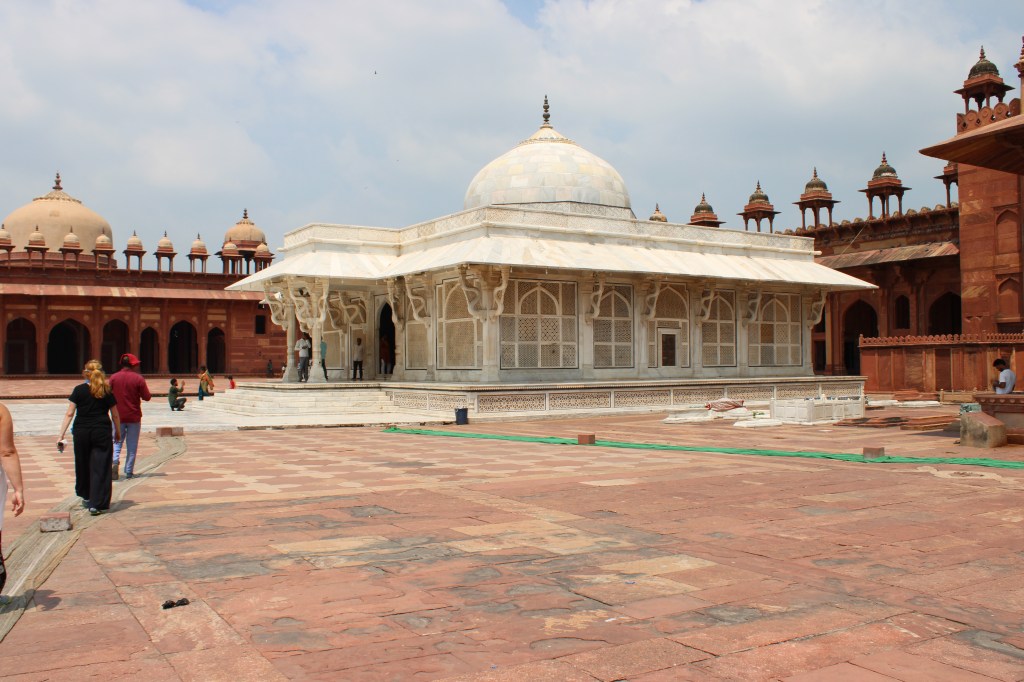
The tomb of Salim Christi.
The Christi order was the first of the seven main Sufi orders represented on the Indian subcontinent. Sufism is a mystical body of Islamic practice characterized by a focus on purification, spiritualism and asceticism. It developed as a reaction to the worldliness of the early Islamic caliphates. To associate himself with this popular Sufi order (and further legitimaze his rule in India), Akbar constructed a walled city and imperial palace in Sikri begining on the second birthday of his son. The royal complex became known as Fatehupur Sikri (the “City of Victory”) after Akbar’s succesful campaign in Gujarat. The 22 mile roadway between Agra and Fatehupur Sikri became “all the way a market of victuals and other things, as full as though a man were still in a town, and so many people as if a man were in a market” in the words of Englishman Ralph Finch.
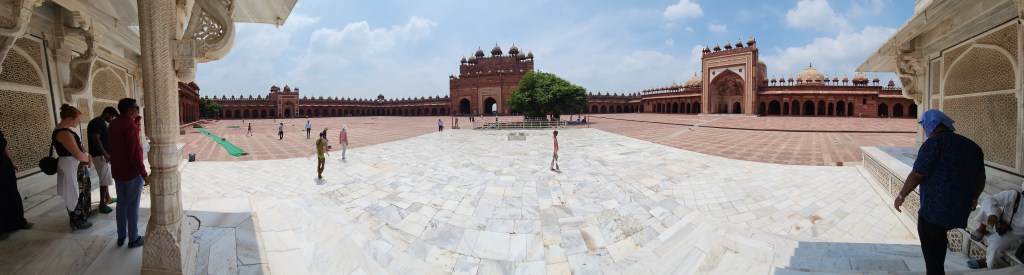
A panoramic view of the main courtyard from the Christi tomb. The gate to the right is the Buland Darwaza (the “Door of Victory”), the highest gateway in the world at 177 feet. It was built to commemorate Akbar’s victory over Gujarat. Interestingly, the inscription over the main gateway is a quote from Jesus in Islamic script: “The world is a bridge, pass over it, but build no houses on it. He who hopes for a day may hope for eternity, but the World endures but an hour.” The gateway is the entrance to the Jama Masjid (not to be confused with the similarly named mosque in Delhi built by Akbar’s grandson – the domes are visible over the wall) which was the largest mosque in India when it was built. It served as a model for later Mughal architecture. It was buit in honor of Christi and was extolled by authors for its beauty and grandeur. In 1579, Akbar delivered a sermon in the mosque (usually reserved for the religious leader). He was also known to join the population for its prayers and even swept the floors (to protray himself as a divine ruler rather than a regular ruler). But he also eliminated the tax on non-Muslims, appointed Hindus to high civil and military posts, and became well known for his tolerance of all religions at a time when religious persecution everywhere else in the world was common.
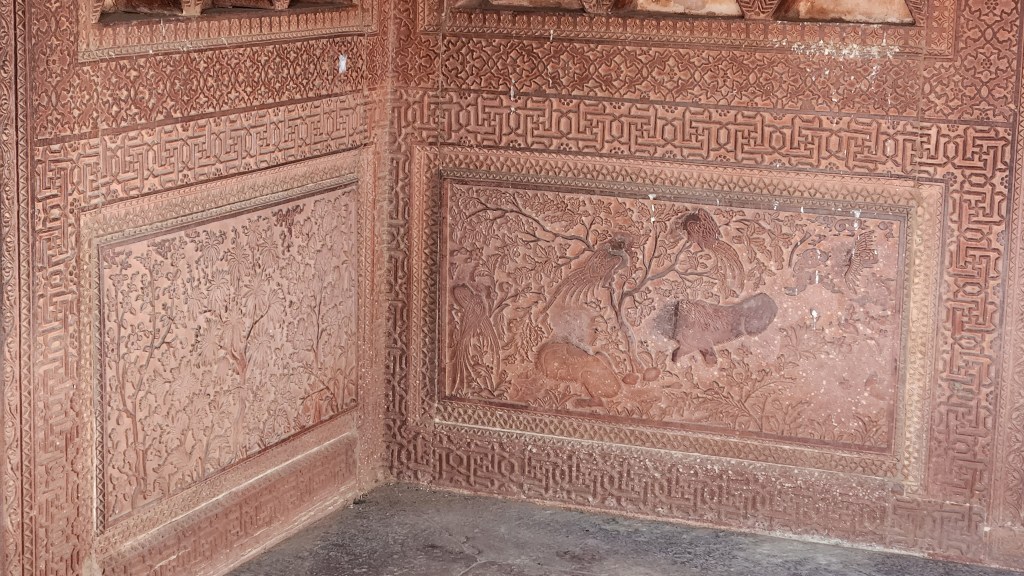
This was the first planned city of the Mughal Empire. It was built on a sloping ridge composed of three levels. The Mosque Complex (and the massive courtyard above) is the highest level, then the royal residences and gardens, and the lowest level was the public complex. The ridge was an exact north-south alignment allowing perfect placement of each complex. Workers were drawn from local artisan guilds (mainly Hindu) and the recently conquered Rajasthan and Gujarat areas, so many of the architectural components look like Hindu temples with their arches, pillars and ornaments. Historians call it a “versatile Indo-muslim composite style, grown from the composite culture of India.”
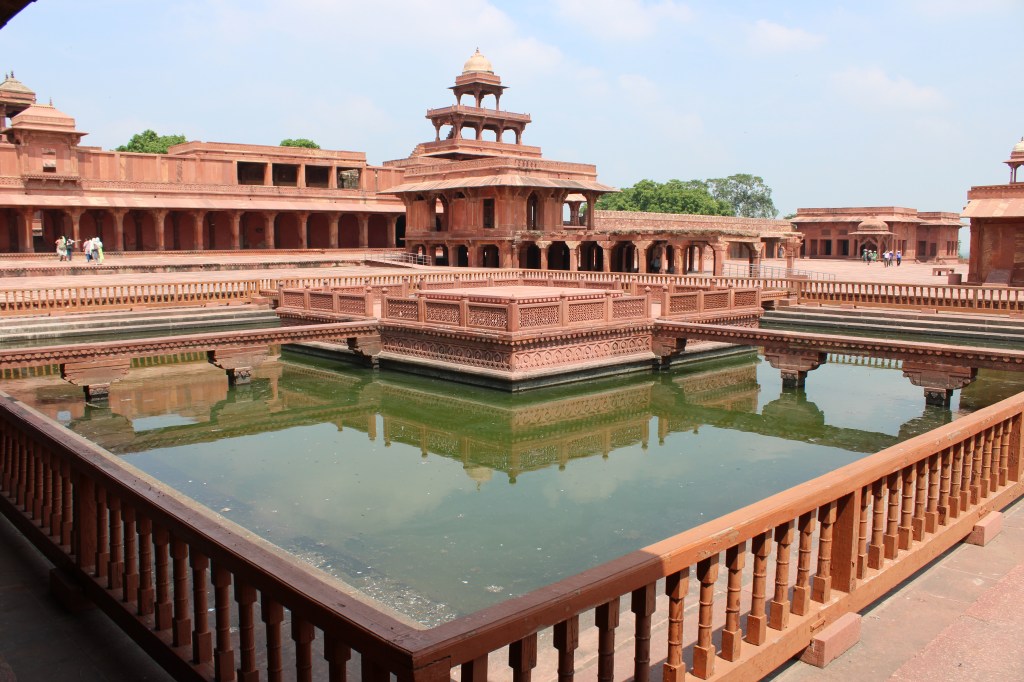
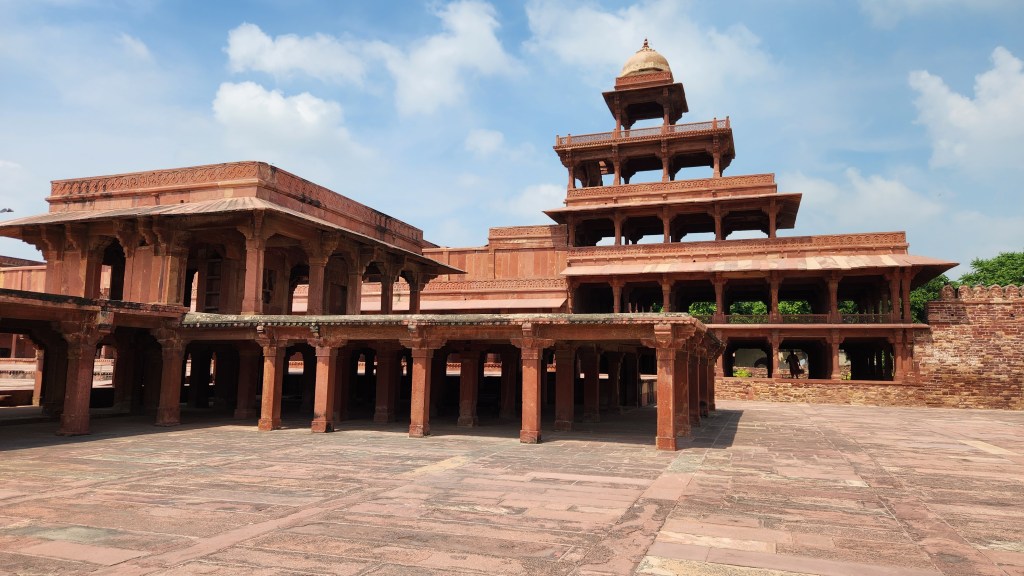
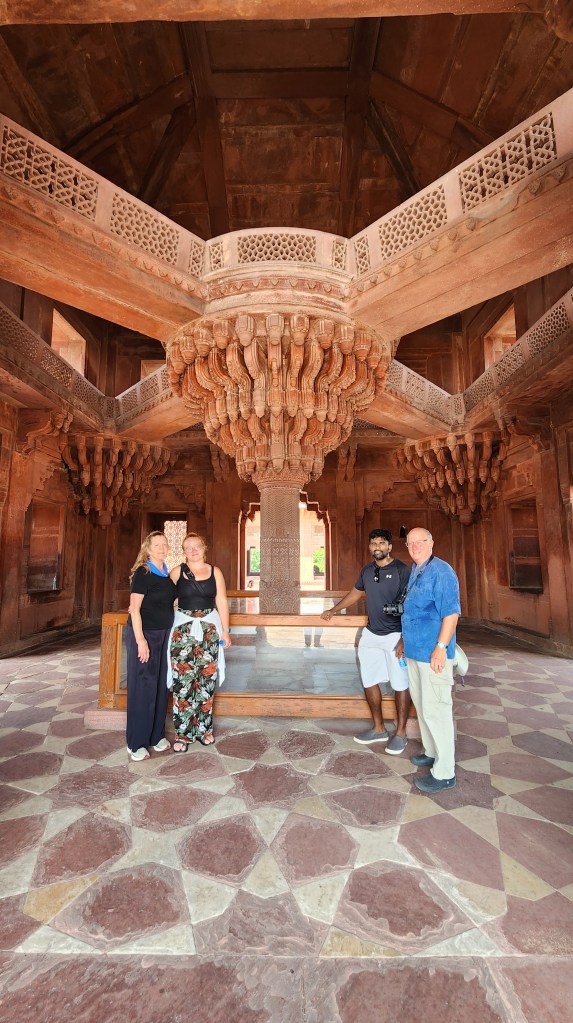
Akbar moved his capital from Agra to Fatehupur Sikri in 1572. He left in 1585 for a campaign in Punjab and only returned once in 1601. He died in 1605 and became one of the few rulers in history to have “the Great” added after his name. His royal complex at Fatehupur Sikri was completely abandoned by 1610 in part because the lake had dried up but mainly because it had been built on Akbar’s whim. Under Akbar’s centralized system of administration, Mughal India developed a strong and stable ecomony that tripled in size under his rule. He also greatly expanded Mughal rule with his “gunpowder army.” It is a testament to the wealth of the Mughal Empire that Akbar built a complex the size and beauty of Fatehupur Sikria that was only used for 13 years. But time is not kind to even masterpieces of Mughal architecture. William French returned around 1610 and noted “It is all ruinate lying like a waste desert.” Akbar’s son Jahangir stayed for three months in 1619 during a bubonic plague epidemic (and his son, to be known as Shah Jahan, studied the design of the mosque that he would duplicate in Delhi). Afgan raiders periodically plundered the abandoned buildings as the Mughal Empire weakened, so a hundred years later, that Mughal Emperor began some repair work. After the British occupied Agra in 1803, they dug wells and established an administrative center on the site which remained until 1850. They also began some restoration of the buildings. The complex is now a tourist attraction maintained by the Archaeological Survey of India.
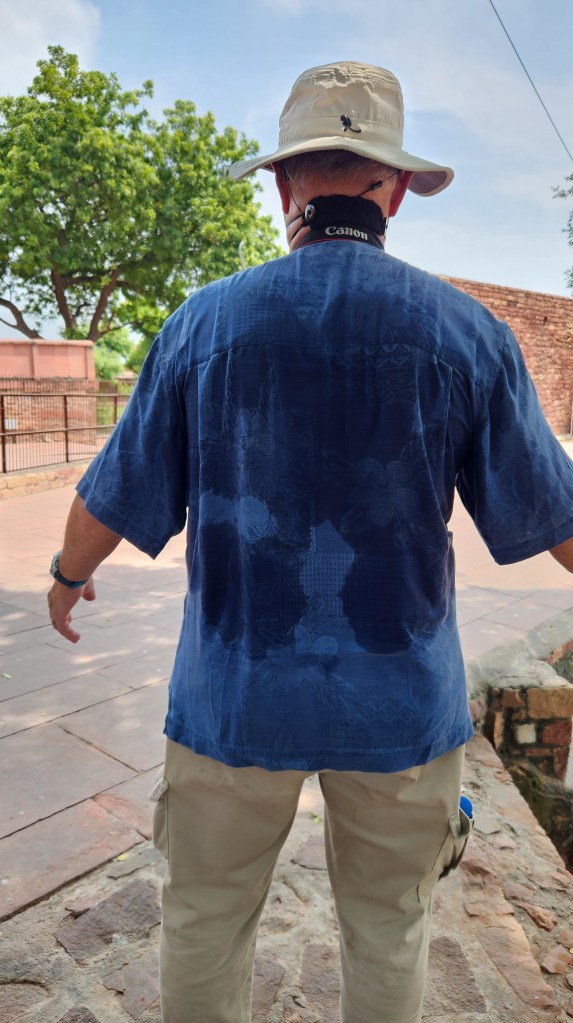
Even though our visit was in the morning, this was by far the hottest day we had experienced in India up to that point. This was me within the first hour of our visit. It only got hotter as the day progressed
 Ginger Without Borders
Leave a comment