
Once we left Fatepur Sikri, we had a 4.5 hour drive to the third point in the so-called Golden Triangle of North India, the “pink city” of Jaipur. Jaipur is part of what was once part of the Mewar Kingdom (now India’s modern state of Rajasthan), once one of the most powerful Hindu Rajput Dynasties in northern India. The Rajput rulers had held off the advances of the Delhi Sultanate for generations. When Moghul Babur invaded northern India, the then Mewar Kingdom’s ruler, Rana Sanga, united the various Rajput sultanates againt Babur. He had some initial success against the first forces that Babur sent into India. But Babur (who had already defeated the Delhi Sultanate) then came with his main forces and, more importantly, his gunpowder weapons (unknown in India at that time). Babur’s army faced Sanga’s allied Hindu forces at the Battle of Khanwa where Sanga suffered a major defeat. The Battle of Khanwa (1527) is considered a pivotal battle in Indian history as it signaled the ascendecy of the Mughals. Sanga was severely injured in the battle and his own nobles poisoned him after the battle to end the conflict with Babur. But Babur described Sanga as the “greatest Indian ruler” of that time.
Babur’s son then lost control of much of the territory that Babur had conquered in a struggle with other Muslim rulers of northern India, including the shah of Gujarat. During these struggles, a Mewar vassal, the Hindu Amber Kingdom, elected to ally with the Mughal Empire. When Babur’s grandson Akbar pursued a liberal policy towards Hindus, the 22nd Rajput ruler of Amber, Raja Bharmal, offered his daughter as one of Akbar’s many wives. Fortunately for the Amber Kingdom, she became Akbar’s chief consort and the mother of his son, the next Mughal Emperor Jahangir. Akbar appointed Bharmal to the highest rank in the Mughal court. And as Akbar expanded Mughal rule in India, Bharmal impressed the Emperor with his competent military leadership. Bharmal’s son and grandson (Raja Man Singh I, the 24th Amber Raja) became leading generals in the Mughal army and Bharmal’s granddaughter became Jahangir’s first wife.
Raja Jai Singh II, became the 29th ruler of the Amber Kingdom at age 11 in 1699. He served the Mughals with distinction under Emperor Aurangzeb (Jahangir’s grandson). After the death of Aurangzeb in 1707, the Mughal war of succession and Mughal conflicts with the expanding Maratha Empire offered Singh an opportunity to free his kingdom from vassalhood to the declining Mughal Empire. So he asserted the sovereignty of his kingdom with a powerful army to defend it.
Given the expansionist ambitions of the Maratha Empire, he also decided to leave the ancient walled city of Amer (the capital of the Amber Kingdom) and plan a new walled city 7 miles from Amer. While he had a formidable army, the walled city of Amer could no longer accommodate its growing population and the increasing scarcity of water. He consulted several architects and designed the layout of the city on the ancient Hindu principals of (i) architecture and (ii) design, arts and sculpture. Construction of the city began in 1726. It was one of the earliest planned cities in “modern India.”
When the Maratha Empire finally lost its wars with the British in the Third Anglo-Maratha War in 1819, the Amber Kingdom signed a subsidiary alliance with the English East India Company to become a Princely State. As a Princely State, the Amber Kingdom remained governed by its Hindu ruler subject to supervision of its affairs by a “resident” British official. Its planned city of Jaipur was dubbed the “pink city” by the Prince of Wales when he visited in 1876 (because the 37th Amber King ordered the walls of the central city to be painted pink in honor of the visit). Most of the avenues still remain painted in pink.
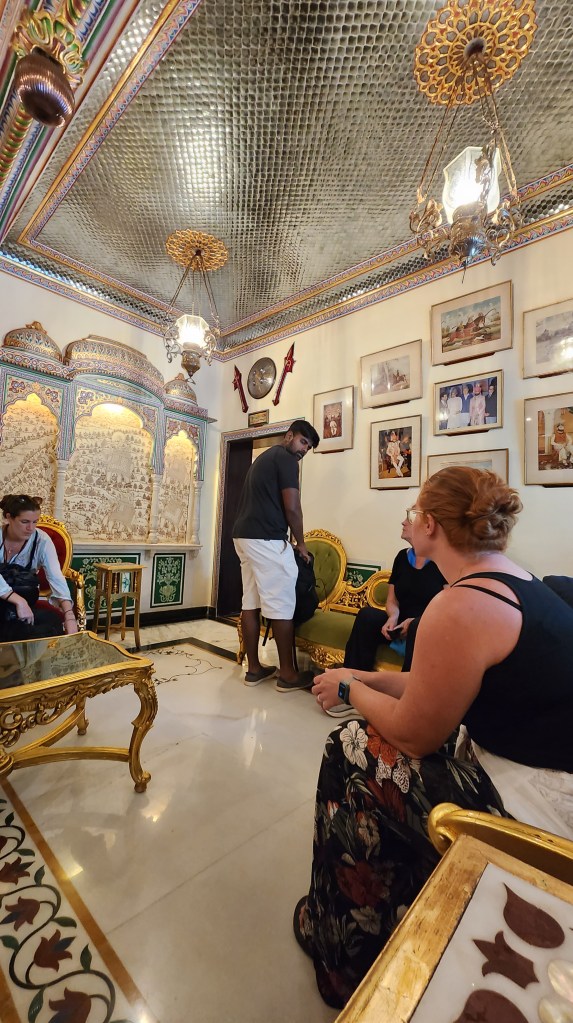
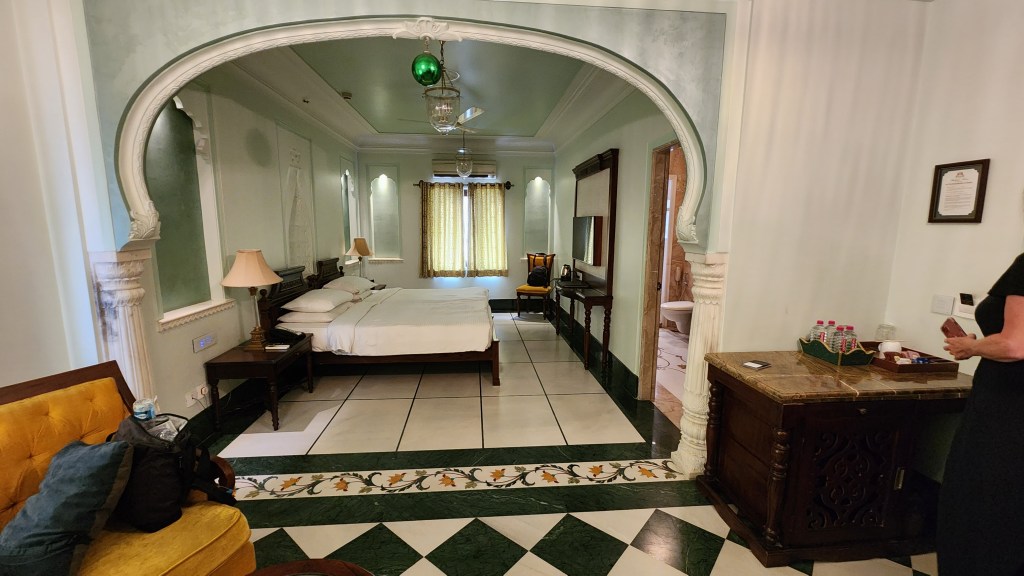
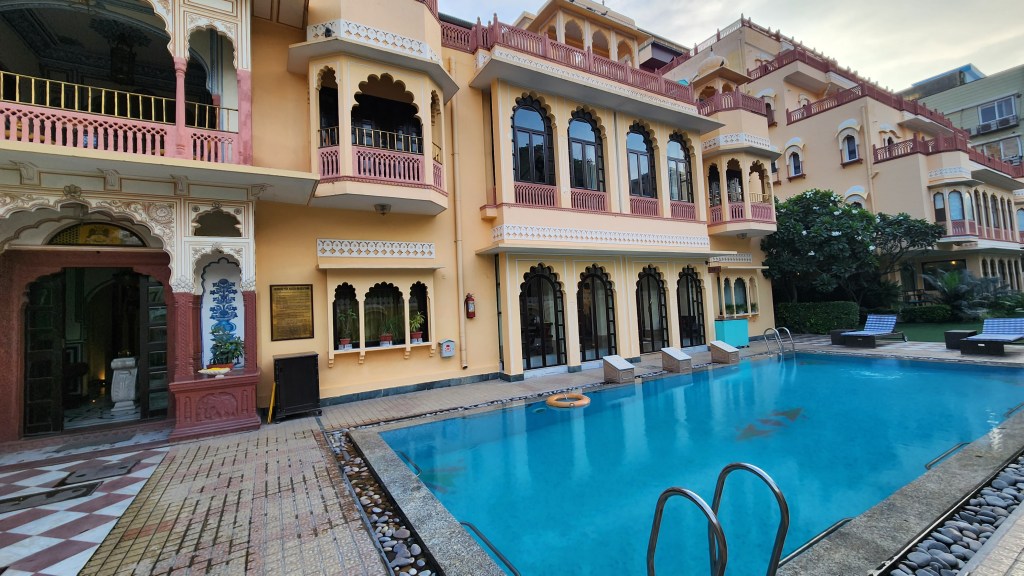
When India gained its independence in 1947, the Amber Kingdom was one of some 565 Princely States officially recognized by British Authorities (these states covered over 48% of pre-independent Indian territory). All were persuaded to merge their states into the new India in return for the payment of generous tax-free state pensions to the former royals (the so-called “privy purse” payments) as compensation for the loss of their ruling rights (and tax collections). In 1971, the Indian Constitution was amended to repeal the privy purse payments, so the former royals had to find other means of revenue. Most had royal residences in many parts of India. Rajasthan, the Indian State where Jaipur is located, has a large nuber of these residences. Some former royals converted these homes into hotels, called Heritage Hotels. We elected to experience one of these Heritage Hotels for our three days in Jaipur. So after a long day of automobile travel, this is where we settled:
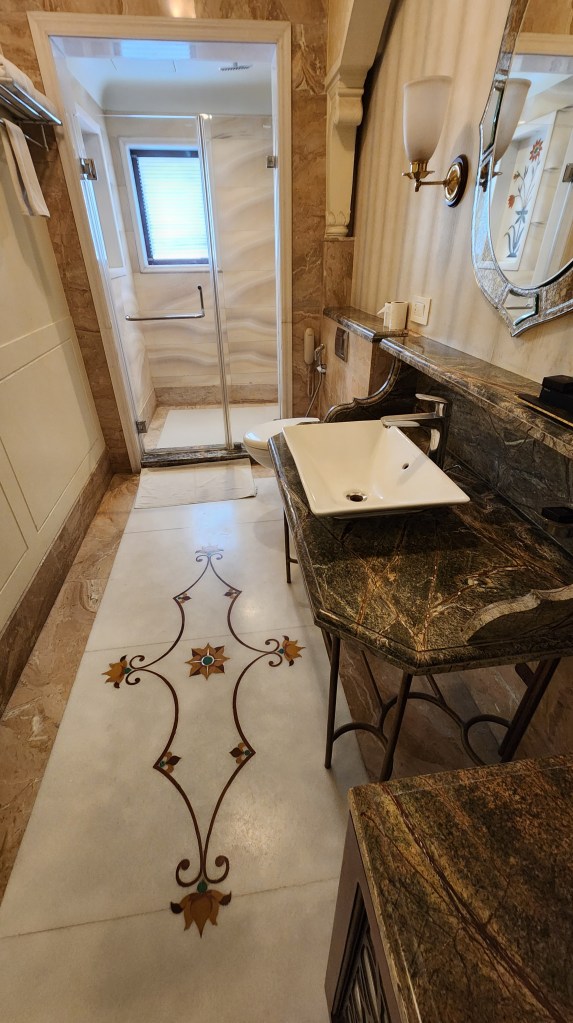
Our bathroom. Look in the mirror to see the inlay in the recessed shelf in the shower. I hope to duplicate this when we remodel our bathroom.

Kingston had told us that the spice level in nothern India would not be anywhere near as dramatic as we had found in Kerala. Lena was actually able to eat dinner in Jaipur. While not as spicy, the food still offered us opportunites to taste new experiences.
 Ginger Without Borders
Leave a comment