
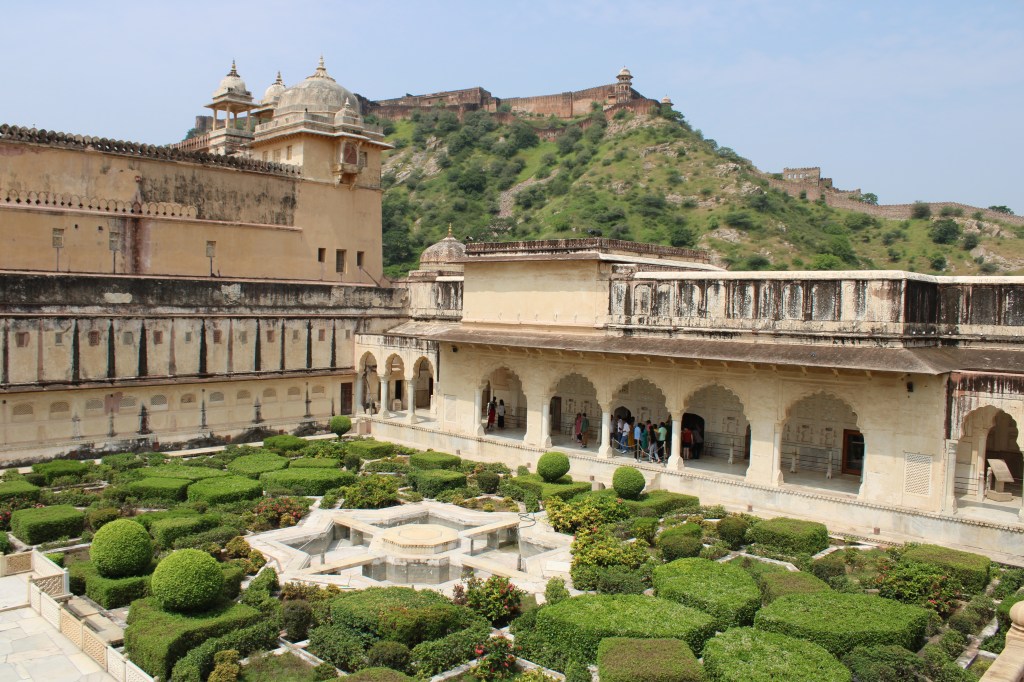
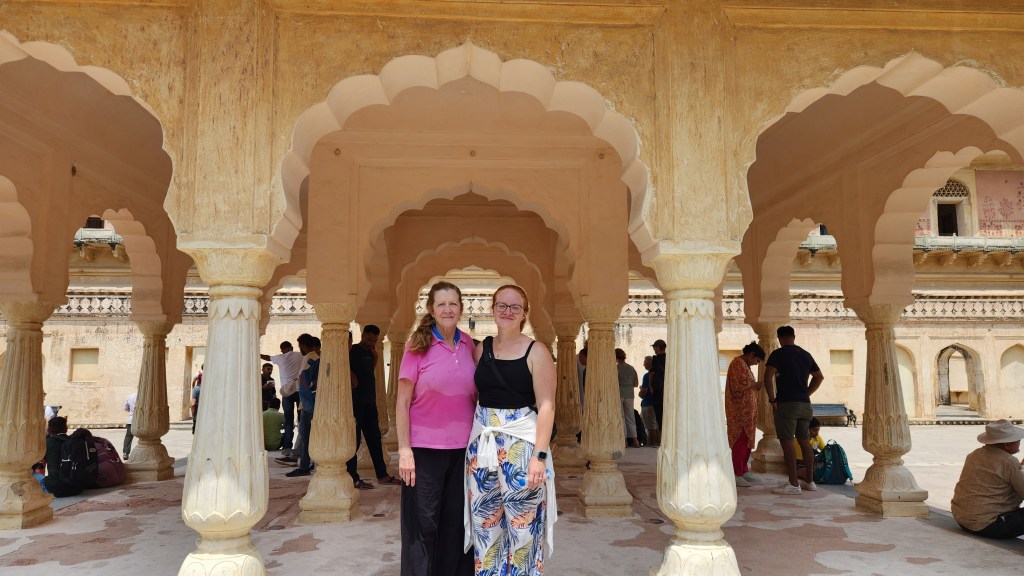
The Muslim Mughals were not the only Indian royalty with extreme wealth and an interest in building monumental architecture. Our second day in Jaipur began with a visit to the fortress built by the Hindu Rajput Amer dynasty during their alliance with the Mughal Emperors: the Amber Fort (also known as the Amer Fort), another UNESCO World Heritage Site. We finally were lucky enough to get the best guide we had in India for our Jaipur explorations. He was a former physician who became a guide in his retirement (India’s Central Medical Services has a mandatory retirement age of 65). He related the Indian history of Jaipur and Amer in conversational tone and actually enjoyed questions.
The city of Amer, the original capital of the Hindu Rajput Amber Kingdom, is 6.8 miles outside Jaipur and features the Amber Fort with its palaces built into a great defensible position in the mountains. The Amber Fort’s large ramparts and gates overlook Maota Lake, which is the main source of water for the fortress. It’s formidible walls (still intact) are 8 miles long with small watchtowers that trace the mountaintops surrounding the old city of Amer.

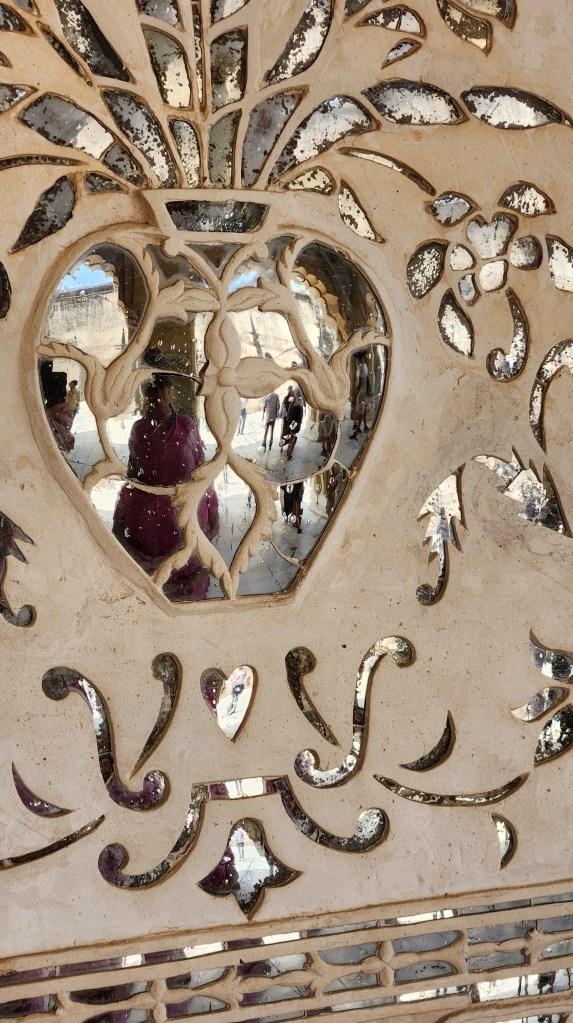
Constructed of sandstone and marble, it is laid out on four levels with six separate courtyards, each with its own gate. Similarly to Mughal palaces, there is the public hall, a private audience hall, and then two levels of royal residences. There are 130 Hindu temples inside the walls of the Fort. The original Fort was built in 1592 by Raja Man Singh I, a close advisor to Mughal Emperor Akbar (one of the Emperor’s “nine jewels” known as the Nauratan). He later expanded it in the early 1600’s to provide a private room for each of his 12 queens. Each room had a staircase connected to the King’s room but the Queens were not permitted to go upstairs. A later Raja had only one queen so he created one room equal to three old queen’s rooms.



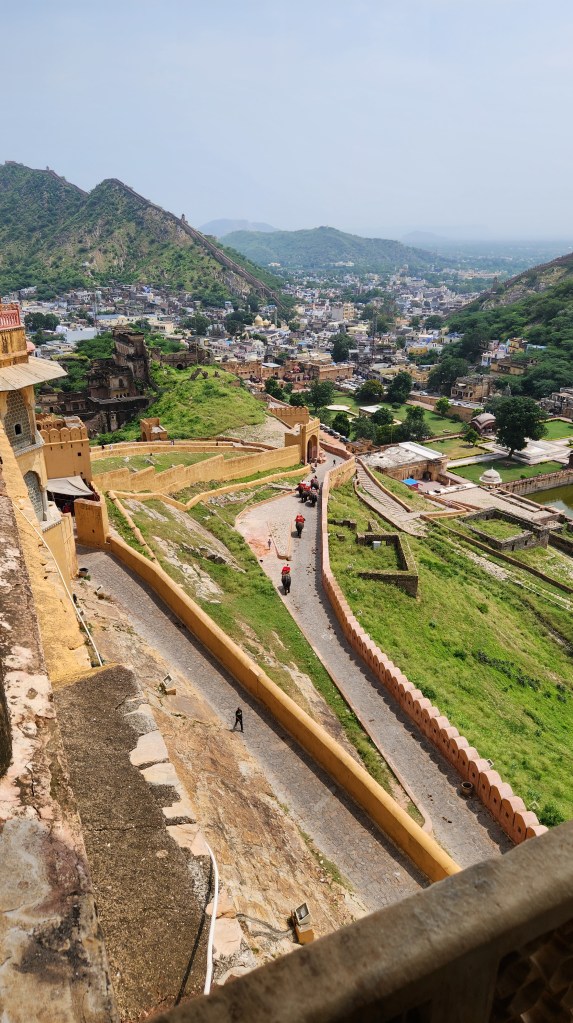

This day was our hottest in India so far. When we stopped at the viewing area on the road to Amer just to the right opposite the Saffron Garden to take pictures of the fort, there was a snake charmer playing for tourists. He put his cobra in his cloth bag and headed towards our group with the White Tourists ($$$). Lena warned him that I was afraid of snakes while I literally started running in the opposite direction. He deduced pretty quickly that we would not leave a big tip and went looking for better prospects. Luckily this was as close to a snake as I got in India. Respect for snakes (Lena would call it fear) is something I inherited from my Mom.
 Ginger Without Borders
Leave a comment