
Lena and Dawn decided they needed a rest day after 21 days of “Kingston travel.” Lena had resisted visiting Hindu, Muslim or Christian religious sites, but Dawn and I have often remarked to each other that many of our European trips have centered around visits to Catholic cathedrals, because we both admire the artworks and the architecture. With the ladies electing to stay at the hotel, Kingston and I decided to stick with our plannned schedule and drive 2 hours west of Jaipur to two famous religious sites, one Hindu and one Muslim.
A little background is in order at this time. India’s current ruling party, the BJP (“Bharatiya Janata Party”) is frequently accused of being a Hindu nationalist party (for things like removing any mention of the Muslim Mughal Empire from Indian school history books). While only roughly half of the Hindu voters in India vote for the BJP, in the parts of northern India where Hindi is spoken, the North and Central (where the Golden Triangle is located) Regions, support for the BJP goes above 65%. And it is visible in the way cows (which are sacred to Hindus) are treated. While we were in South India, the cows we saw were mostly on the sides of the road. During our road trip in North India, they would walk down the highways without fear of any traffic:

Our first destination was Pushkar Lake, a small town identified as one of the ten most religious cities in the world and one of the five most sacred pilgrimage places for Hindus in India. The lake is mentioned on coins as early as the 4th Century BC and related to the mythology of Brahma (from my very limited knowledge of Hiduism, he is the creator god of the Hindu trinity of gods). The town is 95% Hindu. All visitors must pay just to enter the town. The relatively small semi-circular lake ( maximum depth 33 feet) has 52 bathing ghats (steps leading into the water), each of which is believed to possess special medicinal powers. The town boasts over 500 Hindu temples for its many Hindu pilgrims.
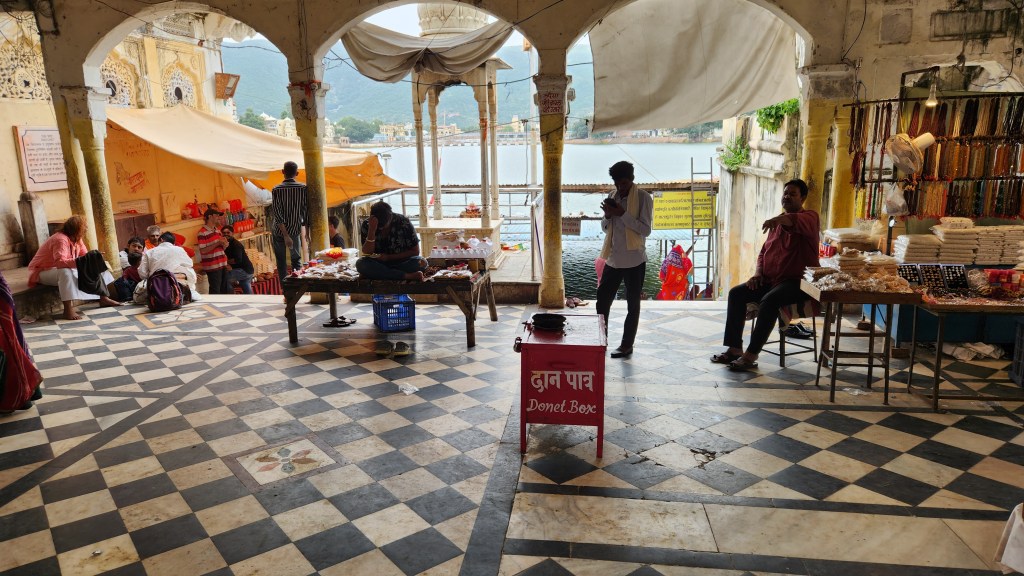
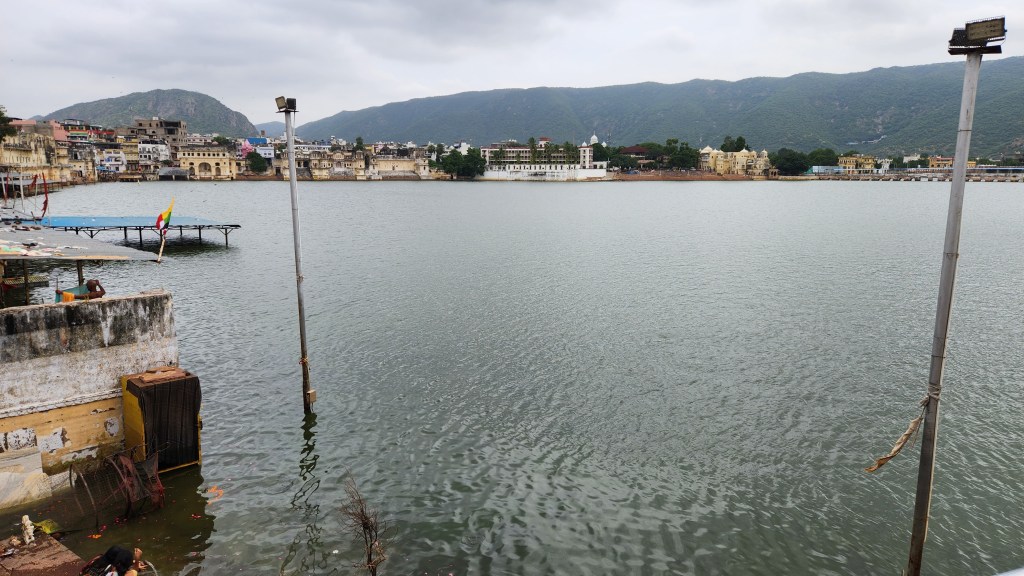
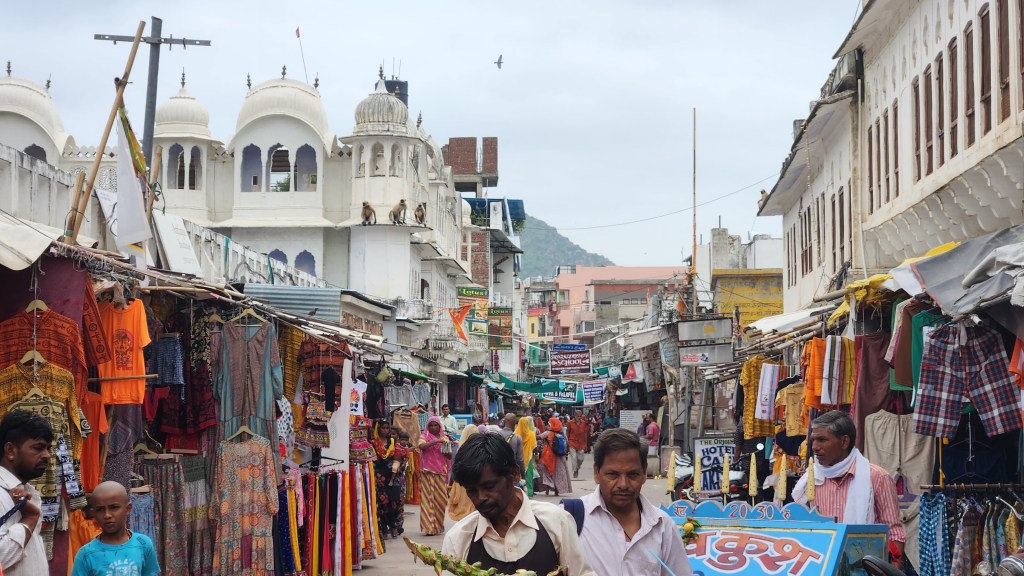
In the center of the town is a temple dedicted to Brahma, built in the 1300s. It is the only major temple dedicated to Brahma in India. In contrast, Vishnu (the preserver god) has countless temples, while Shiva (the destroyer and restorer of the universe) has 108 (105 of which are in Kerala State). The crowds were deep in the many shops surrounding the Brahma temple and there was a long line to enter the temple. Although we had been permitted into the Hindu temple in Delhi, Kingston and I made no attempt to enter the Brahma temple since we had no guide with us. Interestingly, as we wandered the streets crowded with shops, no shopkeepers called on us to buy their wares (one of the few places in India where I experienced being left alone even though I saw no other Europeans in Pushkar).
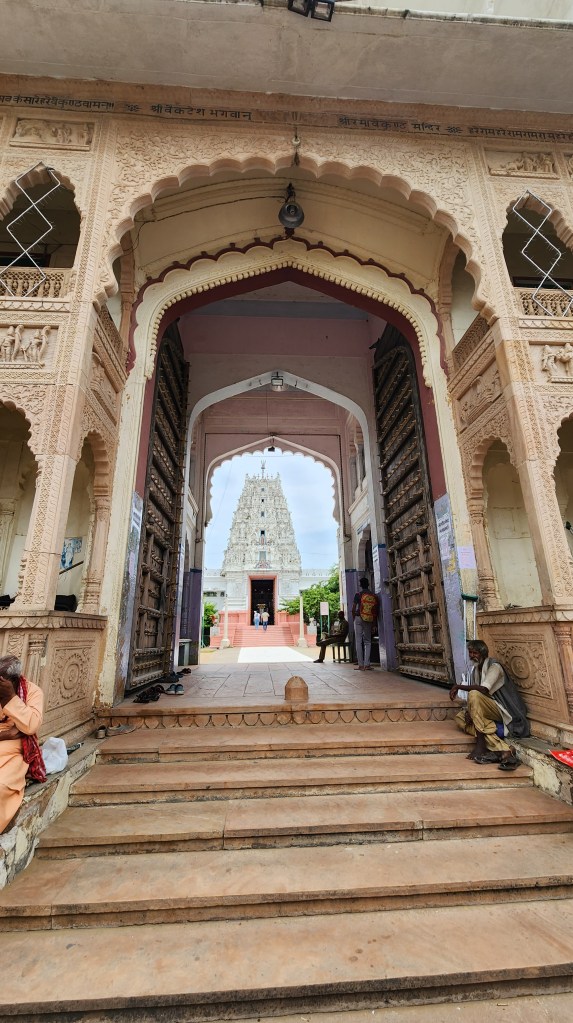
On the outskirts of downtown, we came upon an almost empty Sikh Gurudwara (which is a combination of temple and gathering hall), the Singh Sabha. It celebrates the visit to Pushkar Lake of two famous Sikh Gurus, one in 1509 and the second in 1706. Sikhism is a religion (and philosophy) that originated in the Punjab region of India in the 15th Century. Not derived from any other religion, it is one of the most recently founded major religious groups with about 30 million adherents worldwide. In India, Christians represent the third largest religion (at 2.3%), closely followed by Sikhism (at 1.7%), while Buddism is at 0.7%, and Jainism at 0.4% (see my discussion of Jainism in Mumbai). Sikhism evolved at a time of religious persecution (the Mughal emperors executed two early Sikh gurus who refused to convert to Islam) and gained converts from both Hinduism and Islam. Its founders opposed the Hindu caste system, monastic life, and animal sacrifices. The only diet prohibition is the eating of meat that has been ritually slaughtered (like Halal or Kosher meats). Monotheistic, the Sikh God is neither male or female and the creator and creation are considererd one and the same. The founding Gurus taught that all men and women, rich and poor and all races and faiths are equal under God. Sikh scripture repudiates belief in a physical place called Heaven or Hell (or a Judgment Day). The most commonly known Sikh requirement is the mandatory wearing of a turban. The turban is not just a relgious symbol, it is the identity of a Sikh.
Like other religions, there is much more to the faith than my summary above. But as a history major, Sikhs aroused my interest for their warrior culture. While founded on peace and respect for all religions, their warrior class was forged by self-defense and defiance in a time of religious persecution. Sikh warriors had a duty to protect the innocent. In almost all their battles, Sikh warriors were outnumbered yet usually crushed their enemies, thereby gaining a reputation as valuable allies. Although the Sikh Empire was defeated by British East India Company forces and subjugated as a princely state in 1846 (the last Kingdom in India to be taken by the British East India Company), they became allies of the British in their defeat of the Mughal forces (their ancient enemies) in the Revolt of 1857. During World War II, over 100,000 Sikhs served in the British Army and complete regiments were lost because they refused to surrender.
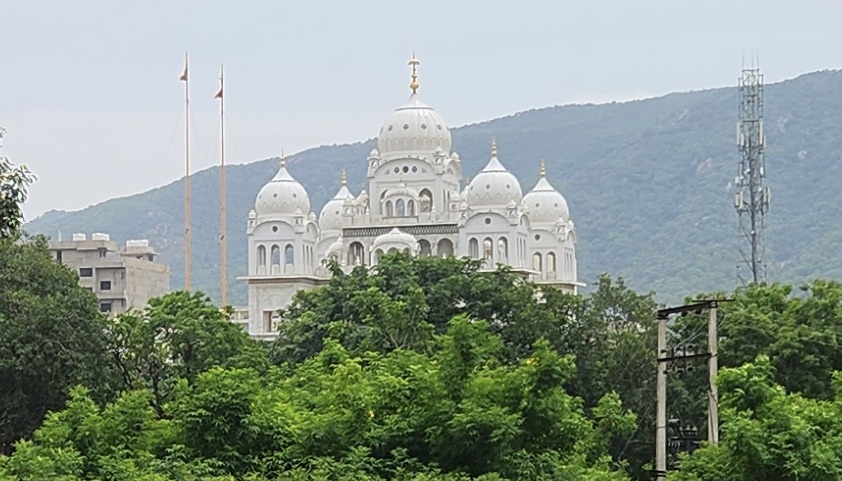
After our tour of the Sikh temple, we drove our van back over the the hills around Pushkar Lake to a city we had passed through that morning.

The city is one of the oldest in what is now the State of Rajasthan, founded by the Hindu Rajputs in the 11th Century. Even though Ajmer is 84% Hindu, the city is famous for its domed tomb of the venerated Muslim Sufi saint, Moinuddin Chishti, who died in 1236. It is considered the most revered Sufi shrine in India. The Moghul Emperor Akbar (who died in 1605) visited the Shrine no less than fourteen times during his reign. His son Jahangir and grandson Shah Jahan renovated the shrine’s structure. Interestingly, Hindus have also venerated the Saint since the medieval period, so there are Hindu pilgrims to the tomb as well.

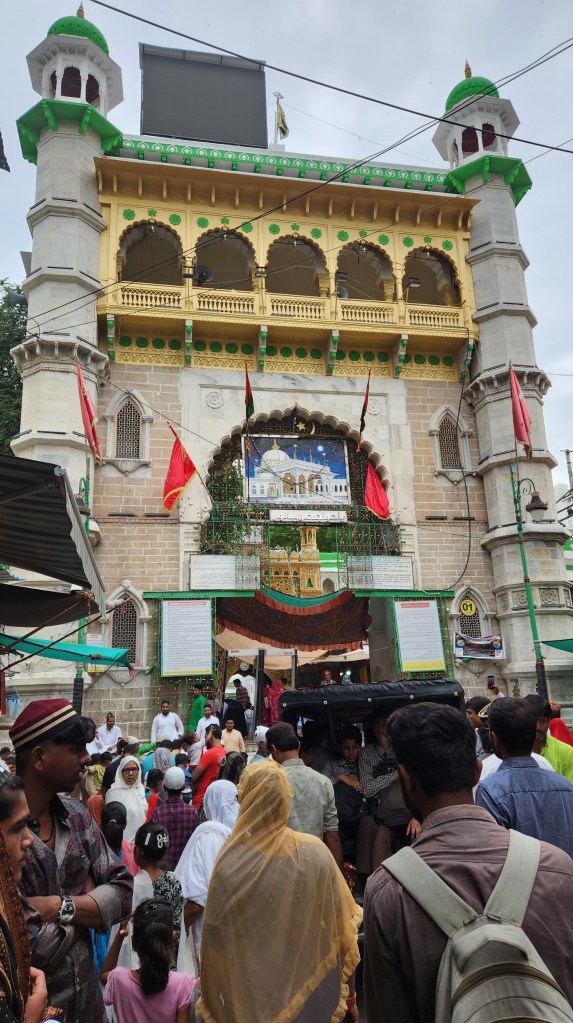
As we got closer to the Shrine, the crowds got uncomfortably tight for me for the first time in India. Kingston stayed right beside me as best he could in the crowded narrow street (with three wheeled taxis and motorbikes wheeling in and out of the pedestrians), but I finally told Kingston it was best to just abandon entry as we got close to the gates of the Shrine. So we ended our religious treck (having only entered the Sihk temple) and headed back to Jaipur.
 Ginger Without Borders
Leave a comment