
Our hotel was on Candolim Beach aong the Arabian Sea, just north of Fort Aguada and on the opposite side of the Mandovi River from Panaji, the capital of Goa (and the last former Portuguese capital). Our day would end in Panaji, but first we stopped at another ancient fort that guarded the sea approach to the site of Panaji.
The Reis Magos Fort (the Portuguese name for the Three Wise Men) was built by the Portuguese in 1551 (50 years before they built Fort Aguada) atop the headland that juts into the narrowest stretch of the Mandovi River. Defended by 33 guns, unlike the expansive grounds of Fort Aguada, it was only large enough for a small garrison. Nevertheless, it accomodated viceroys and other dignitaries from Lisbon. While Shivaji was the Maratha Emperor, the Portuguese were their ally against the Deccan Sultanates. In 1682, less than two years after Shivaji’s death, his eldest son began building a fortified border with Goa. Alarmed, the Portuguese turned to the Mughal Emperor Aurangzeb, whose own expansionist goals made Maratha (a former Mughal vassal) an attractive target. The Maratha Empire invaded Goa and occupied the town below the Fort for two years. But they were not able to take the Fort, in part because, like Fort Aguada, it had its own spring with an abundance of excellent water. The Portuguese capital, the City of Goa, on an island on the opposite side of the Mandovi River was also never taken thanks to the guns of the Fort protecting the river crossing. The Fort’s seige was finally lifted when a large Mughal army invaded Maratha and their army had to withdraw to oppose that invasion.

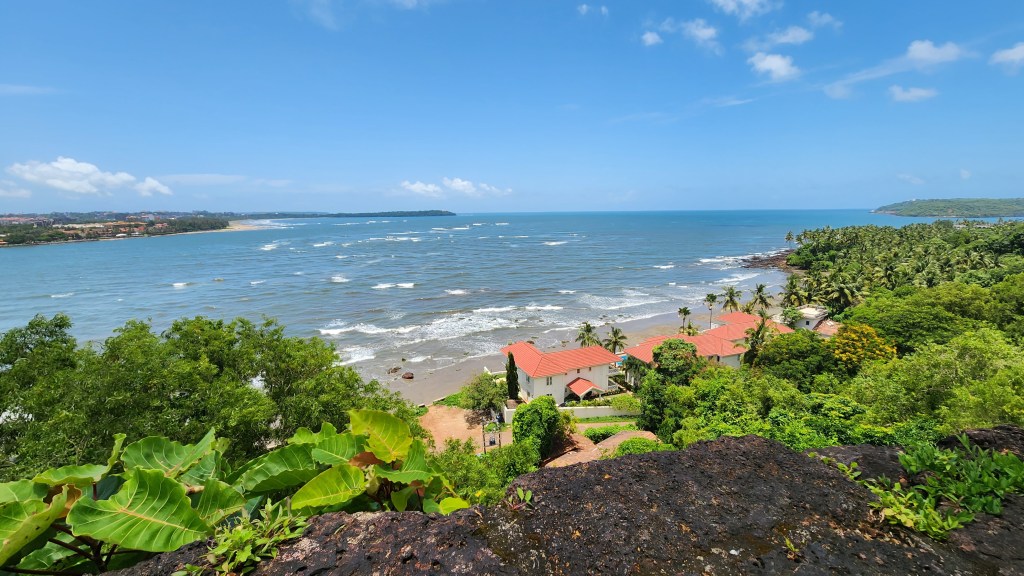

In 1900, the Fort lost its defensive role and was converted into a prison that operated until 1993. During the 1940s and 50s, many of its prisoners were from the Goan Independence Movement. After Indian Independence, with the support of Mahatma Gandhi, non-violent civil disobedience protests in favor of Goan independence were organized but the Portuguese responded with assaults and arrests. Both the Reis Magos Fort and Fort Aquada were used as prisons. In 1955, Portuguese security forces opened fire on a group of about 3,000 protesters including women and children, killing several and wounding hundreds. Further protests resulted in more deaths and arrests, with the prisoners brutally tortured. The Reis Magos Fort now includes a cultural center that addresses the Goan Independence Movement.

We next headed over the Mandovi River Bridge to the opposite bank of the Mandovi River. Our destination was Old Goa (formerly the City of Goa), the original capital of Portuguese Goa. Founded in the 15th Century by the Muslim Bijapur Sultanate (a member of the Deccan Sultanate), it was conquered by the Portuguese in 1510. Under Portuguese rule, the spice trade conducted through the deep water port on the Mandovi River grew Goa to a city of nearly 200,000 people by 1543. But malaria and cholera epidemics ravaged the population over the next 200 years and the city was largely abandoned. In 1759, the Viceroy created a new city, Panaji, about 5.5 miles west closer to the banks of the Mandovi River. By 1775, the City of Goa’s population had fallen to less than 1,500; however, it remained the Portuguese capital until 1843, when the capital was formally shifted to Panaji and the City of Goa became known as Old Goa.
During the 16th Century, Goa was the center of Christianization in the Portuguese East with all religious orders having their headquarters there. Begun in 1594 (but not consecrated until 1605) is the Basilica of Bom Jesus (the “Infant Jesus”), one of the best examples of Baroque Portuguese colonial architecture and a Jesuit church. It is one of the oldest churches in India. It attracts mulititudes of pilgrims because it contains the earthly remains of St. Francis Xavier, one of the co-founders of the Society of Jesus (the Jesuits). His body is reputed to be incorruptible (a Catholic and Orthodox Christian belief that devine intervention protects the Saint’s body from the normal process of decomposition) and to have powers of healing.
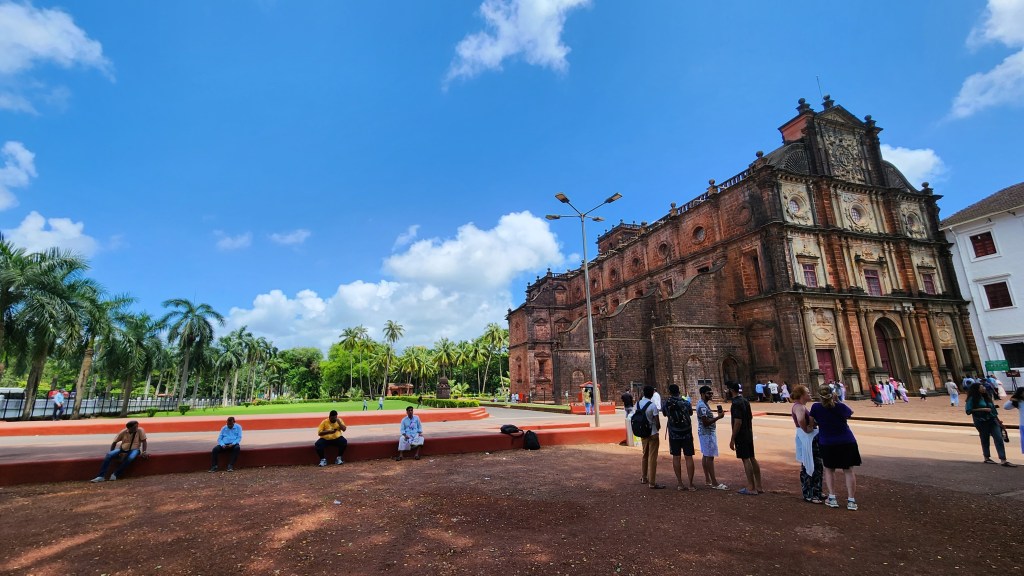
Along with Kingston’s family, we joined the line to tour the interior of the Basilica. The interior is simple but it has elaborate guilded altars and the marble floor is inlaid with precious stones. We did not join the longer line inside the chapel to get a closer look at the mausoleum with its silver casket containing the Saint’s remains (a gift from the Medicis Grand Duke of Tuscany).
From the Basilica, we walked up Monte Santo (“Holy Hill”) to the remains of the complex of the Church of St. Augustine. It was built between 1597 and 1602 by Augustianian friars (a monastic order that served the needs of people in an urban setting) and was considered one of the three great Augustianian churches in the Iberian world. The large church complex included a seminary, a convent, a library, dormitories and numerous cells for the friars. It was noted by many travelers for its grandeur. But the Portuguese government banned monastic orders in 1832 and ordered the friars to become priests. The Church was abandoned and its huge vault collapsed in 1842. The Goan government then auctioned off its architectural members in 1845. The main tower’s bell was moved to Our Lady of Immaculate Conception (in Panaji) in 1871. The facade and three of its four towers fell down by 1938. Only half of the main tower remains but it is one of the most visited tourist destinations in Goa.


To end the day, we loaded back into the mini-bus and drove into Panaji to walk the streets of the former Portuguese section of old town.
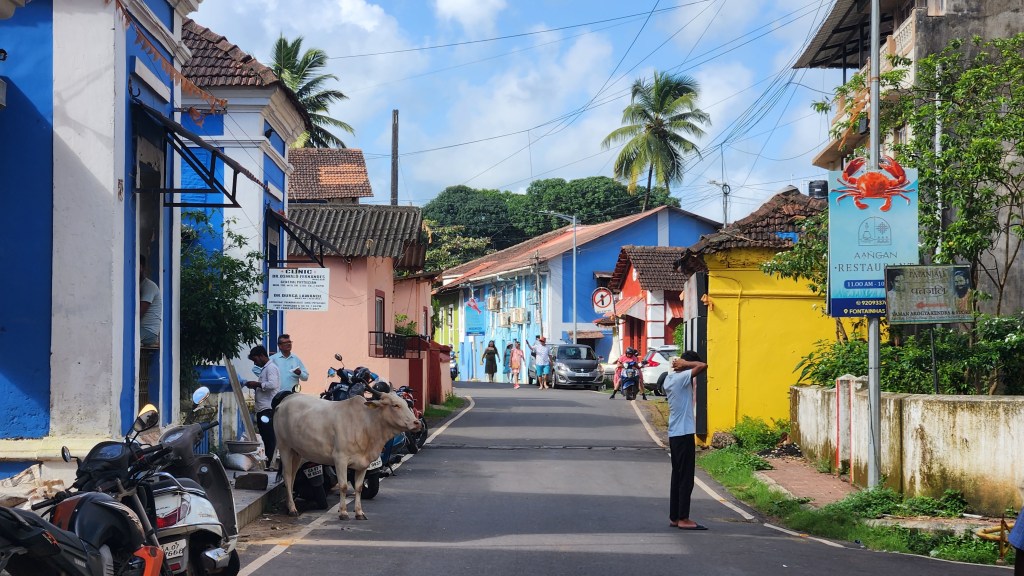

We ended the day with dinner back at the hotel. And we needed to head to bed early because Kingston decided he wanted all of us to visit his favorite beach in Goa, which happened to be two hours south by mini-bus. It was going to be an early start for our final full day in Goa.
 Ginger Without Borders
Leave a comment