
For our last few days in Mumbai, we were able to return to our first hotel in Mumbai (and my favorite breakfast buffet). We were lucky to even get a room on our return because the hotel was full. The Indian political opposition had united in a coalition whose initials are INDIA and INDIA was having a conference at the hotel to prepare for the 2024 elections that have only recently been completed. The roads around the hotel were literally lined with posters featuring the smiling faces of the various opposition political party leaders. Kingston noted that the opposition had attempted coalitions before which usually fell apart shortly before the elections. However, this time the coalition held and despite polls indicating a landslide for Modi and his Hindu nationalist party, INDIA showed surprising strength even in Modi strongholds. Modi’s party lost its majority in the Indian Parliament and must now form a coalition government. So we were able to experience a small part of modern Indian history.
Most of our last full day in Mumbai was spent picking up the tailored clothes we had ordered several weeks ago. I also had spoken to Sister about buying a silver bracelet for myself. She did her usual great job of helping us explore a number of jewelry shops until I found something I really liked. After our shopping trip, we had a final dinner with the whole family at the family apartment. They generously presented us with parting gifts to go along with our photos and memories. And we thanked them for all of their contributions to our India Adventure. Brother had not only been our driver in Mumbai’s notorious traffic but he and Kingston had spent months working with travel agents on our itinerary. His Mother cooked special dinners (and often lunch) for us both in Mumbai and Kerala (paying particular attention to fix Lena “no spice” dishes). Brother’s wife made sure we ate all the food (particlulary the endless supply of flatbread) and kept us supplied with tea and Indian coffee. His Dad was able to find snacks and tasty street food everywhere we traveled. Sister was of course our guide to purchases and her husband was my guide to many tasty Indian dishes. The kids kept us entertained whenever they were around.

I was actually quite surprised that our return bags to the US were almost as full as they were on our flight to India (which transported all of Kingston’s presents for the family he had not seen in five years). We loaded the luggage in one car and the whole family joined us in the other cars for our trip to the airport. We had made sure to leave lots of time since Mumbai traffic is never predictable even though the apartment is quite close to the airport. For some unknown reason, there were literally no backups on the roads this time and we arrived at the airport with hours to spare before loading. So we spent the time taking lots of final pictures and just having a fun family visit in the relatively cool morning air.

As I am writing this last post about our Indian Adventure, I have had almost ten months to process the experience and for the historian in me to research the history of what we saw. As I stated at the beginning of this blog, my knowledge of Indian history was very superficial prior to our Adventure. So how does one briefly summarize the experiences of a trip where almost everything (even the mundane) is new and different and you come to realize that you are definitely in a place with a dramatically different worldview from my Western one? Most everything I have written about Indian history in this bolg was new to me. While Kingston did his best to give us a preview, the food and drinks were much more varied and regional than I had expected. Even though Kingston had warned us about the “different” weather, the temperatures were not (and other than in the North, the humidity was not) that different from our North Carolina summers. And we were blessed with the monsoon drought for most of our travels, so the constant rain that is usual in India in August was not our experience. The crush of humanity in the big cities was beyond anything we had experienced anywhere else in the World but in the rural areas, the crowds were manageable. And everywhere the hospitality industry did its best to make us feel welcome (even when I had to ask them to repeat an answer several times before I could understand the Indian-accented English).
India is an ancient civilization. It had armies so well equipped and trained that they inflicted the greatest losses the famed Western warrior Alexander the Great ever endured on the banks of the Hydaspes River in what is now Pakistan. That costly victory marked the extent of Alexander the Great’s advance into the Indian subcontinent, so he never actually reached the territory that is today’s India. The Macedonian subrulers he left behind in the few areas he was able to conquer in Pakistan were driven away soon after he left. And then India seemingly disappeared from Western history until the Portuguese landed in Kerala some 800 years later. From the moment the Portuguese stepped foot in India, the subcontinent’s history became part of the story of the expansionist drive of European powers. So the historically constantly shifting alliances of the kingdoms of India (only the Mughal Emperor Aurangzeb came briefly close to ruling all of the subcontinent and even he did not conquer the Kingdoms in the Southern tip that is modern day Kerala and Tamil Nadu) now were driven by European ambitions. The wealth of India would ultimately help build the Portuguese, Dutch and British Empires.
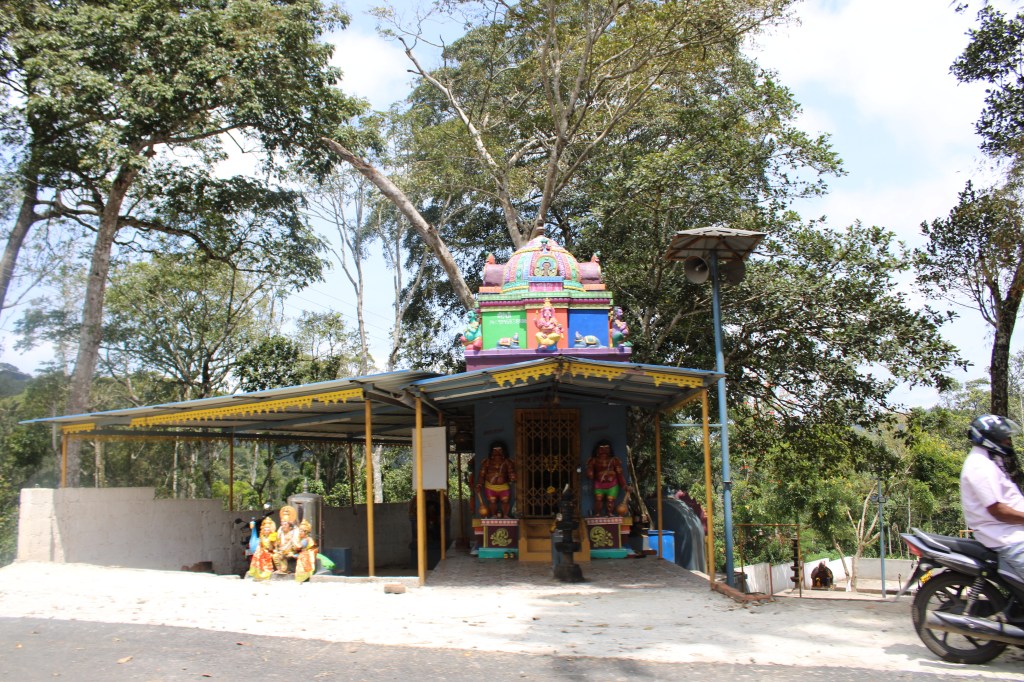
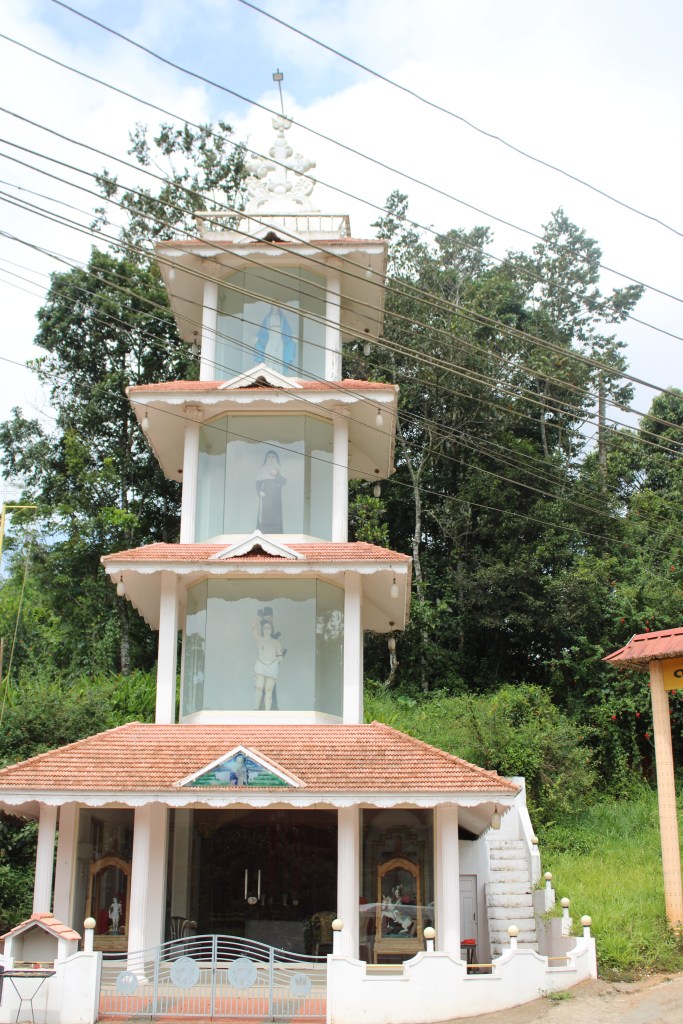
India is the birthplace of four major religions: Hinduism, Buddism, Jainisam and Sikhism (the Dharmic religions). A disciple of Jesus settled in Kerala and that ancient form of Christianity is today recognized by both the Roman Catholic and the Orthodox Chrisitian Churches. Then the Portuguese brought the Roman Catholic Church to India in 1510, followed by the Protestant Churches of the Dutch and English. Christians are now the third-largest religious group in India. With the various Muslim invasions of India (from Tajikistan and Afganistan), India now has the World’s third largest Muslim popluation and the World’s largest Muslim minority population. Religious buildings are omnipresent, particularly the roadside shrines of the Muslim, Hindu and Christian faiths. Hindus respect and honor certain Sufi Muslim religious leaders, so it was not uncommon to have both faiths represented at some religious sites we visited. Both faiths mixed on the street and in the shops regularly. But housing is segregated by Muslim and Hindu. As a Hindu friend pointed out, since Hindus are vegetarian, even the smell of meat cooking (by Muslim or Christian families) is not tolerable to most Hindus. While cows are sometimes used for food (particularly in the Christian South), they are considered sacred by Hindus. So cows are in the streets (and beaches) everywhere. They will be fed as a religious practice by Hindus even if they have been abandoned by their owners (not uncommon after a certain age).
India is a young democracy. It has only been free of Western colonialism since 1947 (and 1961 in Goa). It is the World’s largest democracy, even though there is no official national language. While 77% of India’s population speaks Hindi as their primary language, some 21% (mostly in South India) speak one of the Dravidian family of languages (found throughout Southeast Asia) as their native tongue. Almost every State has its own local language. There are 22 state recognized languages and a total of 121 languages and 270 mother tongues. Hindi is the World’s oldest language. It is part of the language family that includes English, French, Portuguese, Russian, German, and Spanish. English (as used in England) appears to be the common language that is used by most Indians to deal with local language issues. Today’s Indian children in particular seem to prefer to speak English when visiting with their friends. Kingston’s Dad admonished his grandchildren to speak Malayalam, the Dravidian language of Kerala, when in their apartment home. But they live in Mumbia where the local language is Marathi (a Sanskrit based language like Hindi). English has so worked its way into local dialects that some Hindi speakers (one of the official languages of Dehli) coined the term Hinglish (Hindi and English). When I asked Kingston how to say hello and thank you in Malayalam, he said “Hello” and “Thank You.” Everywhere I had difficulty comprehending the Indian-accented British English. And I am relatively sure my Southern American accent gave them issues. Kingston was always nearby to help navigate the communications, but even he had difficulties. At one hotel he asked housekeeping for toilet paper and the staff brought him four bags of Nescafe instant coffee. His missed communication was some slight comfort to this American.
Shoes are removed before entering homes, religious buildings and some shops. Almost every floor in India is made of marble. All homes have a squeegee for cleaning the marble. I grew up barefoot on the baked red clay soil of my small Southern town. Somewhere along life’s way, I had forgotten the cool pleasureable feeling of tile or wood on the soles of my feet. It was probably a week into the trip when I finally just stopped wearing my socks and embraced the feel of my bare feet again. And after my return home, I will now occasionally abandon my shoes and walk barefoot.
I did not find central air conditioning in any home. Most homes have small A/C units mounted at the top of the walls, mainly in the bedrooms and mainly turned on only at night. Even stores and shops use these wall unit A/Cs, not central air. Only the most expensive hotels used central air. Since just moving the air was usually enough to make the heat bearable during the day and evening, most living spaces use multiple ceiling fans operated at high speed. A lot of restaurants are open air and so rely on ceiling fans. If big enough, restaurants usually offer both A/C and non-A/C dining areas. Even though Dawn and I grew up in the humid south at a time when there were only fans, we are now reluctant to camp anymore if the night temperatures are not expected to fall into the upper 70s. Kingston’s folks (approximately our age) did not turn on the A/C to their hotel rooms even when night temps were in the 90s. We, on the other hand, fully embraced the A/C at night.

There are separate lines for men and women at most security checks. Most serurity lines have “dressing rooms” for female security checks. And there are security checks not just at airports but at most museums and many religious buildings (and most hotels in Mumbai). Some airports offer to reserve either female or male driven taxis for customers. Some States offer female only busses. Tamil Nadu, the State just east of Kerala, offers free ridership to all women.
Driving is on the left. Like the US in the 1950s and 60s when I grew up, every highway goes through every town. It appears that there is a major effort (given the number of construction diversions we encountered) to build elevated intersections to allow traffic to flow better. But Kingston said many of these were “under construction” five years ago when he was last able to visit India. So it takes some time to complete construction. Even the main highways between cities have speed calming bumps every few miles and at most intersections. Drivers do not hesitate to pull off to the side of the road (even narrow ones) wherever the mood strikes them with seeming disregard for the traffic flow. Motorcycles are not required to pay tolls on tolled highways, but they are required to stay to the far left side. Many of the modern bridges do not permit motorcycles or the three wheeled taxis. All vehicles honk if they intend to pass or are navigating a blind curve (and there are lots of blind curves on the winding roads in the country and mountains). In a city, the honking becomes non-stop (and in the congestion of Mumbai, a cacophony). All petrol stations offer gas and deisel and there is no self-service. Most gas station attendants wear uniforms and many stations operate 24/7.
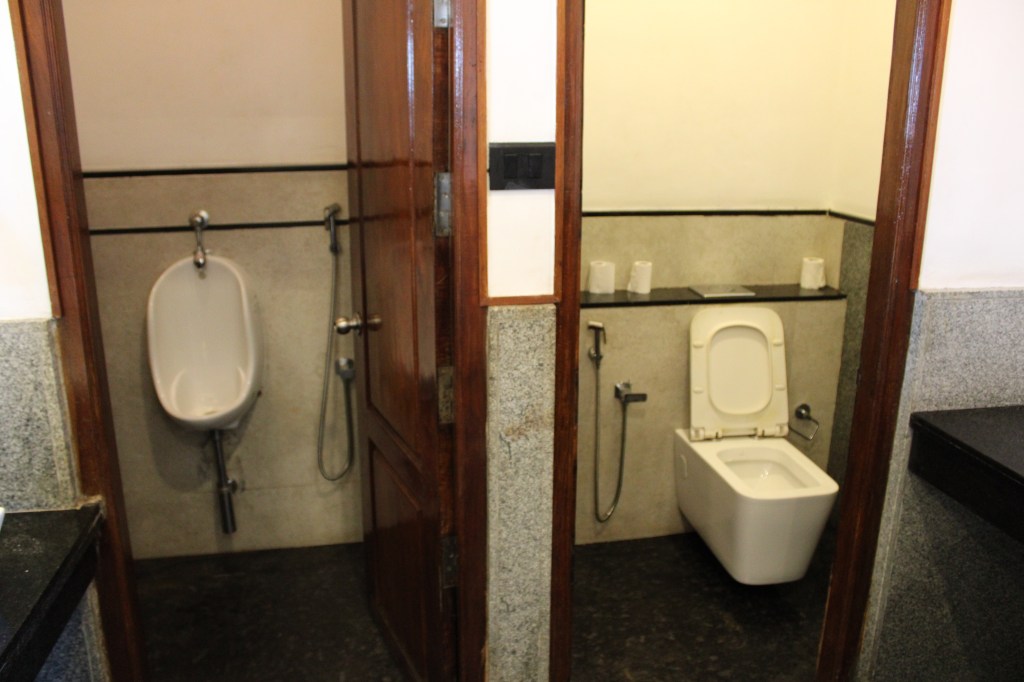
Although (like the caste system) it is illegal in India, male urination beside country roads or rural railroad stations is a not an infrequent sight. And most of these men have no modesty to conceal what they are doing. There are public toilets in the cities (and much less outside male urination). Most museum restrooms are free but others require a modest payment (from 5-10 cents). Not all restaurants have toilets but all have sinks so that hands can be washed before and after eating (since most food is eaten with the hands, using one of the multiple varieties of flat bread as the utensil). Most restrooms offer stalls with both the Western toilet seat (some with toilet paper) and ceramic footsteps over a hole. Both types are accompanied by a handheld nozzel spray as a bidet (for males and females). It took a fair amount of practice, but within two weeks I could use the nozzel without also spraying the toilet seat or my shirt. Once I became a little more accomplished, I had to agree with Kingston that it was a more effecient process and left a much cleaner feeling. That form of bidet will definitely be an addition when we remodel our bathroom.
All hotels provide free bottled water in their rooms, mostly in glass bottles that are washed and reused (so don’t contribute more plastic bottles to the trash). We were encouraged to use only bottled water to brush our teeth due to the risk of developing “Dehli belly” from local water supplies. We were also warned not to use any ice in drinks, which I ignored to my peril. Luckily my experience with Dehli belly only lasted one day. Even Kingston’s family boil the tap water at home before drinking it. They kept a metal jug on their dining table for drinking water. And in most urban areas where apartment buildings are the predominant housing stock, water is delivered to the housing complex by truck, not by water lines.

The need for bottled water for health reasons means plastic bottle waste is a common litter in most urban areas and along the roads and waterways in rural areas. Several of the cities we visited had public campaigns with signage urging a stop to “one use” plastic. The more touristy cities employ older women to sweep the streets with palm frond brooms. These brooms are quite effective and those streets were free of trash and waste bottles.
According to Kingston, during the monsoon season, it will rain, sometimes very hard every day. And August was supposed to be the middle of the monsoon season. We were lucky enough to pick the year of what a Kerala newspaper called the “monsoon drought.” We did have the occasional (sometimes heavy) short storms, but most of our days were blue skies with only a few clouds. The constant rain of a “normal” Monsoon season means the use of plastic tarps is endemic. Some are used for new construction along with plastic bottles covering the tops of the rebar sticking out of the concrete. Some are used for roof coverings for houses. Many are used for the various roadside shops that are everywhere. Some are just for shelter in the abandoned construction sites (and there are many).

In 1700, Moghul Emperor Aurangzeb ruled over the wealthiest empire in the World when he nominally controlled most of India. Beginning in 1765, the British East India Company (and after the 1857 Revolt, the British Government) drained nearly $45 trillion dollars from India by 1938, according to one estimate. Food exports from India by the British led to 12 major Indian famines (the last one during the Second World War in 1943–1944 while Indian soldiers were fighting for Britian) which caused the deaths of millions of Indians. So it should be recognized that India’s struggle to build an economy to lift the world’s largest population from in some cases extreme poverty begins from an extreme deficit created by colonialism. My son-in-law has vowed never to live in Britian.
While the process moves in fits and starts, India is working toward its long term goal to again become one of the world’s richest countries. Kerala has a modern airport run entirely on solar power. There are gleaming steel and glass business districts in many parts of India. There are amazing ancient ruins and national parks welcoming millions of tourists. India runs the biggest free school lunch programme of its kind in the world, feeding 120 million kids in more than 1.27 million schools. State governments have programs that supply food grains to 6.52 million families living below the national government’s poverty line.
In today’s United States, our differences seem to be the driving factor of our national conversation. I am still digesting the history of the subcontinent of India, but it is time to end this blog. So if nothing else (and believe me there are many more pages that I may yet write about our India Adventure) I have an appreciation that, despite literally centuries of bloody internal conflicts, competing religious traditions, and massive colonial exploitation, Indians are struggling to build the world’s largest democratic nation in spite of all its differences in language, religion and historical experience. There are lessons from history here (that both the US and modern Indian political parties can learn). Both the Muslim Mughal Empire and the Hindu Maratha Empire found their greatest successes when they embraced religious tolerance and the growth of trade and local art and industries.
Thanks for indulging my Indian learning experience.
 Ginger Without Borders
Leave a comment