
In an era marked by geopolitical fragmentation and open challenges to international norms, the relevance of international law is often questioned. Yet it is precisely under such conditions that international law is most significant. To that end, understanding the institutions that interpret and articulate international law—particularly in moments of strain—is essential. One such institution is the United Nations International Law Commission (ILC), which occupies a unique position in the international legal order.
This post is the fifth in a multi-part series connected to my work as an adjunct professor at American University, Washington College of Law, where I am teaching an upper-level practicum on the ILC. The aim of this series is to make the institutional role, working methods, and legal significance of the ILC more accessible to readers beyond the classroom.
As always, if there’s something you’d like to see added, clarified, or explored further, I’m happy to hear from you!
Introduction
After establishing the International Law Commission (ILC)’s historical context, mandate, structure, and process of consideration in the series’ first four posts, the next step is to discuss the Commission’s final product. This brings us to our next question: when the Commission completes work on a topic, what exactly does it produce and what legal weight does that work carry? The answer reveals much about the Commission’s institutional identity and its evolving methods.
Over time, the Commission has expanded the range of its final products beyond draft articles intended for treaty adoption. Guidelines, principles, conclusions, and final reports now occupy an increasingly prominent place. This shift reflects both political reality—i.e., States’ reluctance to codify international legal obligations—and the Commission’s adaptive interpretation of its mandate.
Non-Binding—But Not Without Influence
As a starting point, the Commission’s work, on its own, is always non-binding. Its draft texts do not automatically create legal obligations. Binding force arises only if States decide to transform the Commission’s work into a treaty—typically by convening a diplomatic conference and formally adopting a convention.
Yet this does not mean the Commission’s outputs lack legal significance. Many of its texts reflect existing international law (i.e., customary international law and general principles of law). In such cases, the Commission is not inventing new rules but clarifying and articulating binding rules of law that already exist.
At the same time, the Commission also engages in progressive development, both explicitly and implicitly. In regard to the former, the Commission may propose draft provisions that respond to new challenges or unsettled areas of law. In regard to the latter, the Commission outputs may contribute to the formation of previously nonexistent customary international law. For example, the Special Rapporteur’s reports often describe existing State practice, which in turn may prompt an increase in similar State practice (the first element for establishing customary international law). Likewise, the comments submitted directly by States or provided in the UN General Assembly Sixth Committee debates may constitute opinio juris (the second element for establishing customary international law). Thus, without expressly articulating a new legal rule, the Commission’s work may implicitly facilitate the emergence of new customary international legal norms.
Importantly, as this series has noted previously, the Commission has repeatedly acknowledged that it is often impracticable to strictly label its work on each topic as “codification” (lex lata, which is binding) or “progressive development” (lex ferenda, which is non-binding). In practice, its final products frequently contain elements of both. Accordingly, when assessing whether the Commission’s work on a particular topic constitutes lex lata or lex ferenda, it is necessary to examine each provision individually—rather than examining all the draft provisions as a whole—to determine whether the legal norms contained in the provision constitute lex lata or lex ferenda.
Article 20—and Practice Beyond It
Article 20 of the Commission’s Statute only forsees that the Commission would prepare drafts “in the form of articles.” Historically, this model reflected an expectation that the Commission’s work would serve as the basis for multilateral conventions. In practice, however, the specific forms of the Commission’s final products have evolved—and continue to evolve—well beyond what was contemplated in the Commission’s Statute.
The Different Forms of Final Products
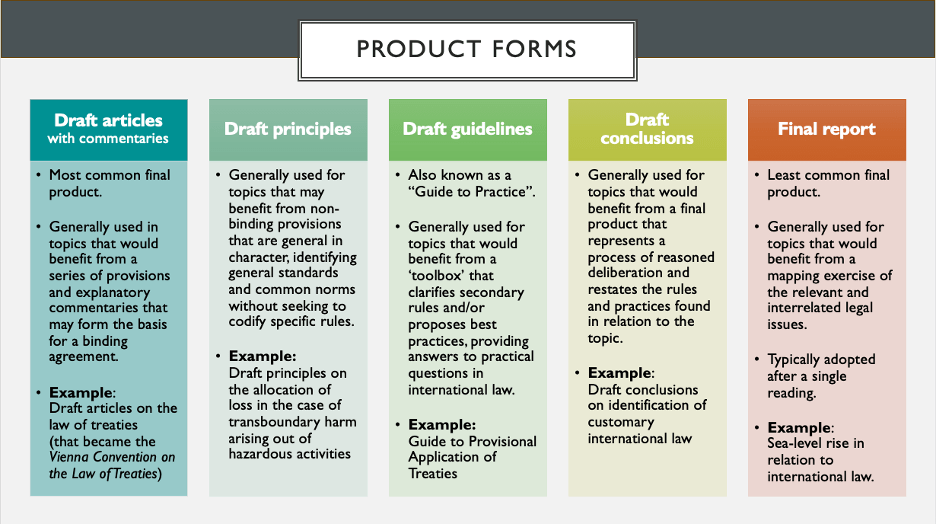
According to the textbook on the ILC,[1] which is created by the UN Secretariat’s Office of Legal Affairs (Codification Division), the Commission’s final output when considering a particular topic may take one of several forms:
- Draft articles
- Draft principles
- Draft guidelines
- Draft conclusions
- Final reports
This classification, however, is not fixed and remains subject to change as the Commission refines its methods of work. For example, former Commission member Sean Murphy proposed a similar—but not identical—typology in a 2013 paper, illustrating that the categorization of outputs has evolved over time.[2]
Five Forms, Five Functions
Each format of output adopted by the Commission serves a distinct function within international law, and is selected based on the nature of the topic and the institutional objective the Commission seeks to achieve.
Draft articles are the Commission’s most common output. They are typically used for topics that would benefit from a structured set of provisions and detailed explanatory commentary, with the expectation that they may serve as the basis for a binding agreement. A classic example is the draft articles on the law of treaties, which ultimately became the foundational international law treaty: the 1969 Vienna Convention on the Law of Treaties (commonly known as the “VCLT”).
Draft principles are typically used for topics that may benefit from non-binding provisions that are general in character. They identify overarching standards or common norms without necessarily seeking to codify precise rules. An example of this type of final product is the “Draft principles on the allocation of loss in the case of transboundary harm arising out of hazardous activities”.
Draft guidelines—also known as a “Guide to Practice”— are typically used for topics that benefit from a practical “toolbox” clarifying secondary rules or proposing best practices, thereby providing answers to recurring technical questions in international law. An example of this type of final product is the “The Guide to Provisional Application of Treaties”, which was adopted with a draft annex containing examples of provisions on provisional application.
Draft conclusions are typically used for topics that would benefit from a final product that represents a process of reasoned deliberation and restates the rules and practices found in relation to a topic. They are particularly common for topics addressing methodological areas of international law, such as the identification of particular types of international law. For example, the “Draft conclusions on the identification of customary international law” were created to assist with the identification of customary legal norms under Article 38(1)(b) of the International Court of Justice Statute.
Final reports are the least common final product. They are typically used for topics that would benefit from a comprehensive mapping exercise of relevant and interrelated legal issues, identifying and analyzing complex questions without necessarily proposing draft provisions. The Commission also often deviates from its usual two-stage process for this type of product: rather than conducting both a first and second reading, final reports are generally adopted after a single reading, thereby foregoing the stage dedicated to incorporating State comments. The most recent example of this type of final product is the final report by the study group on sea level rise, adopted during the Commission’s 75th session in 2025.
The Central Role of Commentaries
Whatever the format, the Commission’s work is always accompanied by detailed analysis. The Commission, by its statute, is required to justify its proposal to the General Assembly, and ultimately to States, on the basis of evidence of existing law and the requirements of progressive development in light of the current needs of the international community. Under Articles 20 and 22 of its Statute, the Commission’s final products must be supported by an explanatory report that extensively references State practice, judicial decisions, doctrine, and precedents. Article 24 further explains that the Commission is responsible for finding ways to make the evidence of customary international law more readily available (e.g., evidence of State practice and opinio juris). Thus, in many respects, the commentary is where the intellectual architecture of the Commission’s work is most visible. Accordingly, the commentaries are not an afterthought—they are integral to the final product. Moreover, these commentaries are not mere explanatory notes—in practice, they often carry significant interpretive weight, particularly before international courts and tribunals.
Draft commentaries are typically prepared by the Special Rapporteur shortly after the adoption of provisions on first reading. Although initially drafted by the Rapporteur, they reflect the position of the Commission as a whole and take precedence over individual views expressed during debate. At the first reading stage, the commentaries generally outline relevant precedents and State practice, explain the rationale for the draft provisions, and may record divergences within the Commission, competing arguments, or alternative solutions considered.[3]
Over the course of the Commission’s work, however, the commentaries evolve significantly. By second reading, they incorporate comments submitted by States as well as the Commission’s further deliberations, but references to internal disagreements or alternative approaches are generally removed. Instead, any remaining differences of view may be expressed by members in plenary at the time of final adoption, which is then reflected in the Commission’s annual report. At this stage, the commentaries focus on explaining the text, identifying sources, clarifying whether provisions reflect existing law or progressive development, and situating them within broader international practice.
This shift in the content of the commentaries is intentional. In the earlier stages, the commentaries provide context for the ongoing debate over the provisions’ content. By the final stages, however, they are designed to present an authoritative interpretation of the provisions, clarifying why they are formulated as they are and how they should be understood rather than preserving the argumentative space reflected in earlier drafts. Thus, by removing references to internal debate, the Commission consolidates its position and limits opportunities for States critical of the project to challenge the coherence or rationale of the final product.
Conclusion
In recent years, the Commission has increasingly worked on topics where the outcome is not necessarily intended to become a treaty. Instead, particularly for topics involving secondary rules or international legal methodology, the goal has often been clarification, systematization, or guidance. Accordingly, for these topics, draft articles would be comparatively ineffective, making alternative forms of output more practical and more responsive to the decline in States’ political appetite for negotiating new multilateral conventions.
The increasing use of non-treaty-oriented products, however, raises broader institutional questions: is this shift a pragmatic response to political realities, recognizing that multilateral treaty-making has become more difficult? Or does it reflect a deeper transformation in the Commission’s conception of its role, from treaty-drafter to authoritative clarifier and systematizer of international law? Whatever the answer, the work of the Commission continues to influence the development and interpretation of international law through draft conventions as well as through the Commission’s other final product forms, the accompanying commentaries, and the methodological guidance that courts, practitioners, and States regularly rely upon. In that sense, the Commission’s products on their own may be formally non-binding—but they are never insignificant.
[1] Work of the International Law Commission, 10th ed. (2023), available here: https://www.un-ilibrary.org/content/books/9789210025911.
[2] See Sean Murphy, “Codification, Progressive Development, or Scholarly Analysis? The Art of Packaging the ILC’s Work Product” (2013).
[3] See Statute, Article 20(b)(ii).
Course Materials
References
International Law Commission: https://legal.un.org/ilc/ilcintro.shtml, https://legal.un.org/ilc/work.shtml, https://legal.un.org/ilc/methods.shtml
Additional Reading
 Ginger Without Borders
Leave a comment