
In an era marked by geopolitical fragmentation and open challenges to international norms, the relevance of international law is often questioned. Yet it is precisely under such conditions that international law is most significant. To that end, understanding the institutions that interpret and articulate international law—particularly in moments of strain—is essential. One such institution is the United Nations International Law Commission (ILC), which occupies a unique position in the international legal order.
This post is the sixth in a multi-part series connected to my work as an adjunct professor at American University, Washington College of Law, where I am teaching an upper-level practicum on the ILC. The aim of this series is to make the institutional role, working methods, and legal significance of the ILC more accessible to readers beyond the classroom.
As always, if there’s something you’d like to see added, clarified, or explored further, I’m happy to hear from you!
Introduction
The Commission’s membership plays a central role in shaping both the content of its work and how that work is received by States,[1] courts, and scholars. Accordingly, the authority of the Commission’s work depends not only on what the Commission produces and how it is produced, but also on who produces it. With that in mind, after examining the Commission’s historical context, mandate, structure, process of consideration, and product forms in the series’ first five posts, the next step is to turn to its composition: who are the legal experts responsible for shaping the Commission’s work, and how are they selected?
Who Can Be a Member?
Under Article 2(1) of the Commission’s Statute, members “shall be persons of recognized competence in international law.” In practice, this means members are individuals with substantial expertise in both the doctrinal and practical dimensions of international law—e.g., distinguished academics, senior diplomats, government legal advisers, and officials from international organizations. Importantly, members do not serve on a year-round basis and only meet during the annual session, which means the members will always have a “day job”, in addition to their work with the Commission.
The Statute contains a strict nationality rule: no two members may be nationals of the same State.[2] Where a prospective member is a “dual national” (i.e., holds nationality in two or more States), the person is considered a national of the State where they ordinarily exercise civil and political rights.[3] This rule is designed to prevent any one State from gaining an undue influence through overrepresentation, therefore ensuring the Commission remains a balanced expert body representing the international community as a whole.
Interestingly, the Statute does not limit eligibility to nationals of UN Member States. Yet, to date, no national of a non-Member State has ever been elected to the Commission.
The Statute is also silent on what happens when a member’s nationality changes after they are appointed to the Commission. Although such instances are rare, the following three cases illustrate how the Commission has navigated these geopolitical shifts:
- When Egypt and Syria formed the United Arab Republic in 1958, two sitting members who were elected in 1956 became nationals of the same State (United Arab Republic). One of the members resigned.
- Following the accession of the German Democratic Republic to the Federal Republic of Germany in 1990, two members who were elected in 1986 became nationals of the same State (Germany). Both completed their terms.
- After the dissolution of Czechoslovakia into the Czech Republic and the Slovak Republic in 1993, the sitting member from Czechoslovakia continued as a national of the Czech Republic.
Drawing from this precedent, the Commission appears to prioritize pragmatic continuity over strict formalism: if the member’s nationality changes earlier in their tenure, one of the two members will resign; but, if it occurs later, the Commission will disregard the prohibition encoded in Article 2(2) and both members will serve out their term.
Size and Representation
To better reflect the expanding international community, the Commission’s size has more than doubled since it began with 15 members in 1949. Following successive expansions in 1956 (to 21 members) and 1961 (to 25 members), the Commission reached its current size of 34 members in 1981.
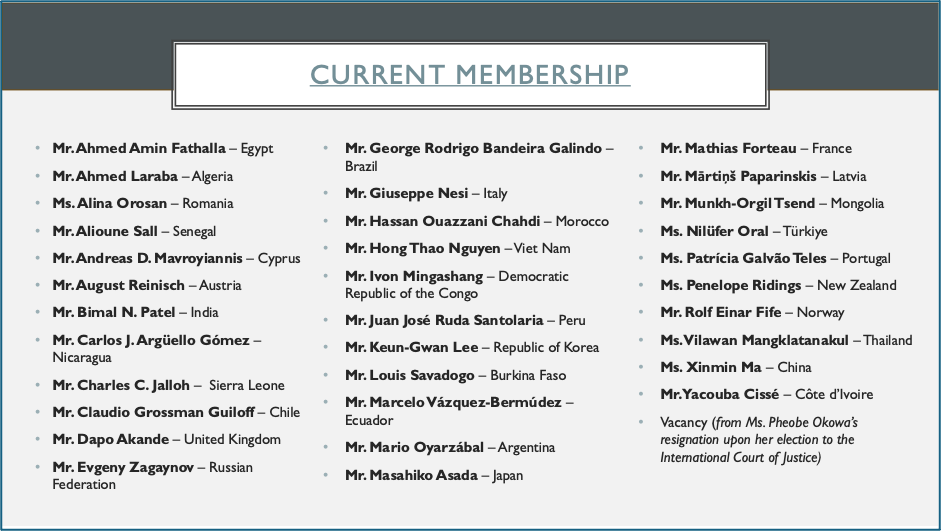
Under General Assembly resolution 36/39 (1981), seats are allocated regionally according to the following pattern:
- Western European and other States: 8 nationals
- African States: 8 nationals
- Eastern European States: 3 nationals
- African States or Eastern European States (in rotation): 1 national (currently an African national)
- Asia-Pacific States: 7 nationals
- Latin American and Caribbean States: 6 nationals
- Asia-Pacific Statesor Latin American States (in rotation): 1 national (currently an Asia-Pacific national)
This geographic distribution seeks to ensure that the Commission as a whole reflects “the main forms of civilization and of the principal legal systems of the world.”[4] Yet nationality remains a blunt proxy for diversity. Although it promotes geographic distribution, it does not necessarily capture differences in legal tradition, professional experience, or perspective. Likewise, the reference to “civilization” is consistently criticized as a colonial-era relic that implies a hierarchy of cultures. While these shortcomings reflect the era in which the Statute was drafted, relying on nationality as the sole metric for representation treats a member’s passport as the substitute for a genuine diversity of legal traditions, professional backgrounds, and lived experiences.
Nowhere is the Statute’s silence on true diversity more evident than in its lack of a gender provision. This omission meant that for over half a century, the Commission functioned as a purely male body; it took until 2001 for the first female members to be elected, and 2023 for the Commission to have a female Chair.[5] Although recent election cycles have seen a modest increase in female candidates and members,[6] women remain significantly underrepresented compared to other international legal bodies. This gap matters not only symbolically, but substantively: who sits at the table influences which legal questions are considered urgent, how the scope of the inquiry is framed, and whose perspectives ultimately define the development of global norms. The absence of a formal gender provision continues to prompt discussion about representation, legitimacy, and inclusivity in international lawmaking.[7]
How Are Members Elected?
The UN Secretary General initiates the election process by notifying Member States of upcoming elections, including noting any relevant Statute provisions, the geographic seat allocations, and a reminder of the nomination deadlines.
Candidates are nominated exclusively by UN Member State governments.[8] Each State may nominate up to four candidates, no more than two of whom may be its own nationals.[9] Multiple States may also nominate the same individual.[10] Nominations are generally due by June 1 of the election year.[11] The UN Secretary General then communicates the names and the curricula vitae (resumes) of the candidates to the UN Member States and provides a list of all of the candidates to the UN General Assembly.[12]
Members are then elected by the UN General Assembly through a ranked voting system for renewable five-year terms.[13] Article 8 of the Statute also requires electors to keep two considerations in mind: first, that each individual elected must possess recognized competence in international law; and second, that the Commission as a whole should represent “the main forms of civilization”[14] and the “principal legal systems of the world”.
Expert Independence
Unlike the political organs of the United Nations, the Commission is composed of international legal experts who serve in their individual capacity—not as representatives of the State of their nationality or the State (or States) that nominated them for election.
This independence is a structural cornerstone of the Commission. In theory, the requirement that members act independently insulates the Commission’s legal deliberations from diplomatic pressure, requiring members to apply the rigors of international law instead of the mandates of national policy. In practice, however, members cannot function in a vacuum.
Members are nominated by governments. They are elected by governments. Many hold “day jobs” as State legal advisors or diplomats with the governments of their nationality. Their professional backgrounds—and the legal cultures in which they were trained—also inevitably shape how they approach treaty interpretation, the identification of custom and general principles, and institutional design.[15] Yet, once elected, they are expected to function solely as independent experts. Consequently, the Commission operates within a constant friction: it is a body created by States, yet its authority rests on its ability to transcend State interests. Ultimately, the credibility of the Commission depends on this separation holding in practice—not because members are entirely detached from politics, but because their conclusions are grounded in the independent rigor of legal reasoning.
Filling “Casual” Vacancies
When vacancies arise between regular elections—whether due to death, resignation, or election to the International Court of Justice—the Commission fills the seat itself, without the involvement of the UN General Assembly.[16]
The Commission’s Statute does not provide a formal procedure. Instead, the UN Secretariat accepts candidate proposals from Member State governments or current Commission members; the nominations are circulated to all Commission members prior to the commencement of the next session; the Commission’s Chair determines an election date; and, on that date, members cast secret ballots during a private meeting. Afterward, the Chair publicly announces the results in a recorded session, documented in the official summary records. The replacement member then serves out the remainder of the departing member’s term, and may be elected to their own full term during the next regular election.
As for the nationality of the replacement members, the Statute does not require that the replacement come from the same regional group as the departing member. Still, in practice, nominations to fill a casual vacancy have always been limited to individuals from the same regional group.
Compensation and Diplomatic Privileges
Members may receive travel expenses and special allowances (the amount of which is determined by the UN General Assembly), but they are not salaried.[17] Historically, members were also paid honoraria (as part of their special allowances); however, in 2002, as part of a broader cost-cutting strategy, the UN General Assembly reduced these payments to a symbolic $1 USD per year.[18] Despite repeated concerns raised by the Commission, these honoraria have never been restored.
This fiscal arrangement assumes a part-time commitment centered on the Commission’s annual session. However, the reality of the workload—particularly for Special Rapporteurs—requires year-round research and drafting that extends well beyond the formal sessions in Geneva. Furthermore, the lack of meaningful financial support creates a structural barrier to entry for experts without independent means or State backing, potentially undermining the Statute’s goal of achieving a diverse representation of the world’s legal systems.
Regarding their legal status, members enjoy the diplomatic privileges and immunities granted to the heads of mission accredited to international organizations and those of experts on missions when acting in their official capacity (e.g., when in Geneva for the Commission’s annual sessions or New York City for the UN General Assembly).[19] In effect, this means members are given a special status while traveling for Commission purposes, which includes less intrusive customs processing and personal inviolability. In plain terms, this means that while on official business, Commission members are treated like top-tier diplomats—essentially carrying a “legal shield” that protects them from being arrested, sued, or having their private files searched by a foreign government.
Conclusion
The International Law Commission exists at a unique intersection of legal expertise and political reality. Its authority is not derived solely from the technical quality of its drafts, but from the perceived legitimacy of the experts who produce them. As this post has explored, the rules governing membership are not merely administrative footnotes; they are the mechanisms that determine whether the Commission remains an elite, independent body or becomes an extension of state diplomacy. Ultimately, the Commission’s authority rests on a delicate paradox: it must be close enough to States to be relevant, yet distant enough from them to be credible.
[1] Side note for those new to international law: when international lawyers write ‘States’ with a big S instead of a small one, we are referring to countries or the governments running those countries.
[2] See Statute, Article 2(2).
[3] See Statute, Article 2(3).
[4] See Statute, Article 8.
[5] The 2023 session was chaired by two females: Ms. Nilüfer Oral of Türkiye and Ms. Patrícia Galvão Teles of Portugal.
[6] The 2021 election cycle saw the largest number of women candidates to date.
[7] See Penelope Ridings, Women and the International Law Commission: Knocking at the Door of Gender Diversity.
[8] See Statute, Article 3.
[9] See Statute, Article 4.
[10] For example, in the 2021 election cycle, 9 candidates were nominated by multiple countries. See “ILC: 2021 election”.
[11] See Statute, Article 5.
[12] See Statutes, Article 6 and 7.
[13] See Statute, Articles 3 (elected by the UN General Assembly), 9 (ranked voting), and 10 (renewable terms).
[14] Use of the term “civilization” is a remanent of colonization that still exists in the wording of the UN Charter and the related Statutes, but is effectively ignored in modern international legal practice.
[15] For example, an expert trained in a civil law tradition might favor a highly structured, code-based institutional design. Conversely, an expert from a common law background or a Global South perspective might advocate for a design that is more flexible or more focused on redistributive justice and state sovereignty.
[16] See Statute, Article 11.
[17] See Statute, Article 13.
[18] See GA Resolution 56/272.
[19] See Juridical Status of the Members of the International Law Commission at the Place of its Permanent Seat.
Course Materials
References
International Law Commission: https://legal.un.org/ilc/ilcmembe.shtml; https://legal.un.org/ilc/guide/annex2.shtml; https://legal.un.org/ilc/elections/2021election.shtml.
Additional Reading
- Mónica Pinto, The Authority and the Membership of the Commission in the Future, in United Nations (ed.), Seventy Years of the International Law Commission: Drawing a Balance for the Future (2021) (open access).
- Dire Tladi, Representation, Inequality, Marginalization, and International Law-Making: The Case of the International Court of Justice and the International Law Commission, 7 UC Irvine Journal of International, Transnational, and Comparative Law 60-90(2022) (open access).
- Penelope Ridings, Women and the International Law Commission: Knocking at the Door of Gender Diversity, 27 Max Planck Yearbook of United Nations Law Online 390-421 (2025) (open access).
 Ginger Without Borders
Leave a comment