
In an era marked by geopolitical fragmentation and open challenges to international norms, the relevance of international law is often questioned. Yet it is precisely under such conditions that international law is most significant. To that end, understanding the institutions that interpret and articulate international law—particularly in moments of strain—is essential. One such institution is the United Nations International Law Commission (ILC), which occupies a unique position in the international legal order.
This post is the seventh in a multi-part series connected to my work as an adjunct professor at American University, Washington College of Law, where I am teaching an upper-level practicum on the ILC. The aim of this series is to make the institutional role, working methods, and legal significance of the ILC more accessible to readers beyond the classroom.
As always, if there’s something you’d like to see added, clarified, or explored further, I’m happy to hear from you!
Introduction
The previous posts in this series have examined the Commission’s historical context, mandate, structure, process of consideration, product forms, and membership. This post turns to a more procedural set of questions: where does the Commission actually meet, how long do the sessions last, and what rules govern its procedure?
These may seem like logistical footnotes, but as with so much in international institutions, the mechanics of how a body operates reveal a great deal about its priorities, its constraints, and the tensions it must navigate. The Commission’s most recent session—the 76th session, held in 2025—is itself a case study in those tensions, having been compressed to just five weeks due to the United Nations’ ongoing financial crisis.
How Long Is a Session?
The Commission’s Statute is silent on the question of the annual session’s length—a gap that has been filled by practice and periodic deliberation. Until 1973, the annual session typically lasted ten weeks. From 1974 to 1996, the annual session’s length expanded to twelve weeks. Then, while examining its working procedures in 1996, the Commission expressed the view that it should, in principle, be able to determine on a year-by-year basis the length of the following session—i.e., twelve weeks or less—based on the state of its work and any priorities set by the General Assembly. Since then, ten-week sessions have been the norm, with the possibility of extending to twelve weeks in particular years as the workload demands.
Two recent notable exceptions have deviated from this pattern. In 2020, the annual meeting was cancelled entirely due to COVID-19, with the 72nd session being fully postponed until 2021. Then, in 2025, the annual meeting was cut to just five weeks—from 28 April to 30 May—as a consequence of the UN’s financial crisis, drawing significant backlash from Commission members and hampering the body’s ability to fulfil its mandate.[1] The upcoming 77th session, scheduled for 27 April to 5 June and 29 June to 30 July 2026, marks a return to a more standard eleven-week schedule.
Split Sessions: An Experiment That Stuck
The Commission’s Statute is also silent on the question of dividing an annual session into two parts. Indeed, for most of its history, the Commission held a single, uninterrupted annual session with one notable exception: the Commission split its 17th session into two parts, the first being held in Geneva, Switzerland, from 3 May to 9 July 1965, and the second in Monaco, from 3 to 28 January 1966.
However, in 1992, during a review of its programme, procedures, and methods of work, the Commission considered dividing its future annual sessions into two parts. Proponents argued that holding such a split session would increase the Commission’s effectiveness, while opponents argued that it would increase administrative and financial problems. Ultimately, the Commission concluded there was insufficient support to proceed with the proposal.
The question returned in 1996, this time with greater traction. The debate over session format again produced two camps. Proponents pointed to a range of practical benefits: the break between parts would give members time for reflection and independent study, enable more thorough preparation before the second part, encourage informal work between sessions, allow Special Rapporteurs to revisit and refine their proposals, and create space for focused work by the Drafting Committee or a working group at the session’s midpoint. Consistent attendance by members was also expected to improve. Opponents, on the other hand, argued that uninterrupted work was essential to making meaningful progress on priority topics, including careful consideration of proposed drafts, while keeping momentum across the Commission’s broader agenda.
This time, the Commission was persuaded that the cost difference between the two formats was unlikely to be significant and agreed to pilot a split session in 1998—with the first part held in New York and the second in Geneva. The experiment was judged a success: the Commission found that a split session was both more efficient and more effective, and that the benefits outweighed the associated cost increases. This conclusion was reiterated in 2011, when the Commission reaffirmed its commitment to the split format, underscoring that it was essential not only for preparing commentaries between parts but also for ensuring adequate member attendance across what would otherwise be an unmanageable 10- to 12-week continuous session. Accordingly, with the exceptions of 2020 and 2025, the Commission’s sessions from 2000 to 2026 have each been held in two parts, with the intervening period used for the modification of reports, preparation of commentaries, inter-sessional study, and translation work.
A Home at the Palais des Nations
Article 12 of the Commission’s Statute originally provided that the Commission would meet at the UN Headquarters in New York, with flexibility to convene elsewhere after consultation with the UN Secretary-General. In practice, however, the Commission gravitated instead toward Geneva, holding its 2nd through 5th sessions (1950 to 1953) at the Palais des Nations (the UN Headquarters in Geneva, which previously housed the League of Nations—the UN’s predecessor). According to the official records, this preference was due to the belief that Geneva’s atmosphere and law library were “more favourable than that of New York for the studies of a body of technical experts”, and also because Geneva was an easier location logistically.[2] This preference eventually became the rule. In 1955, Article 12 was amended to designate Geneva as the Commission’s primary meeting place.
Accordingly, throughout the Commission’s history, it has met in Geneva for the vast majority of its sessions, with a few notable exceptions:
- 1949: The Commission’s inaugural session was held in New York, at Lake Success.
- 1954: The 6th session was held at the headquarters of the United Nations Educational, Scientific and Cultural Organization (UNESCO) in Paris.
- 1966: The second half of the 17th session was held in Monaco.
- 1998: The second half of the 50th session was held in New York.
- 2018: The first half of the 70th session was held in New York.
- 2026: the Commission proposed holding a portion of the session in New York; however, due to the ongoing financial crisis, the proposal was rejected.[3]
Interestingly, when introducing the practice of split sessions, the Commission considered holding the second part of the session in New York, toward the middle of the membership term, to promote the relationship between the Commission, the General Assembly, and the General Assembly’s Sixth Committee.[4] However, as we can see above, since split sessions were introduced, the Commission has held only two sessions in New York (once in 1998, and once twenty years later in 2018).
The Rules That Govern the Room
As a subsidiary organ of the UN General Assembly, the Commission’s proceedings are governed by the Rules of Procedure of the General Assembly for committees—specifically Rules 96 to 133, as well as Rule 45 (duties of the Secretary-General) and Rule 60 (public and private meetings)—unless the Commission (or General Assembly) decide otherwise. The Commission first adopted these rules at its inaugural session in 1949, though it retained the flexibility to modify them when necessary.[5]
The Commission requires a quorum—i.e., the minimum number of members who must be present—of one quarter of its members to open a meeting.[6] Decisions, however, require an affirmative vote by a majority of the members “present and voting” (meaning members who abstain from voting are effectively considered absent for the purpose of the vote).[7] While the Commission is expected to take every effort possible to reach a consensus, it may proceed to a formal vote if consensus cannot be achieved in the time available.[8]
Topics on the Table
Before each session, the UN Secretariat (specifically, the Office of Legal Affairs, Codification Division) prepares a provisional agenda for the Commission. In drafting the provisional agenda, the Secretariat takes into consideration prior decisions by the Commission and any pertinent provisions of the Commission’s Statute. The Commission then formally adopts the agenda at the beginning of each session.
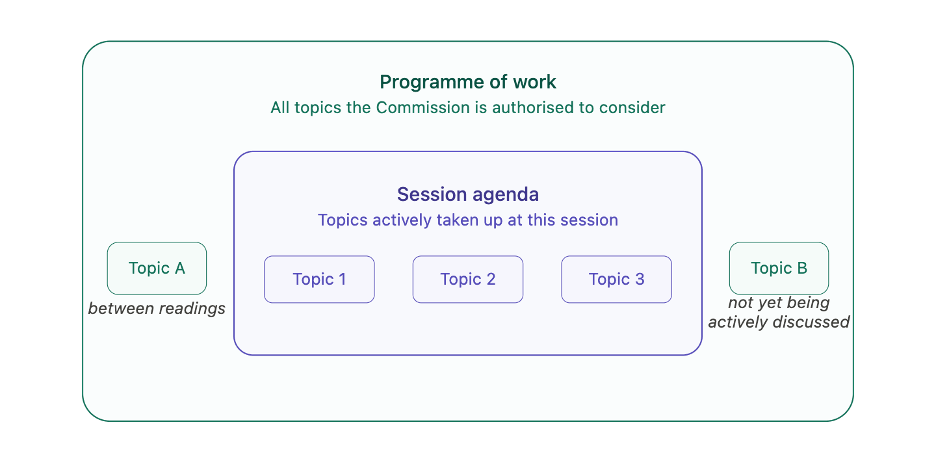
Importantly, the agenda does not reflect the order in which the topics listed will be discussed. The agenda is also distinct from the Commission’s broader programme of work. Think of it as a set of nested circles: all topics available for consideration by the Commission must be on its programme of work; however, only a subset of those topics will be included on the specific session’s agenda. For example, a topic may remain on the programme of work but drop off the agenda during the period between the conclusion of a first reading and the commencement of a second reading.
Working Languages
The Commission’s six official languages are those of the United Nations: Arabic, Chinese, English, French, Russian, and Spanish. All official meetings and documents are translated into each of these languages by the UN Secretariat, and members may deliver their speeches in whichever language they prefer, with real-time translation provided in the room. In practice, however, the working languages tend to narrow to English, French, and Spanish—with English and French carrying particular weight as the traditional languages of international law.
Conclusion—And Why This All Matters
It might be tempting to treat questions of procedure, location, and session length as purely administrative matters—the bureaucratic scaffolding behind the Commission’s more intellectually weighty work. But these structural features carry real consequences for what the Commission can accomplish and how its work is perceived.
The five-week session in 2025 was not simply a scheduling adjustment. It was a compression of the time available for deliberation, drafting, translation, and commentary—all of the careful work that makes the Commission’s outputs authoritative rather than merely persuasive. The return to an eleven-week schedule in 2026 is welcome, but it should not obscure the fact that the underlying financial pressures on the UN remain unresolved. The 2025 session may prove to be an anomaly—or it may prove to be a preview.
The question of session length bears on the authority of the Commission’s final product. The Commission’s authority rests not simply on the technical quality of its drafts, but on the perceived legitimacy of the process that produces them. States, courts, and scholars give weight to the Commission’s outputs because they trust that those outputs reflect careful, independent, and representative deliberation. A body perceived as rushed, under-resourced, or constrained by forces outside its control is harder to hold out as a genuinely authoritative voice in the development of international law. Thus, the mechanics of meetings—in short—are not separate from the Commission’s mission; they are a fundamental part of how that mission succeeds or fails.
[1] See Charles Jalloh, “The International Law Commission’s Seventy-Sixth (2025) Session: The Negative Impact of the United Nations’ Fiscal Crisis on The Codification and Progressive Development of International Law” 120 American Journal of International Law 218 (2026), doi:10.1017/ajil.2025.10137.
[2] See Yearbook … 1955, vol. II, document A/2934, p. 41 para. 26.
[3] As this series has addressed earlier, members do not receive salaries, but the UN does provide them with airfare to and from the sessions and per diems that cover hotels and food. As anyone who has travelled to New York can tell you, hotels alone are upwards of USD$300/night (often more during peak summer season, when the Commission meets), while hotels in Geneva may be only USD$200/night and often provide discounts for long-term stays. Since members often meet for 10+ weeks, Geneva is ultimately less expensive than New York.
[4] See Yearbook … 2000, vol. II (Part Two), p. 132 para. 734; and Yearbook … 2011, vol. II (Part Two), p. 177 para. 388.
[5] See Rules of Procedure of the General Assembly, Rule 161 (Establishment and rules of procedure); Yearbook … 1949, Report of the General Assembly, p. 278 para. 5.
[6] See Rules of Procedure of the General Assembly, Rule 108 (Quorum).
[7] See Rules of Procedure of the General Assembly, Rules 125 (Majority required), 126 (meaning of the phrase “members present and voting”).
[8] See Rules of Procedure of the General Assembly, Rules 124 to 133.
Course Materials
References
International Law Commission: https://legal.un.org/ilc/ilcsessions.shtml, https://legal.un.org/ilc/meetings.shtml
Additional Reading
- Charles Jalloh, “The International Law Commission’s Seventy-Sixth (2025) Session: The Negative Impact of the United Nations’ Fiscal Crisis on The Codification and Progressive Development of International Law” 120 American Journal of International Law 218 (2026), doi:10.1017/ajil.2025.10137.
 Ginger Without Borders
Leave a comment