
In an era marked by geopolitical fragmentation and open challenges to international norms, the relevance of international law is often questioned. Yet it is precisely under such conditions that international law is most significant. To that end, understanding the institutions that interpret and articulate international law—particularly in moments of strain—is essential. One such institution is the United Nations International Law Commission (ILC), which occupies a unique position in the international legal order.
This post is the eleventh in a multi-part series connected to my work as an adjunct professor at American University, Washington College of Law, where I am teaching an upper-level practicum on the ILC. The aim of this series is to make the institutional role, working methods, and legal significance of the ILC more accessible to readers beyond the classroom.
As always, if there’s something you’d like to see added, clarified, or explored further, I’m happy to hear from you!
Introduction
Building upon the discussion of the Commission’s topic choice, past topics, and active program of work, the natural next question is: how do outsiders actually access the Commission’s work?
The best answer is the Commission’s website—though, as I warn my students, it is a 1990s nightmare. Do not be discouraged if you cannot find what you are looking for right away; it is there somewhere, just buried behind a few too many tabs. Beyond the website, there are also three key written resources: the Annual Report, the Summary Records, and the Yearbook of the Commission.
Why Documentation Matters
Before diving into what the Commission’s documentation actually looks like, it is worth pausing on a more basic question: why does it exist, and what is it actually for? Record-keeping might seem like an administrative footnote compared to the procedural and substantive legal questions covered earlier in this series. However, the transparency these practices provide is in fact fundamental to the maintenance of the Commission’s authority.
The Commission considers documentation indispensable to its work for several reasons that operate at different levels. At the most basic level, extensive documentation assists the Commission in fulfilling part of its mandate, including making evidence of customary international law readily available (see Statute of the Commission, Article 24). By publicizing the documents prepared by Special Rapporteurs outlining the State practice concerning a particular topic, and the subsequent documents the Commission receives from States outlining their views on said topic, the Commission provides evidence of the two elements of customary international law: State practice and opinio juris. Moreover, by extensively documenting the Commission’s reasoning for its drafting decisions, the Commission grants States the insight they need to meaningfully engage with works-in-progress. Documentation, in other words, is what makes the consultation process function.
At a slightly broader level, which is equally—if not more—important, documentation helps practitioners understand and interpret the conventions that eventually emerge from the Commission’s work. As discussed earlier in this series, the Commission’s drafting records form part of the respective convention’s travaux préparatoires (drafting record)[1], which is used to interpret the convention (see Vienna Convention on the Law of Treaties, articles 31 and 32). For example, when a government lawyer wants to know what a particular provision of the Vienna Convention on Diplomatic Relations means, the Commission’s records of how that provision was debated and drafted are among the most important places to look. Indeed, the International Court of Justice regularly refers to Commission records in its judgments, and States invoke them in diplomatic correspondence and legal arguments. Accordingly, the Commission’s documentation is not merely an archive; it is an active legal resource.
Most broadly, documentation serves the Commission’s overarching mission: the codification and progressive development of international law, and the dissemination of that law as widely as possible.
Practical Guidance: Finding What You Need
For anyone wanting to engage with the Commission’s documentation directly, the Commission’s website—legal.un.org/ilc—is the starting point. From there, the “Annual Sessions” tab in the site’s sidebar provides access to documents, daily bulletins, and audio recordings organized by session. The “Annual Reports” tab collects the final reports to the General Assembly going back to 1949. The Yearbook is available under a sub-tab to the “Research” tab. And the “Analytical Guide”—a searchable tool organized by topic—provides a comprehensive overview of the documentation available on every subject the Commission has considered, making it possible to trace the full history of a topic from its first consideration to its conclusion.
The Annual Report
At the end of each session, the Commission adopts a report to the General Assembly describing the work of that session. The report is drafted by the session’s Rapporteur, with assistance from the Special Rapporteurs for the topics on that session’s active agenda and the Secretariat, and covers everything of significance that occurred during the session.
The Annual Report serves three core purposes. First, it keeps the General Assembly regularly informed of the Commission’s progress across its active topics. Second, it transmits draft provisions or reports with the Commission’s associated recommendations for the General Assembly’s consideration. Third, in accordance with Articles 16 and 21 of the Commission’s Statute, it publicizes the Commission’s drafts—making them available not only to States but to courts, scholars, and the broader legal community.
In terms of content, the Report is comprehensive. It covers the organization of the session, the progress of work on each active topic, the Commission’s plans for future work on the topics that were substantively considered during the session, the full texts of any draft provisions and commentaries adopted during the session, any procedural recommendations directed at the General Assembly, and any other decisions or conclusions the Commission has reached. All of the Commission’s Annual Reports, going back to its first session in 1949, are available on the Commission’s website.
Summary Records
Alongside the Annual Report, the Commission produces Summary Records of every meeting it holds. These are not verbatim transcripts, but they are detailed enough to capture the substance of each member’s contribution to the debate: what positions were taken, what arguments were made, what alternatives were considered, and why they were rejected.
The Commission began producing Summary Records in 1980, after it concluded that their production constituted a necessary requirement not only for the Commission’s own procedures but also for the broader process of codification of international law.
The Summary Records serve a vital purpose: because the Commission’s drafts are intended to serve as the basis for binding legal instruments, the debates surrounding those drafts are of paramount importance for understanding what the provisions mean. Indeed, on several occasions, the General Assembly and the Commission have described Summary Records as the functional equivalent of travaux préparatoires because they reflect the legislative history of the Commission’s documents.
Summary Records are also a vehicle for transparency and accessibility. By making the Commission’s internal deliberations available to international institutions, practitioners, academics, students, and the general public, they allow the Commission’s work to be scrutinized, debated, and built upon—not just by the States that will ultimately decide whether to adopt a convention, but by anyone with an interest in the development of international law.
Finalized Summary Records are published in Volume I of the Yearbook of the International Law Commission (which is available on the Commission’s website). Provisional versions—prepared before the final editing process—are also available on the Commission’s website under the “Documentation” tab for each annual session, and can often be accessed within weeks of a meeting taking place.
The Yearbook of the International Law Commission
The Yearbook is the Commission’s principal archival publication and one of the most significant reference works in international law. Published by the Secretariat, the Yearbook is an official annual publication containing the summary records of the Commission’s meetings and its principal documents relating to that year’s session. It came into existence in 1955, when the Commission requested—and the General Assembly agreed—that the Secretary-General arrange for the printing of the principal documents (e.g., reports, studies, principal draft resolutions, and amendments presented to the Commission) and Summary Records from the Commission’s first seven sessions, and for the continuation of that practice going forward.
The Yearbook is published in two volumes. Volume I contains the Summary Records of the Commission’s meetings for that year. Volume II reproduces the principal documents, including the Commission’s Annual Report to the General Assembly. Together, the two volumes provide a complete record of everything the Commission considered and produced during a given session.
The Yearbook is published in all six official UN languages: Arabic, Chinese, English, French, Russian, and Spanish. It is treated as an authoritative legal publication—cited in proceedings before international courts and tribunals, referenced by governments in their official communications, and occasionally invoked as evidence of customary international law. All volumes of the Yearbook are available on the Commission’s website, making the full record of the Commission’s work since 1949 freely accessible to anyone with an internet connection.
Audio and Video Recordings
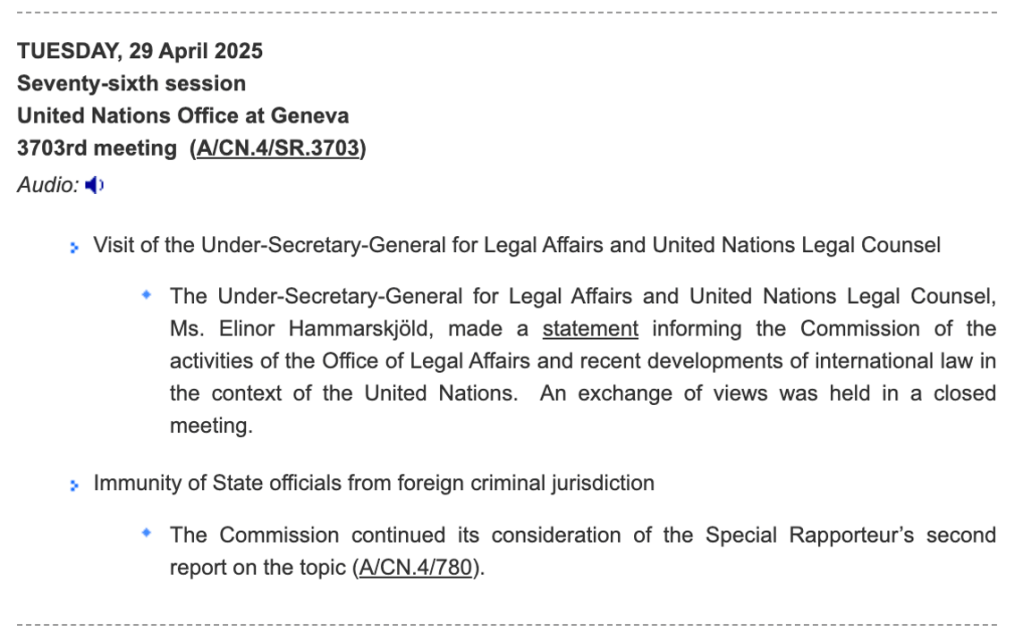
In addition to the Commission’s written documentation and its website, the Commission releases audio recordings of its public sessions. The recordings are available in all six official UN languages—allowing listeners to follow the proceedings in whichever language they prefer. A single plenary meeting of the Commission often runs over two hours, and the availability of recordings means that the Commission’s oral deliberations are as accessible as its written output. These recordings may be accessed through the UN’s digital recordings service, or by going to a particular annual session’s webpage under the “Annual Sessions” tab, then clicking on the sub-tab “Daily Bulletin” (located on the right side of the webpage), and again clicking on an associated “Audio” link for each day’s session:
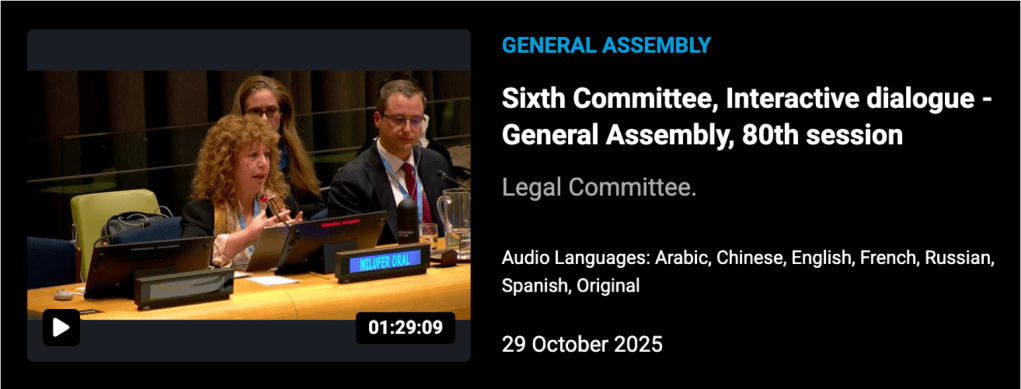
Additionally, although the Commission does not provide video recordings of its sessions, the General Assembly Sixth (Legal) Committee does. Accordingly, the public may watch any reports provided by Commission members to the General Assembly through the UN Web TV service. For example, UN Web TV includes video of the Commission members’ presentation of the Report of the International Law Commission on the work of its seventy-sixth session (U.N. Doc. A/80/10) to the General Assembly Sixth Committee on 29 October 2025:
These technical advances are relatively recent developments in terms of ease of access (for example, audio recordings of the Commission’s sessions are available online starting in 2015), but they reflect the same underlying commitment to transparency and public engagement that has characterized the Commission’s documentation practices from the start. The audio recordings are particularly useful for researchers and practitioners who want to understand not just what the Commission decided, but how the debate unfolded in real time.
Conclusion
The Commission’s documentation system is, at its core, an act of institutional transparency. In a legal order where there is no world legislature and no single authoritative lawmaker, the next best thing is a meticulous record of how legal norms were debated, drafted, and justified by a body of recognized experts. The Annual Reports, Summary Records, Yearbook, and audio and video recordings collectively serve that function: they are what allow the Commission’s work to be understood, challenged, and applied by States, courts, and scholars long after the session that produced the work has ended. In that sense, the documentation is not merely a byproduct of the Commission’s work. It is part of what gives that work its authority.
[1] Travaux préparatoires is a French term meaning “preparatory works.” In treaty interpretation, it refers to the negotiating history of a treaty: the drafts, debates, and records that preceded the final text.
Course Materials
References
International Law Commission:
- Annual Reports: https://legal.un.org/ilc/reports/
- Summary Records: https://legal.un.org/ilc/meetings.shtml#a24
- Yearbook: https://legal.un.org/ilc/meetings.shtml
- Audio recordings: https://conf.unog.ch/digitalrecordings/en/clients/12.0110
- General Assembly Sixth (Legal) Committee recordings: https://webtv.un.org/en/search/categories/meetings-events/general-assembly/80th-session/sixth-committee
 Ginger Without Borders
Leave a comment