
Kingston recognized we needed “some” rest from the long air journey, so he gave us the morning to eat a leisurely Western breakfast. Our hotel is a Western chain, but their buffet offered Asian and Indian sections in addition to the English breakfast section (the bacon was thick and tasty). Kingston’s brother was again our driver after he finished his work call around 12:30pm.

It took about 45 minutes to navigate the maze of Mumbai streets from Kingston’s family apartment near the airport in Northern Mumbai (Santa Cruz neighborhood) downtown to the old city of Mumbai. There is road construction everywhere in Mumbai (including a massive bridge through downtown), so the “temporary” road diversions create bottlenecks. India drives on the left, like British Isles, Australia, and New Zealand. They add the game of chicken with opposing traffic, but Brother said there are few accidents. And there is the constant blare of horns as vehicles jockey for position on the street.

Our first stop was the Gateway to India memorial arch. It has become a symbol of modern Mumbai through its complicated history. The first British monarch to visit India was Queen Victoria’s son, George V. He landed at this spot in 1911. To commemorate the event, British Bombay officials commissioned the design of a triumphant memorial arch made of local basalt. Although the architect was British, his design was based on classic Indo-Islamic architecture from neighboring Gujarat state. Begun in 1911, construction was not completed until 1924 due to WWI interruptions in funding. The British used the Gate to parade newly arrived troops into India as Bombay was Britain’s main port of entry. The last British troops left India in 1948 after Indian Independence was declared in 1947, and they marched through the Gate. With that event, the Gate gained a new meaning for Mumbai residents. It is now the most visited domestic and foreign tourist site in Mumbai. But it is being threatened by rising sea levels where high tides inundate the surrounding jetties.
On the present day site is another memorial, an equestrian statue of Shivaji, the founder of the Maratha Empire of the late 17th century. At its height, Maratha controlled most of central India. The Marathi language is still the principal language of 42% of the people who live in Maharashtra, the state where Mumbai is located. In India, there are 22 languages that various States recognize as official within their borders. Their 2001 Census recorded 30 languages which were spoken by more than a million native speakers and 122 which were spoken by more than 10,000 native speakers. The constitution of India permits the use of Hindi and English in government documents. I always assumed Hindi was a common language throughout India, but it is the principal language of only northern India (essentially the area north of Mumbai). Hindi is not even taught in the schools of the 4 principal southern states. And English is used in street signs and advertising and in the streets, if only for certain phrases (Hinglish). But I digress from Shivaji’s story.
Shivaji ruled from 1674 to 1680. He built a strong navy which maintained supremacy over coast of Maharashtra, and kept the Portuguese and British navies in check. He created and expanded his empire by defeating several powerful Muslim Mogul princes. He became a hero for the Indian Independence Movement of the early 1900s. A social reformer, he revived Hindu political and court traditions in the former Mogul territories, championed the chivalrous treatment of women, and employed all Hindu castes in his military and government offices. As is so often the case, his legacy is not universally praised in all parts of India. The Brahmin (highest Hindu caste) historians were hostile to his employment of lower castes in positions they dominated under British rule. Muslim historians are largely negative because he was so pro-Hindu. And the British don’t care for anyone who challenges their rule (says the American). Particularly in Mumbai (a part of the Maratha Empire), there are numerous statues to his memory, and the city’s history museum has numerous exhibits detailing his life.
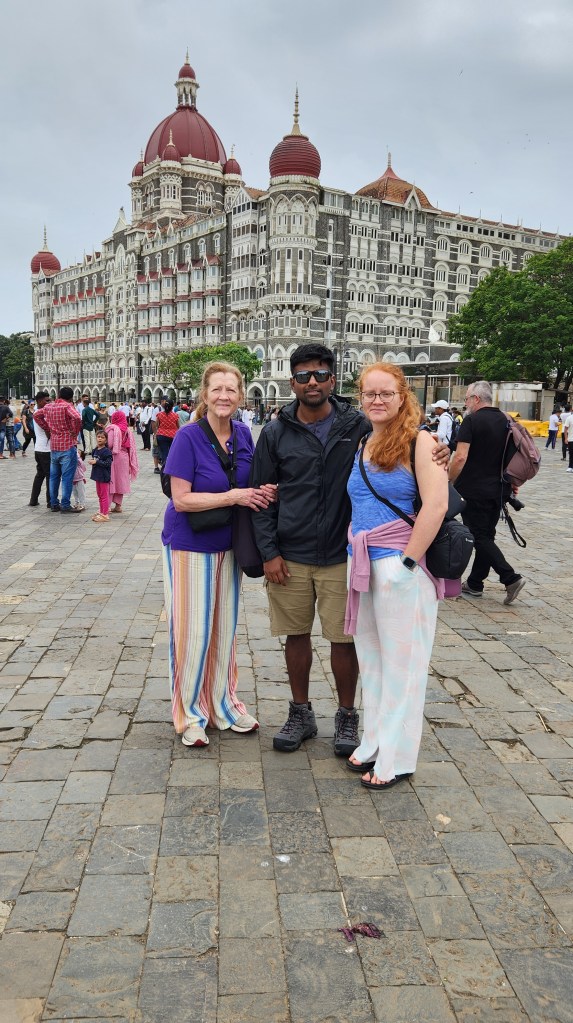
The compound containing the Gate and Shivaji’s statue is always crowded (but I only noticed two other European couples in the throng of tourists). From the compound (literally we just turned around from facing the Gate in the picture above), you can see and photograph the Taj Mahal Hotel with its stunning architecture. Opened in 1903, it has continually been recognized by travel experts as one of the best hotels in Asia. It was commissioned not by the British, but by Jamseti Tata, an industrialist who immigrated to India from Iran due to religious persecution. He also founded the Tata Group, now India’s largest conglomerate. Due to his donations to various health and education causes (over $102 billion in today’s dollars), he was named in some polls as the greatest philanthropist of the 1900s. When Pakistani terrorists were chosing targets for their surprise attack on Mumbai in 2008, they chose the Taj because of its tourist symbolism and its proximity to the Gate. Their 3 day seige destroyed the Taj’s roof and killed over 31 (mostly foreign) guests of the hotel. Combined with other Mumbai targets, the terrorists killed over 160 people. The Taj reopened in 2010 with President Obama as the first foreign dignitary to visit the hotel.
Our day continued with a tour of the Hanging Gardens (a tranquil large garden in the center of Mumbai and home to bats and kites overlooking the beach) at the top of Malabar Hill on the south end of Mumbai. It was designed and built in 1881.
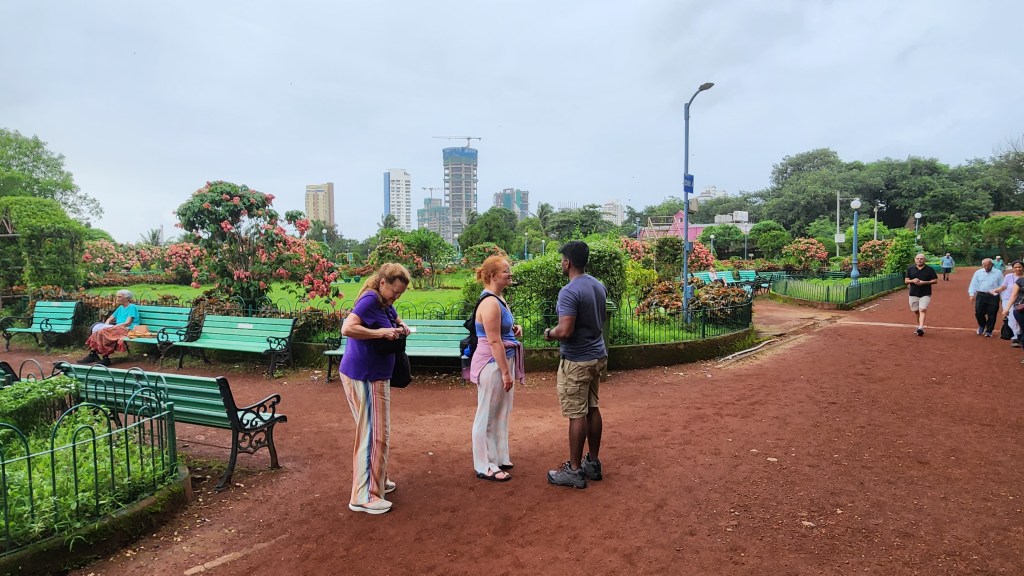
While driving through the neighborhood towers of Malabar Hill (one of richest in Mumbai), Kingston pointed out a tower that is a single family home named the Antilia. It is valued at $1 billion by Forbes. It’s considered one of the most expensive residences in the entire world and was built by one of India’s richest men. The Antilia is equipped with 27 floors and 9 high-speed elevators. The present day chair of the Tata Group was quoted in writing “It makes you wonder why someone would do that. That’s what revolutions are made of.”
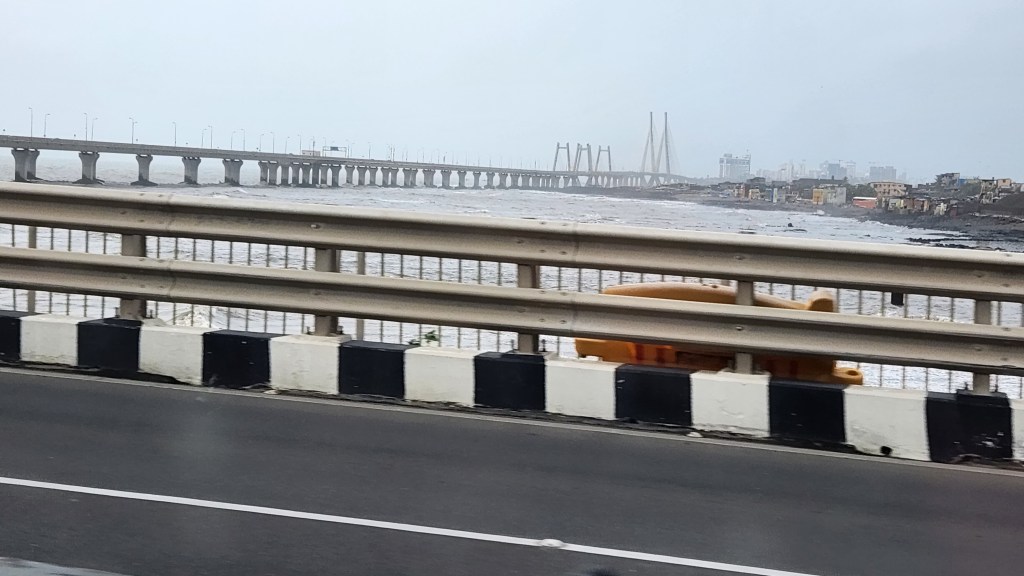
During our tour of Mumbai, there were noticeable changes in traffic as we progressed through Mumbai. Kingston explained that rickshaws were banned from the oldtown business district (which lowered but did not silence the sound of horns). We headed back north for dinner at Kingston’s as the day was darkening around 7pm. Rather than negotiating the town streets, Brother took the Worli Sea Link bridge (a 5.6 km long, 8-lane wide cable-stayed bridge). No cabs or rickshaws are permitted.
After another special meal with Kingston’s family, we were delivered to our hotel about 11:30pm. Kingston keeps our day full.


Leave a Reply