
In an era marked by geopolitical fragmentation and open challenges to international norms, the relevance of international law is often questioned. Yet it is precisely under such conditions that international law is most significant. To that end, understanding the institutions that interpret and articulate international law—particularly in moments of strain—is essential. One such institution is the United Nations International Law Commission (ILC), which occupies a unique position in the international legal order.
This is the thirtieth, and final, post in a multi-part series connected to my work as an adjunct professor at American University, Washington College of Law, where I am teaching an upper-level practicum on the ILC. The aim of this series is to make the institutional role, working methods, and legal significance of the ILC more accessible to readers beyond the classroom.
Although this is intended to be the final post, if there’s something you’d like to see added, clarified, or explored further, I am always happy to hear from you!
Introduction
On the eve of the 77th session of the Commission (which begins tomorrow, 27 April 2026), the final post of this blog series addresses the last, and arguably most important, question: what is the International Law Commission’s role in the ever-changing world of international law?
Over the past several weeks, we have examined the Commission’s historical context, mandate, structure, process of consideration, product forms, and membership. We have also considered the Commission’s roster of topics for consideration, prior topics, and current topics; its methods of documentation; and, most recently, its external relationships. Taken together, these posts have traced the contours of a body whose members serve in their personal capacity, whose outputs require external State approval to become binding, and whose influence nevertheless pervades international litigation, treaty-making, and diplomatic practice—raising a persistent question about the nature of that influence and where it comes from. This final post brings those threads together and asks what they collectively reveal about the Commission’s place in international law: not just as it has operated historically, but as it must operate now, in a moment of mounting skepticism toward multilateral institutions.
More Than the Sum of Its Parts
During our final class, I asked my students a handful of questions. One of those questions was: considering the Commission’s composition and history, should the Commission be understood primarily as a law-making body, a scholarly body, an extension of States, or something else entirely?
Immediately, one student answered “definitely not a law-making body.” Another added, “the first thing I thought of was a brainstorming body.” A third offered, “it is a body at the intersection of State practice and legal development.” A fourth concluded, “it cannot be considered only a law-making body because it does so much more.”
There is no single, correct answer to this question. Its purpose is to prompt serious consideration of what a body under any of these categories would look like—and how the Commission resembles or diverges from each. But, in thinking through your own answer, the distinction between the Commission and private scholarly bodies is particularly instructive. Consider the difference: what form of law would the work of a private association—such as the International Law Association or the Institut de Droit International—qualify as under Article 38 of the International Court of Justice (ICJ) Statute? And what form would the work of the Commission qualify as?
Unlike private associations, the Commission operates within the UN system, reports to States, and is embedded in a formal feedback loop with governments. That institutional embeddedness gives its work a distinctive authority even in the absence of binding force—an authority that no private association can replicate.
For example, Commission outputs that are never transformed into binding treaties can nevertheless become central reference points in international litigation and diplomacy. The Articles on Responsibility of States for Internationally Wrongful Acts (“ARSIWA”) are perhaps the clearest example: never adopted as a binding treaty, yet routinely cited before the world’s highest courts as evidence of customary international law. This is because the Commission’s draft provisions either codified previously existing rules of custom, or—when they reflected progressive development—the debate surrounding them generated sufficient evidence to crystallize emerging norms into binding custom. The International Court of Justice has relied on these drafts accordingly; in Gabčíkovo-Nagymaros Project (Hungary/Slovakia), for instance, the Court treated ARSIWA draft Article 33 on the state of necessity as reflecting custom.[1]
Notably, this dynamic is not unique to the Commission. At the 1930 Codification Conference—a direct precursor to the Commission’s establishment—delegates were unable to adopt a convention on territorial waters, yet the provisionally adopted draft articles on that topic were nonetheless treated by States as a statement of existing international law.
Not All Commission Documents Are Created Equal
One of the most important—and frequently misunderstood—features of the Commission’s work is that not all ILC-related documents carry the same institutional weight. Different materials reflect different institutional voices, and understanding those distinctions matters enormously for anyone seeking to rely on Commission outputs in legal arguments.
At the apex sits outputs of the Commission as a whole: draft articles, conclusions, and commentaries adopted collectively, as well as portions of the Annual Report adopted in plenary. These are the materials that most directly represent the Commission’s authoritative position.
Below that level, individual members—most prominently Special Rapporteurs—produce reports and make statements during plenary debates that carry persuasive weight, but are not attributable to the Commission itself.
Similarly, outputs of subsidiary bodies—such as drafting committees, study groups, and working groups—remain a reflection of the views of a group within the Commission until formally adopted by the plenary, at which time they become the position of the Commission as a whole.
Rounding out the picture, States submit written comments and observations in response to Commission’s drafts, while the Secretariat produces memoranda and studies through the Codification Division—both of which shape the informational landscape without themselves representing Commission views.
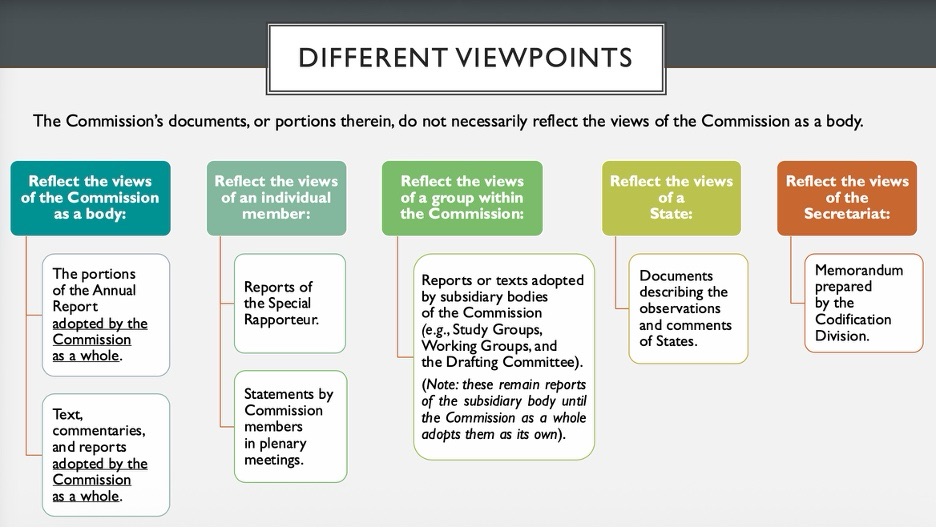
This differentiation matters doctrinally. International courts and tribunals frequently rely on Commission materials, but they do so with careful attention to who authored the text and whether it reflects the Commission’s collective view. Collectively adopted texts are treated differently from Special Rapporteur reports, which carry persuasive but not authoritative weight—a distinction that practitioners and scholars ignore at their peril.[2]
Commission Products as a Source of Law
This brings us to a question that cuts to the heart of the Commission’s significance: under Article 38 of the ICJ Statute, which enumerates the sources of international law, where does the Commission’s work fit?
If you ask an international lawyer this question, you will likely receive numerous different answers. Many would classify the work of the Commission as a body of “highly qualified publicists”—i.e., a subsidiary source of law under Article 38(1)(d). However, as this series has explained, the work of the Commission cannot summarily be classified as such given its role in drafting treaties and identifying customary international law and general principles of law. Instead, the most likely ‘correct’ answer is also the lawyer’s favorite answer: it depends. The Commission’s outputs, as a whole, interact with all four sources of law in ways that resist simple classification.
When the Commission’s final product is transformed into a treaty within the meaning of Article 38(1)(a), the work leading up to it—e.g., draft articles, commentaries, Special Rapporteur reports, and Commission debates—constitutes part of the treaty’s travaux préparatoires, and may therefore be used as an interpretive tool pursuant to the Vienna Convention on the Law of Treaties.
The Commission’s work may also codify or crystallize customary international law norms within the meaning of Article 38(1)(b).[3] The most significant issue with customary international law is that it is not written down, and therefore needs to be proven. But how do you prove it? As Professor Claudio Grossman (the Commission member I assist) says, “it is easier to collect words than stones”. To prove custom, you need two elements: State practice and opinio juris.[4] For the former, such evidence may be found in the sections of Special Rapporteur’s reports that outline State practice. For the latter, States’ comments on the Commissions’ work, either commending or refuting a particular draft provision, may serve as evidence of whether the State views the outlined obligation as mandatory / legally binding. Accordingly, the Commission plays a vital role in establishing the elements necessary to identify a norm of customary international law.
The Commission’s work may also articulate general principles of law within the meaning of Article 38(1)(c). First and foremost, like with customary international law, the Special Rapporteur’s reports may include a comparative analysis of legal norms, which may serve as evidence for the existence of a general principle of law.[5] Secondarily, in articulating the Commission’s draft provisions for each project, the Special Rapporteur and the Chair of the Drafting Committees will explain the Commission’s justifications for its drafting choices, which may include a statement that the Commission believes the provision reflects a general principle of law. In such a case, the provision itself (though not the statements of the Commission) would be properly considered as reflecting a general principle of law.
Lastly, when a Commission product reflects the views of Commission members (e.g., Special Rapporteur reports, Annual Reports, and transcripts of the Commission’s deliberations), the work qualifies as the output of highly qualified publicists under Article 38(1)(d). Importantly, one of the key distinguishing features between primary sources (treaties, custom, and general principles) and subsidiary means is who is describing the norm. Subsidiary means are, in theory, what people (highly qualified publicists through academic publications and judges through judicial decisions) say, not what the States themselves say. However, in practical reality, because custom and general principles are not written down, the international community needs these statements by people to identify what the State obligations are for these unwritten norms. In this, the Commission plays a vital role.
A Note on the United States’ Purported ‘Withdrawal’
On 7 January 2026, Donald Trump signed an executive order withdrawing the United States from 66 international organizations and UN-affiliated entities, claiming these organizations were “contrary to the interests of the United States.”[6] The Commission was among the bodies listed.
As a threshold matter, this purported withdrawal is logically incoherent. The Commission does not involve ‘State participation’ in the sense that a State sends a representative to act on its behalf. Commission members serve in their personal capacity as independent legal experts, not as State delegates. Moreover, the Commission does not currently include a member with United States nationality—meaning there is not even a question of whether a sitting U.S. member would be directed to resign from the Commission. In practical terms, the only form of “withdrawal” available to the United States is a refusal to submit comments on Commission products.
Indeed, that is precisely the problem with Trump’s approach. By withdrawing, the United States is not neutralizing the Commission’s work—it is forfeiting its ability to shape it. International law will not cease to exist because the United States refuses to recognize it, nor will it stop evolving because the United States declines to engage in the processes designed to codify and progressively develop it. The Commission will continue to produce its work, regardless of whether the United States—or any other State—refuses to participate in the process. The only practical consequence of this withdrawal is the development of legal norms in the absence of U.S. input. Norms will continue to develop and be codified, some of which may cut against U.S. interests; however, by giving up its seat at the table, the United States has forfeited its only form of recourse. The irony is difficult to miss: the executive order characterizes the Commission as “contrary to the interests of the United States”, when it is the withdrawal itself that most directly threatens them.
A Final Thought
The final question I posed to my students was: what would it look like for the ILC to truly fail, and how would we know if it had?
One student offered a particularly thoughtful response, “I think we would know the Commission has failed when most States, across a series of different agenda items, refuse to engage with it. It would not be sufficient for a single State, or a group of States in regard to a single output, to boycott the Commission’s work. As the number of States that refuse to buy in increases, we’d know it had failed—in effect saying, this is so unimportant we are not even going to bother to protest.” Another added, “it could also be when a particular region boycotts the Commission’s work, the way certain regions have withdrawn from the International Criminal Court.” A third noted, “but at least in that case, there could be time to reverse course and fix the institution.”
That last observation may be the most reassuring of all. As the United States’ purported withdrawal illustrates, a single State’s refusal to engage does not diminish the Commission—it simply removes that State from the conversation. The Commission has weathered periods of geopolitical tension before, and its continued operation does not depend on any one actor’s participation. And if the more dire scenario were ever to materialize—a broad, cross-regional withdrawal of the kind that would signal genuine institutional crisis—it would not arrive without warning. The gradual nature of that erosion is itself an opportunity: time to diagnose what went wrong, to re-engage disillusioned States, and to course-correct before the damage becomes irreversible.
Conclusion
The Commission is not a legislature. It cannot compel compliance, ratify treaties, or bind anyone to anything. Nevertheless, its draft provisions shape litigation before the world’s highest courts, its commentaries appear in diplomatic negotiations, and its outputs are cited as evidence of what international law actually requires. This influence is a product of institutional design. By embedding expert legal work within the UN system—subject to Secretariat support and a sustained feedback loop with governments—the Commission’s outputs carry a weight that purely academic scholarship cannot match. The Commission matters not because of what it can force, but because of what it can articulate. In a period of contested multilateralism and uneven compliance, that role is not peripheral. It is foundational.
[1] Gabčíkovo-Nagymaros Project (Hungary/Slovakia), Judgment, ICJ Reports 1997, p. 7, paras. 47, 50–53.
[2] See Fernando Lusa Bordin, “Reflections of Customary International Law: The Authority of Codification Conventions and ILC Draft Articles in International Law” (2014) 63 International & Comparative Law Quarterly 535; Sotirios-Ioannis Lekkas, “The Uses of the Outputs of the International Law Commission in International Adjudication” (2022) 69 Netherlands International Law Review 327.
[3] Remember: this engagement with Article 38(1)(b) is statutorily required. Under Article 24 of the Commission’s Statute, the Commission must “consider ways and means for making the evidence of customary international law more readily available.”
[4] Opinio juris means the belief that the obligation is already legally binding.
[5] See the criteria for identifying a General Principle of Law, articulated in A/CN.4/L.1018 (the most recently adopted text for the General Principles of Law project). Note that, as of April 2025, this is an ongoing project—meaning the text of the provisions may still change.
[6] “Withdrawing the United States from International Organizations, Conventions, and Treaties that are Contrary to the Interests of the United States”, Presidential Memoranda (7 Jan 2026).
Additional Reading
- Yejoon Rim, The Authority of the Work of the International Law Commission and its Final Form (2025).
- Felix Herbert, The ILC’s Function beyond Codification and Progressive Development: Catalysing Customary International Law Making (2025).
- Luigi Crema, The ILC’s New Way of Codifying International Law, the Motives Behind It, and the Interpretive Approach Best Suited to It (2022).
- Sotrios-Ioannis Lekkas, The Uses of the Outputs of the International Law Commission in International Adjudication: Subsidiary Means or Artefacts of Rules? (2022).


Leave a Reply